
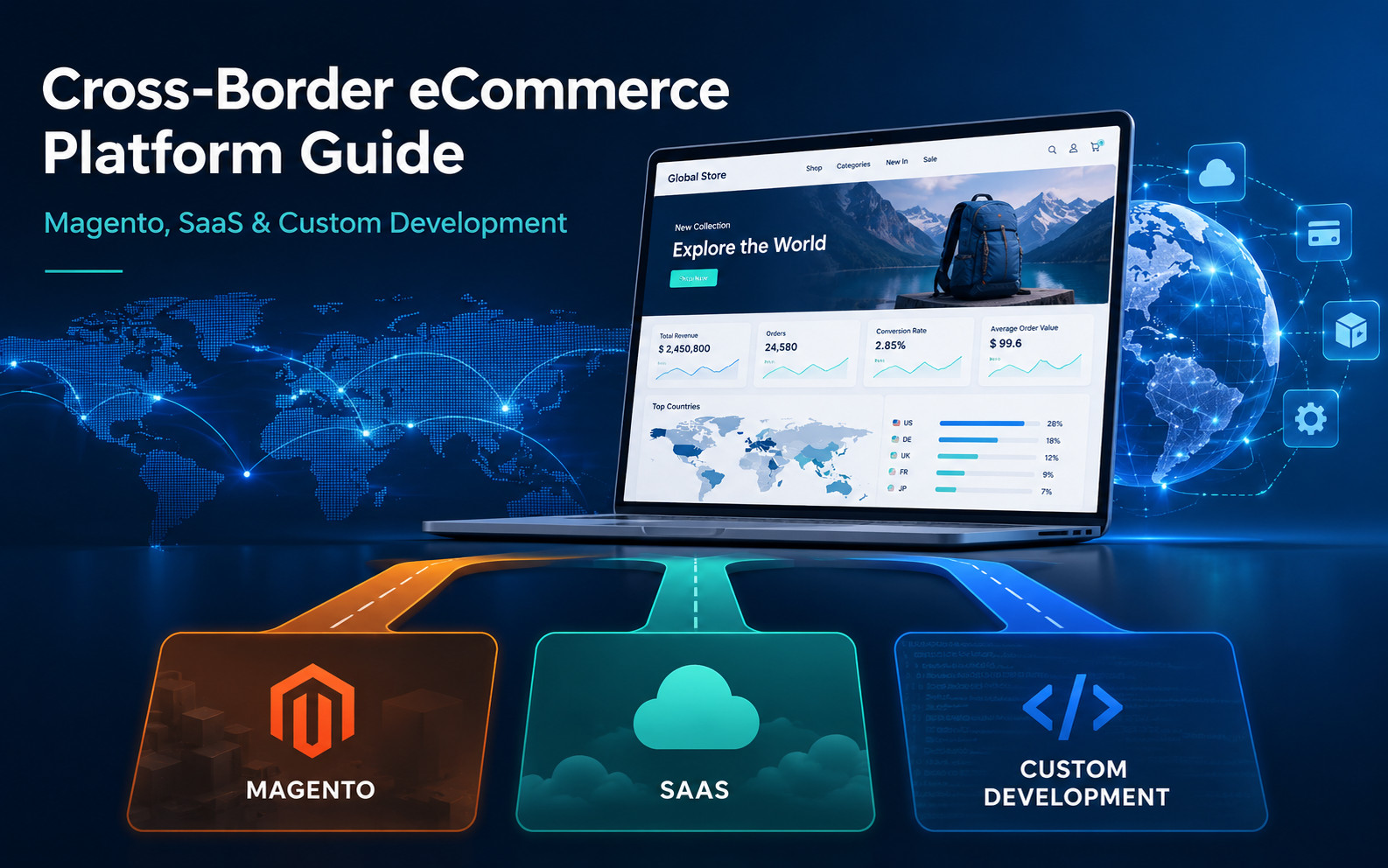
Cross-Border E-Commerce Platform Guide: Magento, SaaS & Custom Development
Adobe Commerce (Magento), e-commerce Platforms
26 June 2026
Summary
When companies evaluate which cross-border ecommerce independent website platform is best, they often compare only price, launch speed, and template design. For enterprise-level global brands, the real question is whether the platform can support multi-market operations, complex product structures, customer data accumulation, and long-term growth. This article compares Magento Open Source, SaaS platforms, and custom development to build a selection framework that better fits enterprise decision-making.
1. Introduction: why independent website selection should not only focus on launch speed

There is no single answer to which cross-border ecommerce independent website platform is best. Lightweight businesses can first evaluate SaaS, companies with complex products and B2B transactions can consider Magento Open Source or Adobe Commerce, and highly specialized workflows may justify custom development. A brand that is just testing overseas markets and a company that already has multi-country sales networks, complex SKUs, distributor systems, and membership operations will need very different platform answers.
Therefore, when choosing an independent website for a global brand, companies should not only look at whether the homepage is attractive, whether the backend is simple, or whether the monthly fee is low. They should judge whether the platform can support future business complexity. Adobe Commerce materials show that it is designed for B2B and B2C companies and supports scalable enterprise ecommerce operations. These capabilities are better suited to brands that need to build long-term ecommerce capabilities, complex transaction processes, and system integrations.
2. Four platform paths: Magento Open Source, Adobe Commerce, SaaS, and custom development
In enterprise scenarios, cross-border independent website platforms generally fall into four paths: open-source systems, enterprise commercial platforms, SaaS solutions, and custom development. They are not simply better or worse than one another; each fits different business stages, transaction complexity, technical team capabilities, budget structures, and long-term TCO.
1. Open-source systems: represented by Magento
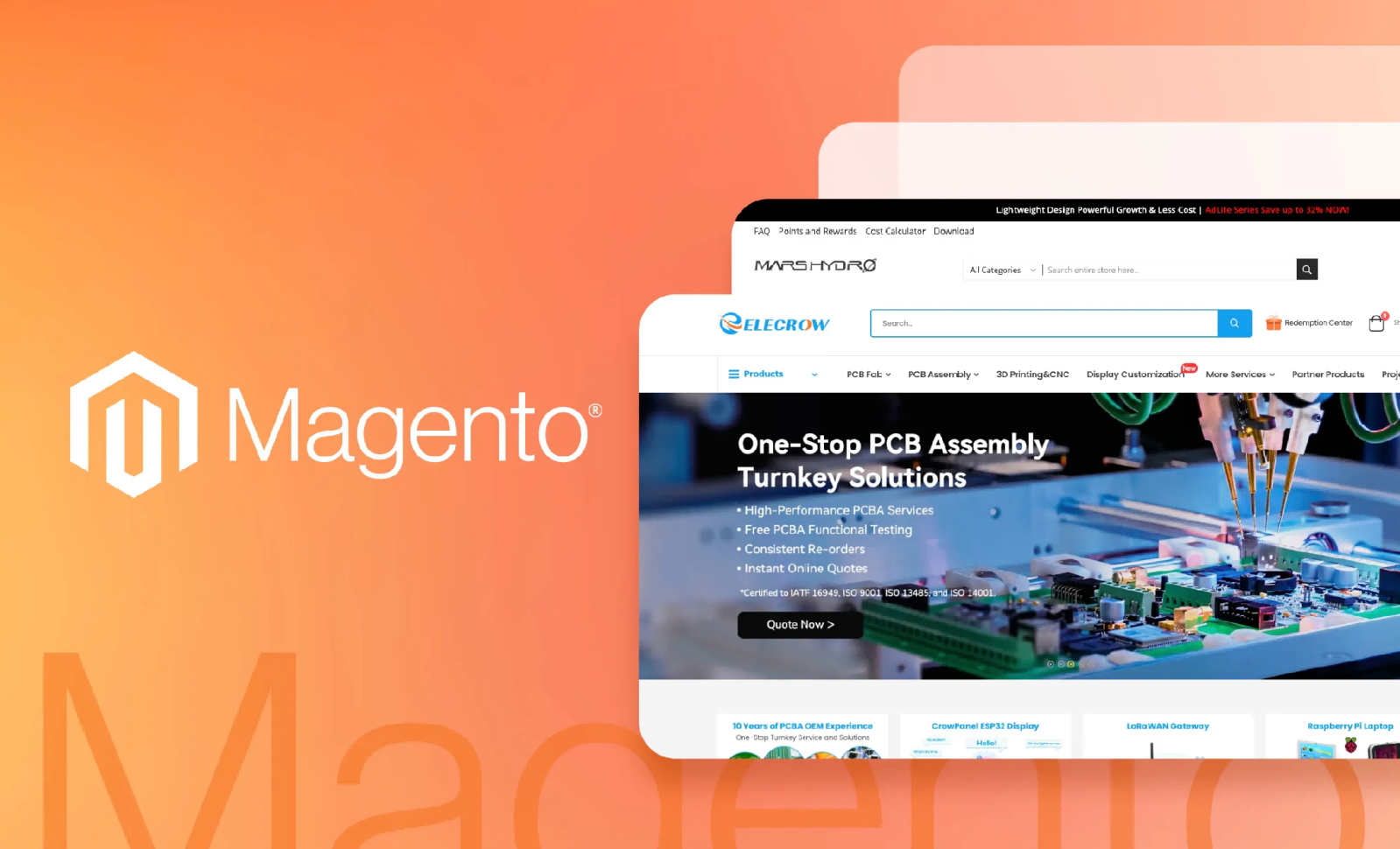
Magento’s strength lies in control and extensibility. Companies can conduct deep development around product structures, pricing systems, membership tiers, B2B quotations, system integrations, and frontend experiences. Adobe Commerce B2B documentation shows that it supports company accounts, shared catalogs, quick order, and negotiable quotes, making it suitable for complex procurement and enterprise customer scenarios.
2. SaaS platforms: represented by Shopify, BigCommerce, and similar solutions
SaaS is more suitable for fast launch and lightweight operations. Shopify B2B documentation shows support for company profiles, customer-specific catalogs, custom pricing, payment terms, and self-service purchasing portals. BigCommerce also provides multi-storefront capabilities, allowing multiple unique storefronts to be managed from one backend.
3. Custom development: fully self-built or highly customized systems
Custom development suits companies with very special business processes, highly personalized frontend experiences, or complex system boundaries, but it requires stronger team capabilities, larger budgets, and long-term maintenance.
If a company is still asking which cross-border ecommerce independent website is best, it should first break the question into five areas: business complexity, SKU and pricing rules, B2B transaction needs, system integration depth, and team and long-term maintenance capabilities.
Magento / Adobe Commerce
- Suitable as an enterprise ecommerce foundation for complex product structures, B2B quotations, system integrations, and long-term control
SaaS platforms
- Suitable for fast launch, lightweight operations, standardized transaction flows, and market validation stages
Custom development
- Suitable for highly specialized business processes, fully personalized frontend experiences, and complex system boundaries
Enterprise decision focus
- Business complexity, SKU and pricing rules, B2B transaction requirements, system integration depth, and team and long-term maintenance capabilities
3. Platform selection matrix: judging by business complexity, TCO, and integration needs
Companies can use a simple matrix when judging which cross-border ecommerce independent website platform is best.
| Decision factor | Magento / Adobe Commerce | SaaS platforms | Custom development |
|---|---|---|---|
| Launch speed | Medium | Fast | Slow |
| Customization capability | Strong | Moderate | Strongest |
| Initial cost | Medium to high | Low to medium | High |
| Long-term control | Strong | Moderate | Strong |
| Complex B2B transactions | Strong | Depends on platform and plan | Customizable |
| System integration | Strong | Depends on APIs and ecosystem | Can be deeply designed |
| Operations and maintenance requirements | Relatively high | Relatively low | Highest |
For brands in the early validation stage, SaaS is usually more practical. For global brands that already have stable overseas orders, need owned data assets, and require complex transaction rules, Magento Open Source or Adobe Commerce is more worth evaluating. If the business process is highly specialized and standard platforms cannot meet the needs, custom development may be considered.
This selection method is more reliable than simply comparing “which platform is better,” because the success of cross-border ecommerce independent websites usually depends on how well the platform matches business complexity.
4. Magento Open Source: for brands that need development control
The core value of Magento Open Source is code control and flexible extensibility. Adobe Commerce builds on this foundation with more complete enterprise capabilities and B2B functions, making it suitable for more complex commerce system development. For companies with complex SKUs, multiple customer types, many pricing rules, and integration needs with ERP, CRM, PIM, DAM, and other systems, Magento is better suited as a long-term ecommerce foundation.
Companies suited to Magento / Adobe Commerce:

Complex product structures with multiple specifications, attributes, and product combinations

B2C, B2B, agent, or distributor businesses operating at the same time

Need for customer-specific pricing, quote negotiation, and bulk ordering

Plans to connect ERP, CRM, warehousing, logistics, and analytics systems

Desire to retain long-term control over customer data and platform extensibility
In Adobe Commerce B2B features, shared catalogs can set different product prices for different companies, and Negotiable Quotes can support price negotiation between company buyers and sellers. These capabilities show why the Magento ecosystem is more suitable for complex transaction scenarios.
However, Magento is not a universal answer. High-quality Magento development requires clear architecture planning, performance optimization, security governance, and long-term maintenance. Without a professional team or service provider, projects can easily face extended development cycles, plugin conflicts, or high maintenance costs later.
Therefore, when a company asks which cross-border ecommerce independent website is best, Magento should be prioritized if the business has already entered a stage of multi-market operations, multiple customer types, and complex transactions.
5. SaaS platforms: for fast validation and lightweight operations
The biggest advantages of SaaS platforms are launch speed, hosted operations, and app ecosystems. They fit standardized transaction processes and lightweight teams. For companies just starting cross-border ecommerce independent websites, SaaS can help complete store launch, payment setup, template building, and basic marketing configuration quickly, making it suitable for market validation, product testing, and early sales process development.
SaaS is more suitable for:
A limited number of SKUs and relatively simple product structures
DTC retail as the main business model
Teams that want to reduce technical maintenance pressure
A stronger focus on fast launch and operational convenience
No major need for custom business processes at the current stage
Shopify B2B can use catalogs to manage the products and prices accessible to B2B customers. Shopify Plus provides more complete B2B catalog assignment capabilities. BigCommerce Multi-Storefront can manage multiple storefronts from one backend for different brands, regions, or customer segments.
But the limitations of SaaS are also clear. When companies need deep checkout customization, complex permissions, special pricing rules, or highly customized system integrations, platform boundaries gradually appear. For mid-sized and large global independent websites, whether SaaS is enough does not depend on whether it can launch in the first year, but whether it can still support the business in the third year when complexity increases.
Therefore, SaaS is not a low-end choice. It is simply more suitable for low-complexity, high-speed cross-border independent website strategies.
6. Custom development: for highly differentiated businesses
Custom development fits scenarios where business logic is highly specialized, standard platforms and plugin ecosystems cannot meet the requirements, and the company has long-term technical budget, product management, and operations capabilities. Examples include complex product configurators, highly customized quotation flows, order journeys involving multiple internal systems, or fully differentiated frontend experiences.
Advantages of custom development
- Can be designed entirely around business processes
- Provides the highest frontend experience flexibility
- Can deeply connect with internal systems
- Can reduce dependence on existing platform feature boundaries
Risks of custom development
- Long development cycle
- High initial investment
- Ongoing maintenance depends on the technical team
- If architecture is poorly designed, expansion costs will continue to rise
Therefore, custom development is not suitable for every cross-border ecommerce independent website project. It is better suited to companies that already know exactly what they need and have long-term technical budgets and management capabilities.
From a decision-making perspective, choosing the best cross-border ecommerce independent website is not a simple three-way choice. Some companies first use SaaS to validate the market and then migrate to Magento Open Source or Adobe Commerce. Others use Adobe Commerce as the transaction core and improve the experience through a headless storefront or custom frontend. The key is that the platform path should serve the business rhythm, rather than being driven by tool trends.
7. Conclusion
When companies evaluate which cross-border ecommerce independent website platform is best, they should not only ask which platform is cheaper or faster to launch. They should ask whether the business will become more complex in the next three years, whether it needs multi-market operations, whether it needs B2B quotations and customer-specific pricing, whether it needs to connect ERP, CRM, and data platforms, and whether it needs to accumulate owned customer assets over the long term.
If a company is in the market validation stage, SaaS is usually more efficient. If the company has entered scaled global expansion, Magento or Adobe Commerce is more suitable as a long-term ecommerce foundation. If the business model is highly specialized, custom development may be worth the investment. For brands that truly value long-term growth, selecting an independent website for global expansion is essentially a combined decision about business model, technical architecture, and operational capability.
If you are evaluating cross-border independent website platforms, Magento development, or enterprise-level cross-border ecommerce website development, you are welcome to learn more about our cross-border ecommerce and Adobe Commerce services. You can also visit Contact Us to discuss your business stage, platform roadmap, and implementation plan with our consulting team.
8. Related Articles
- Cross-Border Ecommerce Platform Recommendation for Global Brands: How Adobe Commerce Supports B2B/B2C Growth
Suitable for further understanding the value of Adobe Commerce in complex products, B2B/B2C integration, and enterprise ecommerce. - Build Your Own Website or Use an Overseas Website Builder? A Full Comparison for Global Expansion
Suitable for comparing self-built websites, platform-based website building, and long-term control. - B2B Ecommerce Website Solution: An Integrated Global Brand Platform Based on Adobe Commerce and AEM
Suitable for understanding how content platforms and ecommerce platforms jointly support global brand expansion.