
CRM Implementation Failures and Consultant Selection Guide
Customer Relationship Management (CRM)
8 June 2026
1. Introduction: Why Many CRM Projects Ultimately Fail
CRM, or Customer Relationship Management, has long become an important foundation for enterprise digital transformation. From sales management and customer service to marketing automation, more and more companies hope to use CRM to build more complete customer data and interaction processes.
However, many CRM implementation projects in the market fail to deliver real value. Some systems are successfully launched, but adoption remains low. Some companies invest heavily, only to see their teams return to Excel or manual workflows. In some cases, CRM projects are even forced to stop during the implementation process.
This article will help companies understand:
- Why CRM projects often fail
- The real role of CRM consultants and service providers
- What key factors to consider when choosing a CRM implementation partner
- How to reduce CRM project risks and improve the success rate
The core of CRM implementation is never just “buying a system.” It is about redesigning the way a company operates and interacts with its customers.
2. Common Reasons CRM Implementations Fail
When evaluating CRM projects, many companies tend to focus on features and pricing. However, the real reasons for failure usually come from processes, organizational structure, and execution.
1. Lack of Clear Implementation Goals
Many companies implement CRM simply because “everyone else is doing it,” without truly defining the problems they want to solve. Some companies want to improve sales performance, but their sales process itself is unclear. Some want to integrate customer data, but lack a data governance strategy. Others expect to improve customer service efficiency, while their processes still rely heavily on manual work. When implementation goals are unclear, CRM can easily become a simple data entry tool instead of a platform that truly improves operational efficiency.
2. Treating CRM as an IT Project
CRM implementation is often led by the IT department, but in reality, CRM involves cross-department processes and operating models. If sales, marketing, and customer service teams do not truly participate in requirement planning, the final system often fails to match real work scenarios. This is also why many companies end up with a situation where “the system has the features, but no one wants to use it.”
3. Processes Are Not Organized First
CRM can amplify good processes, but it can also amplify chaotic ones. Many companies do not clarify the customer journey, sales stages, data definitions, and permission management methods before implementing CRM. As a result, the original messy processes are only digitized after the system goes live, without any real improvement. This is why some companies see more data after implementing CRM, but no improvement in management efficiency.
4. Lack of Internal Champions
Successful CRM projects usually require internal champions. Without management support and cross-department promotion, CRM can easily become “extra work” instead of a tool that improves efficiency. This is especially true in large enterprises. Without executive support, CRM implementation often struggles to truly change existing processes and culture.
3. CRM Implementation Is More Than System Launch
Many companies believe that the completion of a CRM project is marked by a “successful launch,” but what truly matters is whether the system continues to be used by the team afterward.
A successful CRM project usually starts with business requirements and process review, followed by system architecture planning, permission design, and data governance. After system setup is completed, companies still need user training, go-live support, and ongoing optimization to ensure the CRM is continuously adopted by the team.
Without ongoing optimization and training, CRM can quickly lose its value after launch.
Therefore, what companies need is not just a technology vendor, but a consulting team that truly understands processes and operations.
4. Five-Step CRM Implementation Process
A CRM implementation can be divided into five connected steps. Business teams, IT, management, and consultants should participate throughout the process rather than waiting until the system has been built to validate decisions.
- Define business goals and KPIs: Identify the problems CRM should solve, such as improving opportunity conversion, shortening the sales cycle, increasing retention, or standardizing service processes.
- Map customer journeys and business processes: Document the actual flow from lead and opportunity management through closing and after-sales service, then identify duplicate work, information gaps, and unclear ownership.
- Plan data and system integration: Define customer master data, field standards, permissions, data cleansing, and integration requirements for ERP, marketing automation, customer service, or BI systems.
- Design, test, and train users: Configure and develop the prioritized solution, validate workflows through user acceptance testing, and provide role-based training and operating guides.
- Launch, measure, and continuously improve: After go-live, track adoption, data completeness, and KPIs, then collect user feedback and refine processes and functionality.
The process does not end after these five steps. A mature CRM program continues to evolve through data and user feedback as business strategy and customer needs change.
5. The Role of Consultants and Service Providers in CRM Projects
When choosing a CRM service provider, many companies only compare pricing and development capabilities. However, the role of a truly capable CRM consultant goes far beyond “system setup.”
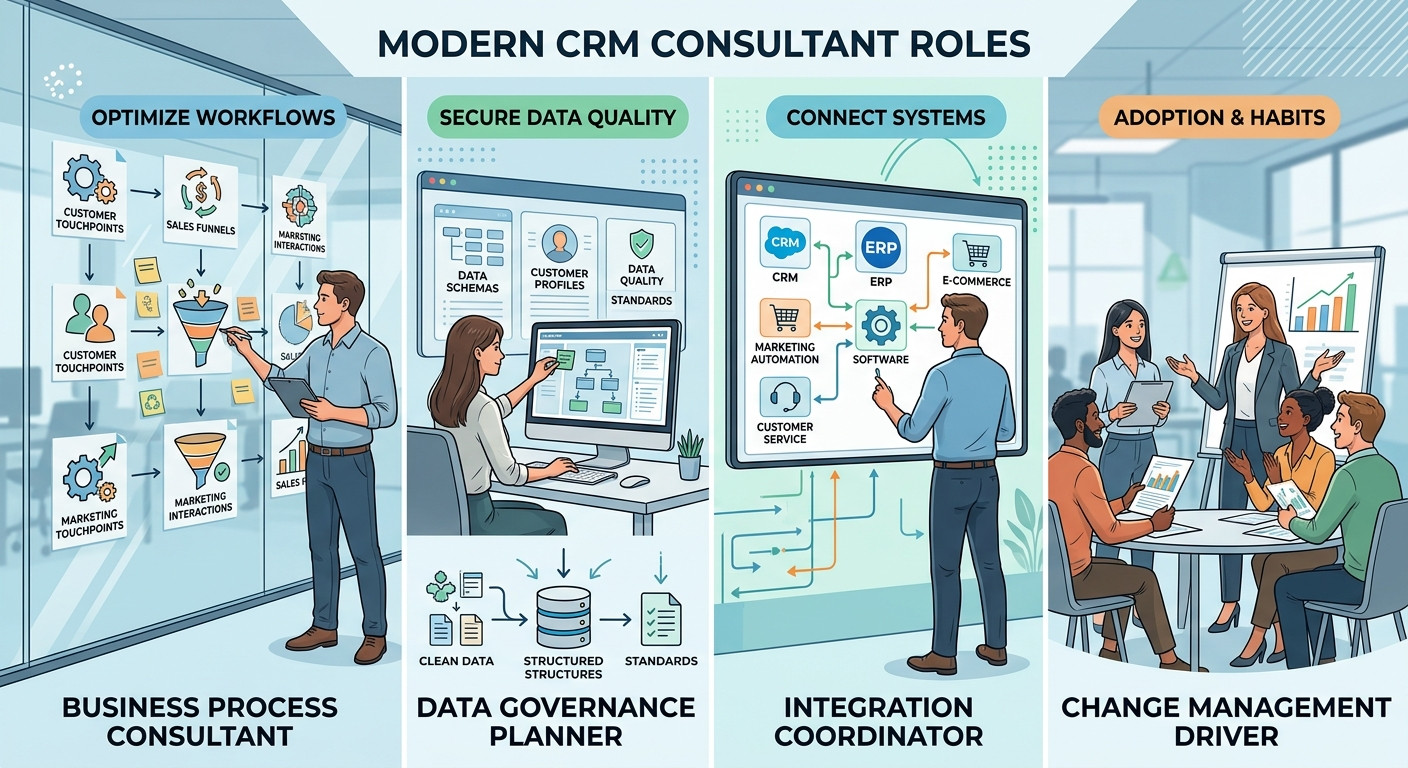
Business Process Consultant
A CRM consultant must first understand the company’s overall operating model, including customer touchpoints, sales processes, marketing activities, and customer service mechanisms. From there, the consultant can identify areas that are suitable for CRM optimization. A mature consultant will not start by recommending features, but by helping the company clarify its processes and goals.
Data Governance Planner
The value of CRM comes from data quality. Therefore, consultants must also help companies establish a complete data governance mechanism, including customer data standards, field definitions, permission management, and data synchronization strategies. Without these standards, CRM can quickly become a database that is difficult to maintain, affecting future analysis and decision-making quality.
Cross-System Integration Coordinator
Modern CRM systems rarely exist independently. They usually need to integrate with ERP, marketing automation platforms, e-commerce systems, customer service platforms, and BI analytics tools. Therefore, in addition to understanding processes, CRM consultants must also have capabilities in overall architecture and cross-system integration.
Change Management Driver
CRM implementation is also a form of organizational change. Consultants need to help companies reduce user resistance, build usage habits, and help teams understand the value of CRM in their daily work.
6. Five Key Factors When Choosing a CRM Service Provider
1. Whether They Understand Your Industry and Processes
CRM requirements vary greatly across industries.
B2B, retail, finance, education, and manufacturing all differ in sales cycles, data requirements, and customer journeys.
Therefore, companies should prioritize CRM consulting teams with relevant industry experience.
2. Whether They Only Talk About Features, Not Processes
If a service provider only emphasizes:
- System features
- Technical specifications
- Development capabilities
but rarely discusses business processes and business goals, this often indicates limited consulting capabilities.
A mature CRM consultant will first understand the company’s processes before discussing system design.
3. Whether They Have Integration Capabilities
Modern CRM rarely exists as a standalone system. Most companies need to integrate CRM with ERP, marketing automation platforms, customer service systems, or BI tools. Therefore, when evaluating service providers, companies should also confirm whether they have API integration, data synchronization, and cloud architecture capabilities, as these capabilities directly affect the future scalability and stability of the CRM.
4. Whether They Value Training and User Adoption
Many CRM projects fail not because the system is poor, but because the team does not use it.
Therefore, companies should observe whether the service provider values:
- User training
- Go-live support
- Adoption strategy
- Continuous optimization mechanisms
5. Whether They Can Provide Long-Term Consulting Capabilities
CRM is not a one-time project.
As a company grows, CRM usually needs to be continuously adjusted and expanded.
Therefore, when choosing a CRM service provider, companies should not only compare price and features. They should pay more attention to consulting capabilities, process understanding, system integration capabilities, and experience in long-term cooperation and continuous optimization.
7. CRM Implementation Challenges for Different Types of Companies
Companies of different sizes and industries face different challenges when implementing CRM.
Small and Medium-Sized Businesses
Common challenges for small and medium-sized businesses include:
- Lack of a dedicated IT team
- Limited budget
- Processes that have not yet been standardized
Therefore, they need a CRM architecture that is fast to implement, easy to use, and capable of generating results quickly.
Large Enterprises
Large enterprises more often face:
- Difficult cross-department coordination
- Data silo issues
- Complex permission management
- Multi-system integration challenges
Therefore, consulting and governance capabilities are often more important than technical capabilities alone.
International Enterprises
Multinational companies usually need to consider:
- Multiple languages
- Multiple brands
- Different market processes
- Regional regulations and data management
The CRM architecture must also have sufficient flexibility and governance capabilities.
8. CRM Implementation: Before-and-After Example
The following representative B2B sales scenario illustrates how operations may change after a CRM implementation. Actual outcomes vary according to business processes, data quality, user adoption, and integration scope.
| Area | Before CRM Implementation | After CRM Implementation |
|---|---|---|
| Lead Management | Lists are spread across spreadsheets, email, and personal contacts, creating duplicate follow-up and missed leads | Leads are centrally managed, classified by source, industry, region, and status, and assigned to clear owners |
| Sales Process | Each salesperson tracks opportunities differently, with no consistent stages or next-step definitions | Standardized stages, tasks, and reminders allow managers to identify progress and bottlenecks |
| Customer Data | Contact details, communication history, and quotations are fragmented and easily lost during handoffs | Accounts, contacts, activities, and documents form a complete record accessible across teams according to permissions |
| Sales Forecasting | Forecasts rely on manual consolidation and subjective reporting, so reports become outdated quickly | Real-time dashboards use opportunity value, stage, and expected close date to improve forecast transparency |
| Team Collaboration | Important information remains in personal email or messaging tools, making alignment across marketing, sales, and service difficult | Teams share customer context and task history and collaborate from the same data |
| Management and Optimization | Lead quality, conversion, sales cycle, and loss reasons are difficult to measure | KPIs and funnel performance are continuously tracked so teams can identify issues and improve processes with data |
These improvements do not happen simply because software has been installed. They result from process standardization, data governance, user training, and continuous optimization.
9. Common Characteristics of Successful CRM Implementation Projects
Successful CRM projects usually share the following characteristics:
- Continuous involvement from senior management
- Clear business goals
- Process review completed at the early stage of the project
- CRM connected to company KPIs
- Complete user training
- Continuous optimization after launch
A successful CRM project is often not the one with the most features, but the one that best fits the company’s processes and culture.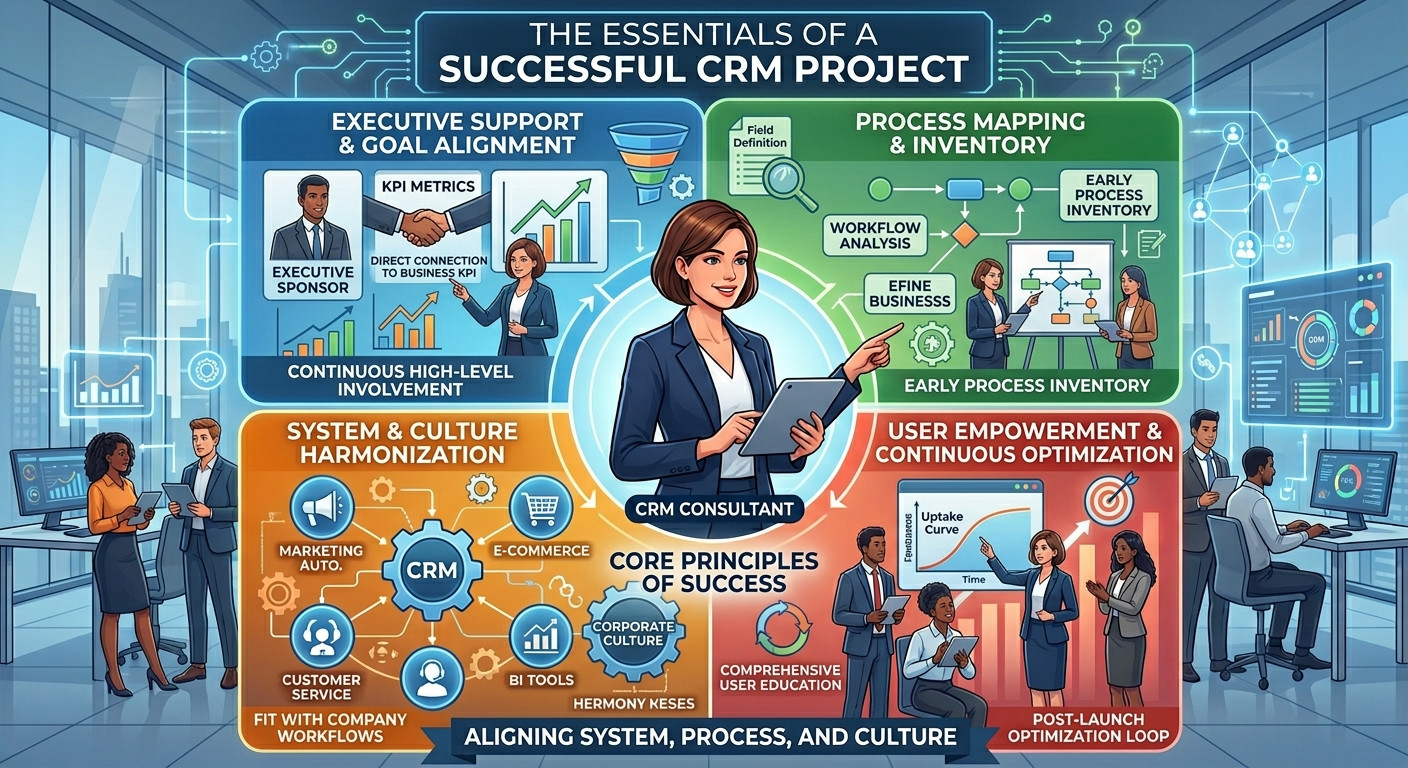
10. The Relationship Between CRM and Enterprise Digital Transformation
CRM is not just a customer management tool. It is also an important foundation for enterprise digital transformation.
Once a company establishes a complete CRM architecture, it can further promote:
- Marketing automation
- Customer journey management
- AI and data analytics
- Personalized experiences
- Omnichannel integration
Therefore, the success or failure of CRM implementation often directly affects the development of a company’s future digital capabilities.
In the era of AI and data-driven business, CRM is no longer just a tool for recording customer data. It is an important platform for companies to understand customers, build relationships, and improve operational efficiency.
11. Conclusion
CRM implementation fails not always because the system is poor, but often because companies underestimate the importance of processes, organization, and consulting capabilities.
A truly successful CRM project requires more than technical setup. It requires a professional consulting team that can help the company reorganize processes, establish data governance, and drive organizational adoption.
Therefore, when choosing a CRM service provider, companies should not only compare price and features. They should place greater emphasis on:
- Consulting capabilities
- Process understanding
- Integration capabilities
- Long-term cooperation capabilities
Only when CRM becomes part of business operations, rather than just a system tool, can it truly deliver long-term value.
If you would like to further evaluate your CRM implementation strategy, system integration architecture, or learn how to plan a CRM platform that supports your company’s growth needs, feel free to contact our consulting team.
We will help you start from processes, data, and operational goals to build a CRM architecture that can truly be implemented and continuously generate value.


Further Reading
CRM vs. CDP: How Should Enterprises Choose a Customer Data Management Platform?
From SEO to GEO: How AEM LLM Optimizer Helps AI Correctly Understand and Cite Enterprise Content
What Is AEM as a Cloud Service? A Key Step Toward Cloud-Based Enterprise Content Platforms
Related Articles

Enterprise AI MarTech Trends Analysis 2024-2029 Outlook Report
From AI content productivity tools to a core engine for revenue growth and marketing transformation
*The PDF will be sent directly to your inbox.