
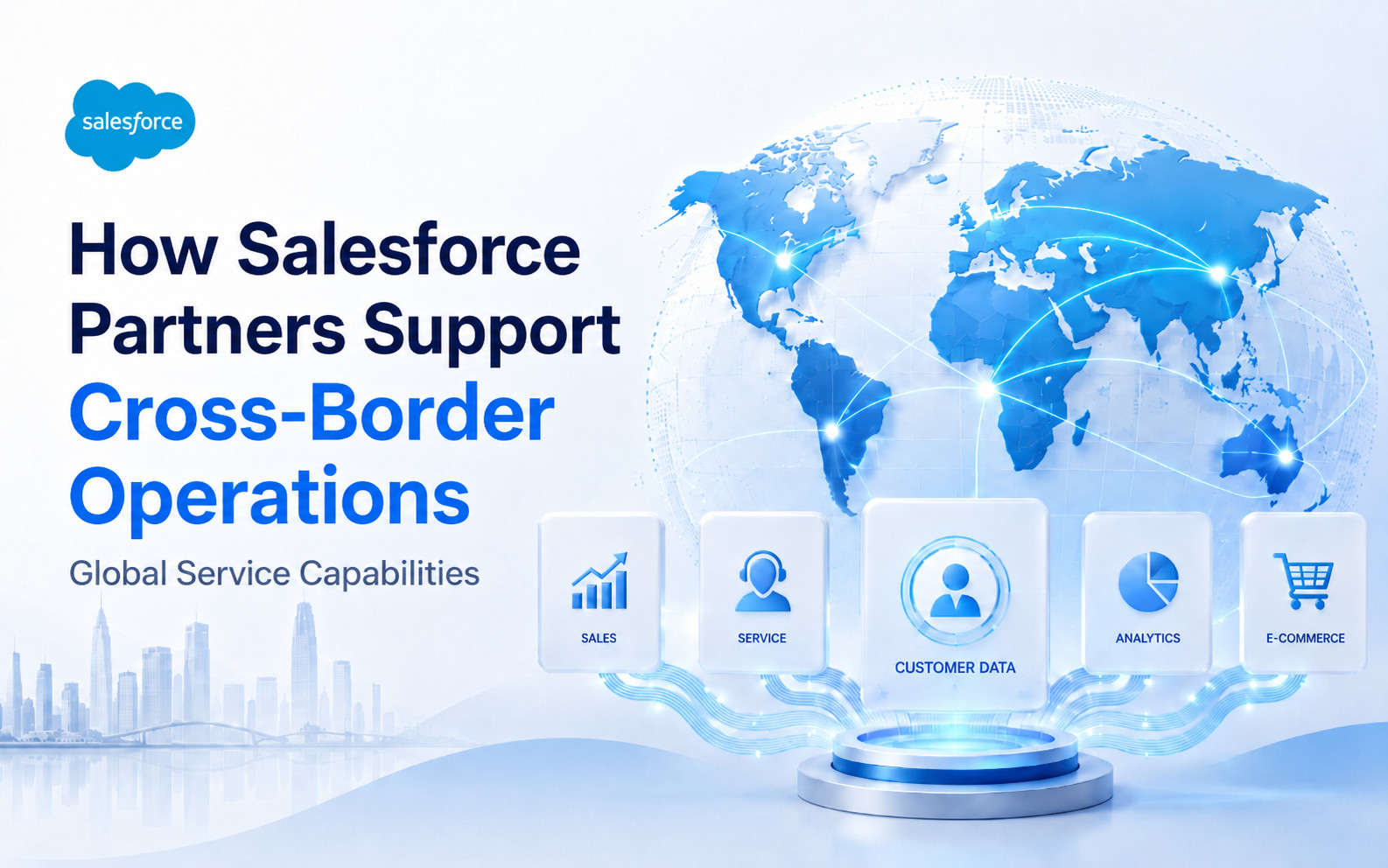
How Salesforce Partners Support Cross-Border Operations Adaptation
Customer Relationship Management (CRM), Salesforce
12 June 2026
Article Summary
The challenge of CRM in cross-border business is often not whether the system can go live, but whether it can adapt to sales processes, service rules, customer data structures, and team collaboration models across different countries. This article looks at cross-border operations adaptation and explains the global service capabilities an experienced Salesforce partner should provide, as well as how enterprises can use the right Salesforce solution to support long-term overseas business growth.
LeadsTech’s experience is that cross-border CRM performance depends on sales workflows, regional data rules, and platform governance working together—not on Salesforce configuration alone.
1. What Kind of Salesforce Partner Is Suitable for Cross-Border Operations?

In the early stages of overseas expansion, many companies treat CRM as a sales record tool: entering customer data, logging follow-ups, and checking opportunities. But once the business enters multiple national markets, CRM complexity increases quickly. Different markets may have different sales stages, quotation practices, agent models, service response requirements, and customer data rules.
A Salesforce partner suitable for cross-border enterprises should not only know how to configure CRM, but also have capabilities in global process modeling, data governance, system integration, and post-launch operational optimization. Salesforce officially positions Customer 360 as integrating applications for sales, service, marketing, commerce, IT, and more on a single platform, helping enterprises build a cross-touchpoint customer view. As the Salesforce product portfolio evolves, Customer 360 can also be understood as the application layer within Agentforce 360 for CRM and customer operations. For cross-border companies, a “unified customer view” is not only a system concept, but also an important foundation for improving global sales, service, and customer collaboration.
2. CRM Complexity in Cross-Border Operations
The focus of a cross-border CRM project is not simply moving a domestic sales process overseas. The real challenge is that business logic often differs from market to market.
Common complexities include:
1. Differences in sales processes
- North American markets may place more emphasis on standardized sales funnels
- European markets may care more about compliance and customer authorization
- Southeast Asian markets may rely more heavily on channels and local partners
2. Complex customer organization structures
- An overseas customer may involve procurement, technical, finance, and regional stakeholders at the same time
- B2B purchasing decisions are often not made by a single contact
3. Different service and after-sales requirements
- Response times, service languages, and escalation paths differ by country
- After-sales data needs to support renewal and repeat purchase opportunities for sales teams
4. Inconsistent data definitions
- Regions, industries, customer tiers, and lead source definitions may differ
- Management teams may struggle to compare market performance accurately
Therefore, when choosing a Salesforce partner, enterprises should look beyond whether the partner understands system configuration and evaluate whether it truly understands cross-border operational differences.
3. Global Service Capabilities of a Salesforce Partner

Ordinary CRM implementation vendors usually focus on fields, pages, and basic process configuration. A cross-border operations-oriented Salesforce partner needs to handle global templates, local differences, data governance, system integration, and continuous optimization at the same time.
Enterprises should focus on five types of capabilities:

1. Global process modeling capability
The partner can identify real collaboration relationships among headquarters, regions, channels, and service teams, and design scalable processes.

2. Multi-market data governance capability
The partner can unify data structures for accounts, contacts, leads, opportunities, orders, and service cases.

3. Cross-system integration capability
The partner can connect CRM with the website, e-commerce platform, ERP, CDP, marketing automation, customer service systems, and analytics platforms, while clarifying master-data relationships among systems.

4. Localized operations understanding
The partner can handle differences in language, time zones, multi-currency, permissions, approvals, regional sales rules, and service SLAs instead of only building a single-region template.

5. Continuous optimization service capability
After go-live, the partner can continuously optimize reports, processes, automation, and data quality based on business changes.
As a Salesforce Consulting Partner with cross-platform implementation experience across Magnolia, Adobe Experience Cloud, CRM, CDP, MA, CMS, and more, LeadsTech can help enterprises extend from a single CRM implementation to a more complete MarTech and digital experience architecture. For enterprises, this kind of cross-platform capability is better suited to complex overseas digitalization projects.
4. From Sales to Service: Adapting Multi-Market Customer Journeys
Cross-border customer journeys are often longer than those in a single market. Customers may first learn about a brand through website content, then meet sales teams at trade shows, and later move through sample testing, quotation negotiation, contract approval, delivery service, and repeat purchase stages.
An experienced Salesforce partner should help enterprises place these stages into a unified management model.
Sales stage adaptation
- Unify global sales stages while allowing regional differences
- Set different sales paths by country, industry, and channel
- Let headquarters view the overall pipeline while regional teams manage local execution
Service stage adaptation
- Support multilingual service cases
- Set service response standards for different countries
- Feed after-sales issues back to sales and product teams
Customer operations adaptation
- Identify high-value customers
- Trigger repeat purchase, renewal, or upsell reminders
- Incorporate service data into customer health evaluation
The value of this type of Salesforce solution is that it helps enterprises move from “managing sales activities” to “managing global customer relationships.”
5. Data Collaboration in Cross-Border E-commerce and B2B Business
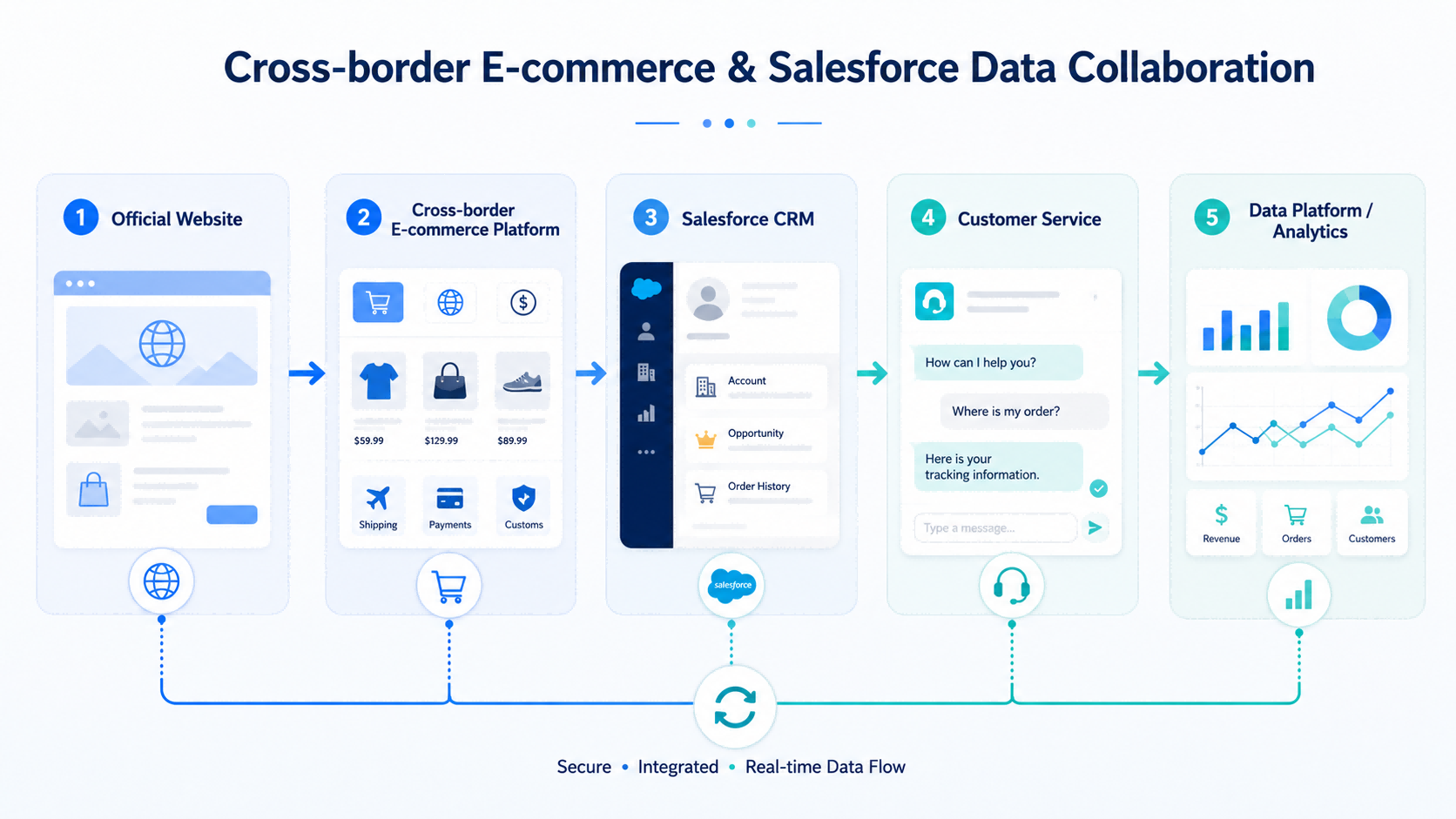
In cross-border business, B2B sales and cross-border e-commerce operations often run in parallel. Enterprises need to manage key-account opportunities while also handling online inquiries, member registration, orders, after-sales service, and remarketing.
If data cannot collaborate across systems, several problems may appear:
E-commerce and sales data are disconnected
The e-commerce system knows the order, but sales teams do not understand the customer background.
Website behavior cannot enter CRM
CRM records customer follow-up, but cannot see website behavior.
Customer service and marketing lack linkage
Customer service handles problems, but marketing cannot identify repeat purchase opportunities.
Management struggles to evaluate lifecycle value
Management sees order growth, but not customer lifetime value.
Therefore, in cross-border e-commerce operations, CRM should not be built in isolation. It should collaborate with e-commerce platforms, orders, customer service, marketing automation, and customer data systems. Salesforce official product materials emphasize that Customer 360 applications cover sales, service, marketing, commerce, IT, and other business areas. If enterprises need to unify multi-source data from CRM, official websites, e-commerce, customer service, marketing interactions, and data lakes / data warehouses into actionable customer profiles, they can evaluate Salesforce Data 360 (formerly Data Cloud). Whether it is necessary to implement Data 360 should depend on the number of data sources, real-time requirements, identity resolution, segmentation activation, and AI application needs.
This means that when enterprises choose a Salesforce partner, they should focus on whether the partner can place e-commerce data, sales data, service data, and marketing data into the same customer operations framework.
6. How Enterprises Should Evaluate Partner Capabilities
When choosing a Salesforce service provider, enterprises can start with the following questions:

1. Can the partner understand cross-border business, not just CRM?
A qualified Salesforce partner should be able to design solutions from market, sales, channel, service, data, and operations perspectives.

2. Does the partner have multi-system integration experience?
Cross-border enterprises usually already have websites, e-commerce, ERP, customer service, and marketing systems. Whether a Salesforce service provider can connect data and coordinate processes directly affects project value.

3. Can the partner handle regional differences?
A global template does not mean every market should operate in exactly the same way. A strong team should balance unified governance with local flexibility.

4. Can the partner provide post-launch operational optimization?
A CRM project is not a one-time launch. As the business grows, enterprises still need to continuously optimize automation, reports, permissions, and data quality.

5. Can the partner translate technical capability into management value?
A mature Salesforce solution is not just about adding fields and reports. It helps enterprises understand global customer status, market opportunities, and operational efficiency through unified customer data, standardized sales stages, service case closed loops, and management dashboards.
From this perspective, when evaluating a Salesforce service provider, enterprises should focus on whether the provider has “cross-border operations adaptation capability,” instead of only comparing standard implementation quotes.
7. Conclusion
Cross-border business is essentially complex operations: multiple countries, teams, channels, and customer stages all interact. If CRM is only treated as a record-keeping tool, it is difficult to truly support overseas growth. Only when CRM can connect sales, service, e-commerce, customer data, and management decision-making can it become a global operations platform.
Therefore, the key to choosing a Salesforce partner is not who can launch the system fastest, but who can balance global templates with local flexibility and continuously optimize sales, service, data, and customer operations processes. An experienced partner should understand business processes, platform architecture, data governance, and continuous optimization, helping CRM better support global customer management and growth.
If you are evaluating cross-border operations, you are welcome to learn more about our Salesforce partner services; you can also visit Contact Us to discuss your cross-border operations goals and implementation path with our consultants.
Related Articles
- Recommended Cross-Border CRM System: Why Overseas Enterprises Choose Salesforce for Full-Lifecycle Customer Management
Suitable for further understanding how Salesforce supports global customer lifecycle management. - CRM Vendor Selection: A Full Salesforce Implementation Guide for B2B Overseas Enterprises
Suitable for evaluating CRM implementation capabilities from a vendor selection perspective. - How to Choose a Global Customer Acquisition Technology Partner? Evaluating Adobe/Salesforce Implementation Experience and Industry Cases
Suitable for further judging whether an overseas project service provider has long-term strategic partnership capabilities.
Related Articles
Enterprise AI MarTech Trends Analysis 2024-2029 Outlook Report
From AI content productivity tools to a core engine for revenue growth and marketing transformation
*The PDF will be sent directly to your inbox.