
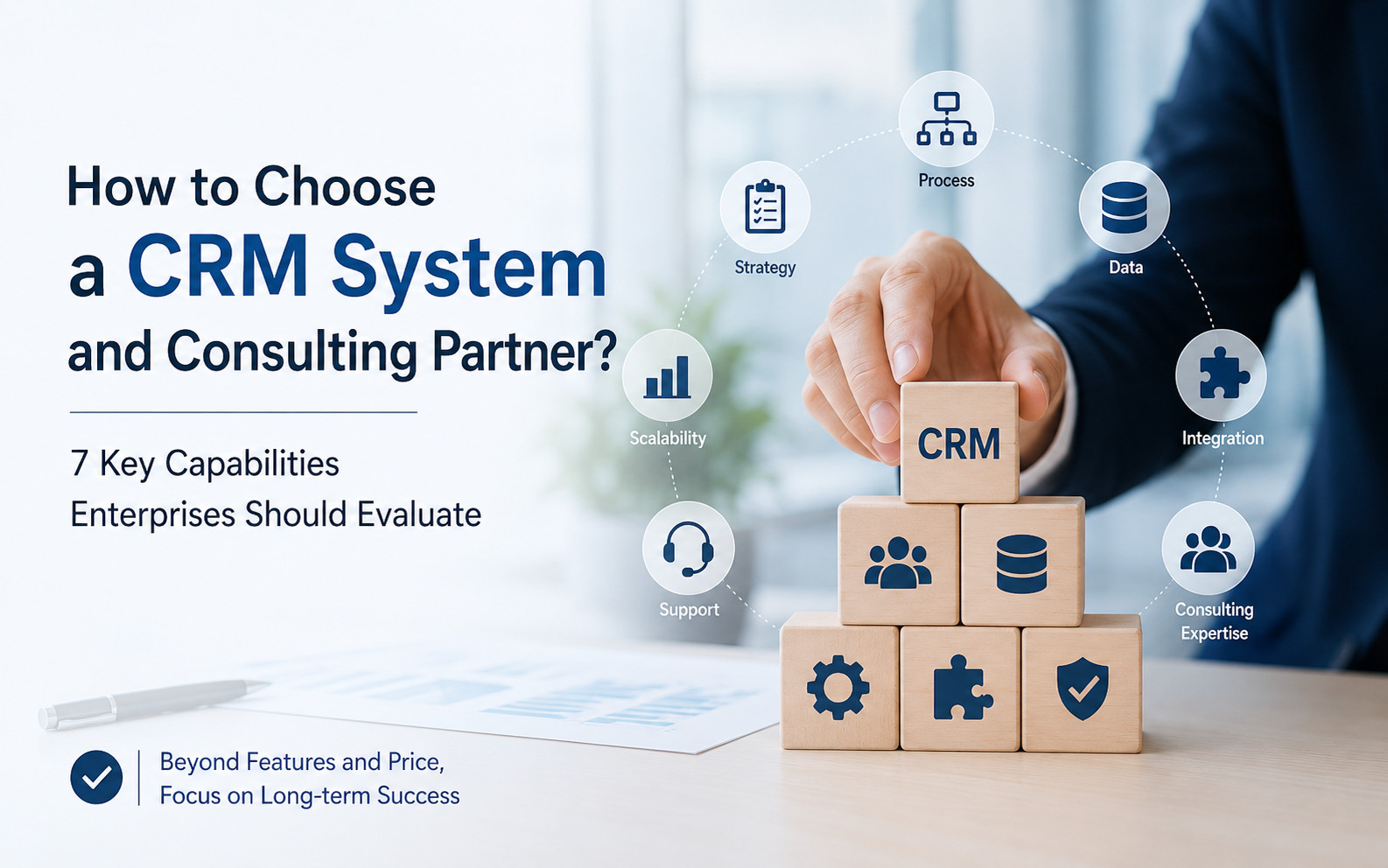
How to Choose a CRM System and Consulting Firm: 7 Key Capabilities
Customer Relationship Management (CRM), Salesforce, Social CRM
9 June 2026
Purpose and Key Takeaways
This article helps enterprises understand that choosing a CRM system should not be based on product features alone. Companies also need to evaluate business processes, data architecture, system integration, implementation methodology, and the long-term service capabilities of the consulting partner. After reading this article, you will understand the seven key capabilities for evaluating CRM systems and consulting firms, so you can reduce implementation risk and build a scalable foundation for customer management.
LeadsTech approaches CRM selection by clarifying sales workflows, data ownership, and the operating model before comparing platform features, so the system can support real collaboration after launch.
1. How should enterprises choose the right CRM system and consulting partner?
The answer is: enterprises should first clarify their sales processes, customer data, cross-department collaboration, and future growth goals. They should then evaluate whether the CRM platform can support these needs, and whether the consulting firm has the capabilities for strategy planning, system integration, process implementation, and long-term optimization. A truly suitable CRM is not simply an “easy-to-use system.” It is a core platform that helps enterprises continuously manage customer relationships, improve sales efficiency, and support operational growth.
2. Why CRM selection should not be based only on feature lists
CRM stands for Customer Relationship Management. Its core value is to help enterprises manage interactions with existing and potential customers, enabling teams to track opportunities more effectively, manage customer data, standardize sales processes, and improve operational efficiency. Salesforce defines CRM as a system for managing a company’s interactions with current and potential customers, with the goal of improving relationships and driving business growth. Gartner also notes that CRM products and services help organizations manage, analyze, and strengthen customer interactions.
Therefore, when choosing a CRM system, comparing only the number of features, licensing price, or interface design can easily overlook the factors that truly determine success: whether business processes are clear, whether data is trustworthy, whether departments are willing to use the system, and whether the CRM can integrate with websites, ERP, customer service, marketing automation, or CDP platforms.
CRM implementations usually fail not because the system lacks features, but because the enterprise has not planned processes, data, and user habits together.
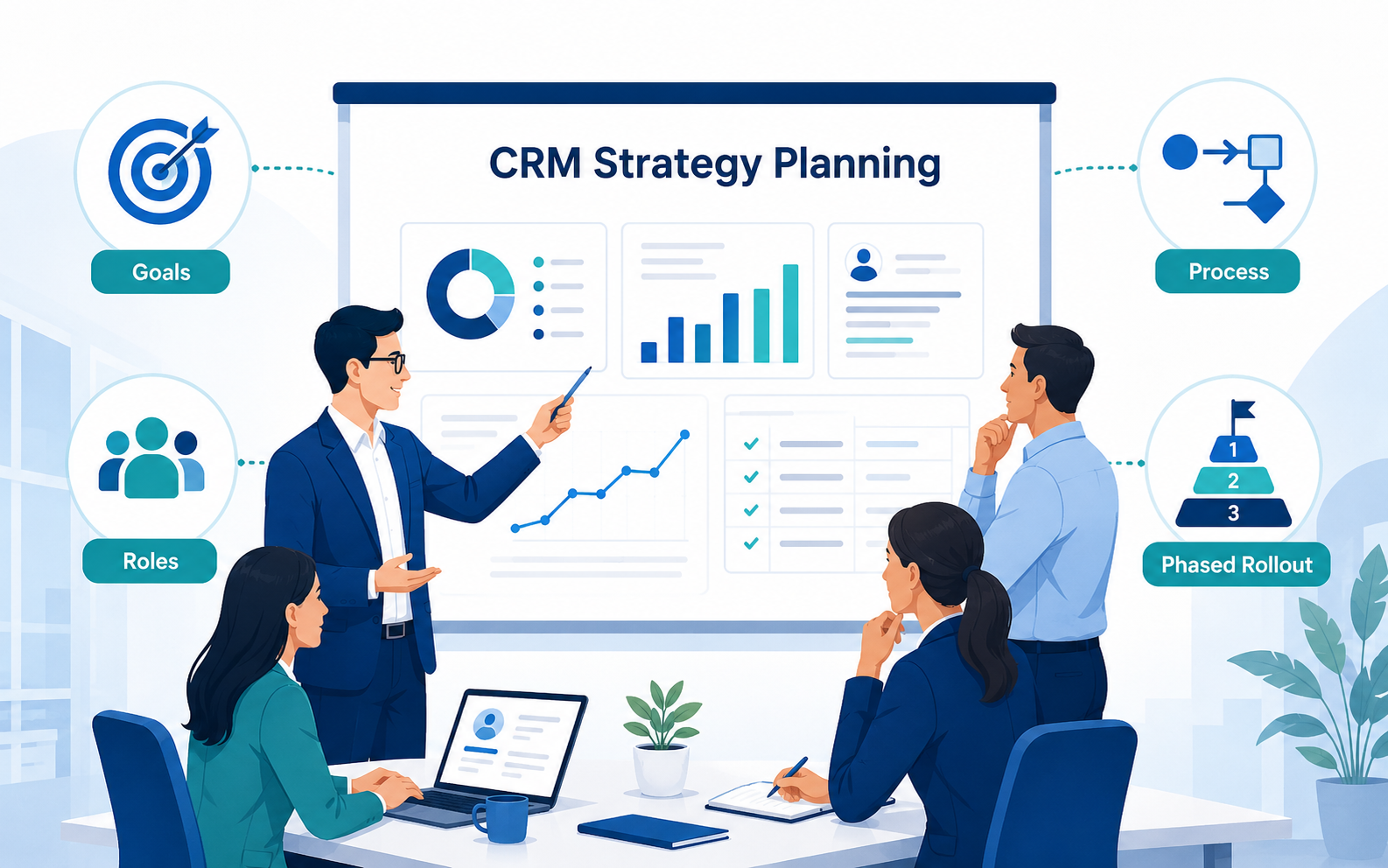
3. Key Capability 1: Business needs diagnosis and CRM strategy planning
A good CRM consulting firm does not start by recommending product modules. Instead, it helps the enterprise clarify its current business situation and implementation goals.
Enterprises should evaluate whether the consulting firm can answer the following questions:

Are business goals clearly defined?
Is CRM intended to improve win rates, shorten sales cycles, improve service efficiency, or integrate customer data?

Have process pain points been identified?
Where do current leads come from? How are they assigned? How are opportunities followed up? Are quotation and approval processes clear?

Are user roles clearly defined?
What tasks should sales, managers, service teams, marketing teams, and executives each complete in the CRM?

Is the implementation scope phased?
Should the project start with core scenarios in Sales Cloud, Service Cloud, or Customer 360 before gradually expanding?
If a consulting firm only talks about features without discussing processes and management goals, it will be difficult for the enterprise to determine whether CRM implementation can truly deliver value.
4. Key Capability 2: Platform architecture and future scalability
A CRM system should not only meet current needs; it should also support business growth over the next three to five years. For enterprises that are expanding quickly, operating across markets, or managing multiple brands, the CRM platform must be highly scalable so that sales management, customer service management, marketing automation, customer data integration, and AI applications can be added gradually as the organization grows.
Taking Salesforce Customer 360 as an example, its value is not limited to a single CRM system. It can integrate sales, service, marketing, and customer data to help enterprises build a unified customer view. LeadsTech’s Salesforce Customer 360 product page also emphasizes that CRM should work together with content, experience, and data architecture to form a complete Martech architecture.
When evaluating a platform, enterprises should pay special attention to whether the system supports multi-market, multilingual, and multi-team permission management; whether it can integrate with existing ERP, e-commerce, CMS, customer service platforms, and marketing tools; and whether it has sufficient APIs, data models, and automation capabilities. These factors directly affect whether CRM can evolve from a single-department tool into an enterprise-level customer operations platform.
5. Key Capability 3: Data governance and system integration capabilities
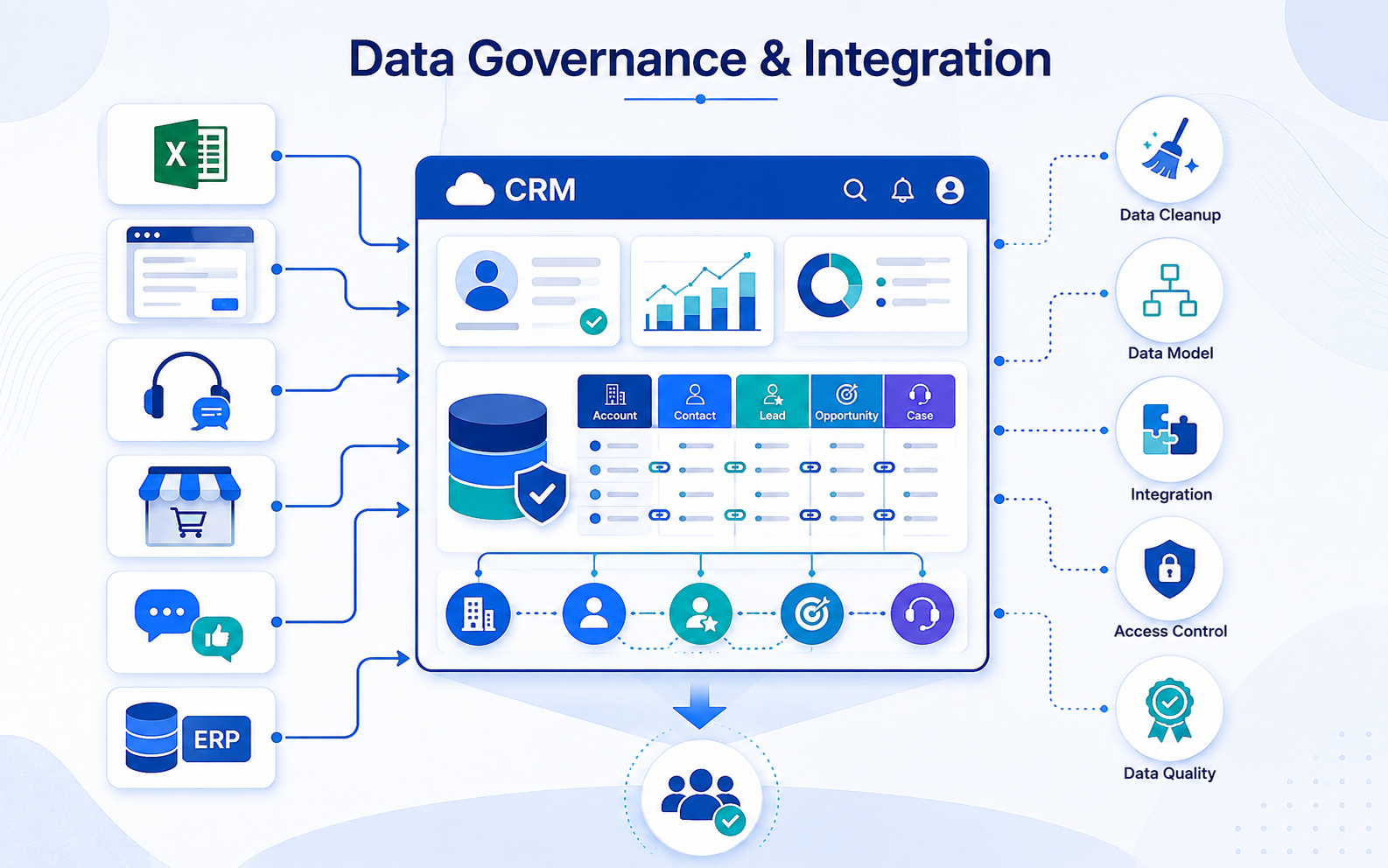
The value of CRM comes from data, but the risks of CRM often come from data as well. If customer data is scattered across Excel files, website forms, customer service systems, e-commerce platforms, social messaging tools, and ERP systems, implementing a new CRM may simply create another data silo.
Enterprises should evaluate whether the consulting firm has the following data and integration capabilities:
Data inventory and cleansing
Can the firm help organize customers, contacts, opportunities, cases, orders, and interaction records?
Data model design
Can it design data relationships such as Account, Contact, Lead, Opportunity, and Case according to business logic?
System integration capabilities
Can it integrate website forms, ERP, CDP, marketing automation, customer service platforms, LINE, WhatsApp, or e-commerce systems?
Permission and compliance design
Can it plan data viewing, editing, and export permissions for different departments, regions, and roles?
Data quality maintenance mechanisms
Does it provide duplicate data management, field standards, required-field rules, and long-term governance processes?
CRM implementation is not simply moving old data into a new system. It is the process of rebuilding the enterprise’s customer data standards.
6. Key Capability 4: Sales, service, and marketing process design
The success of CRM depends heavily on whether processes can truly be put into practice. Sales teams need clear opportunity stages, follow-up tasks, and forecasting mechanisms. Customer service teams need case assignment, service records, and knowledge bases. Marketing teams need to understand lead sources, nurturing status, and conversion performance.
Therefore, when choosing a CRM consulting firm, enterprises should confirm whether the partner understands cross-department processes, rather than only being able to complete system configuration. Taking Salesforce Sales Cloud as an example, its core capabilities include leads, opportunities, sales forecasting, and automation. LeadsTech also provides services ranging from implementation planning and process optimization to system design and ongoing operations.
A mature CRM implementation makes process design part of daily work. For example, when a salesperson creates an opportunity, the system automatically generates the next follow-up task; when a service case is escalated, the manager is automatically notified; when a marketing campaign generates a high-scoring lead, it is automatically assigned to the right salesperson. These processes are not just system features; they are concrete expressions of operational efficiency.
7. Key Capability 5: Reporting, forecasting, and management insights
CRM is not only a work tool for frontline teams. It is also a decision-making platform that helps management understand revenue and customer status.
Enterprises should assess whether CRM can support the following management needs:
Sales funnel analysis
Understand the number, value, conversion rate, and dwell time of opportunities at each stage.
Revenue forecasting
Estimate future revenue based on opportunity stages, win probabilities, and historical data.
Customer interaction analysis
See which channels customers come from, how frequently they interact, and whether service cases are increasing.
Team performance management
Compare performance across salespeople, regions, product lines, or markets.
High-risk opportunity identification
Use reports or AI insights to identify opportunities that have not been followed up for a long time, have declining win probabilities, or carry customer churn risks.
If CRM can only record data but cannot generate usable insights, management will find it difficult to view CRM as a decision-making tool. The consulting firm should be able to help enterprises design reporting logic, not merely deliver standard dashboards.
8. Key Capability 6: Implementation methodology, training, and change management
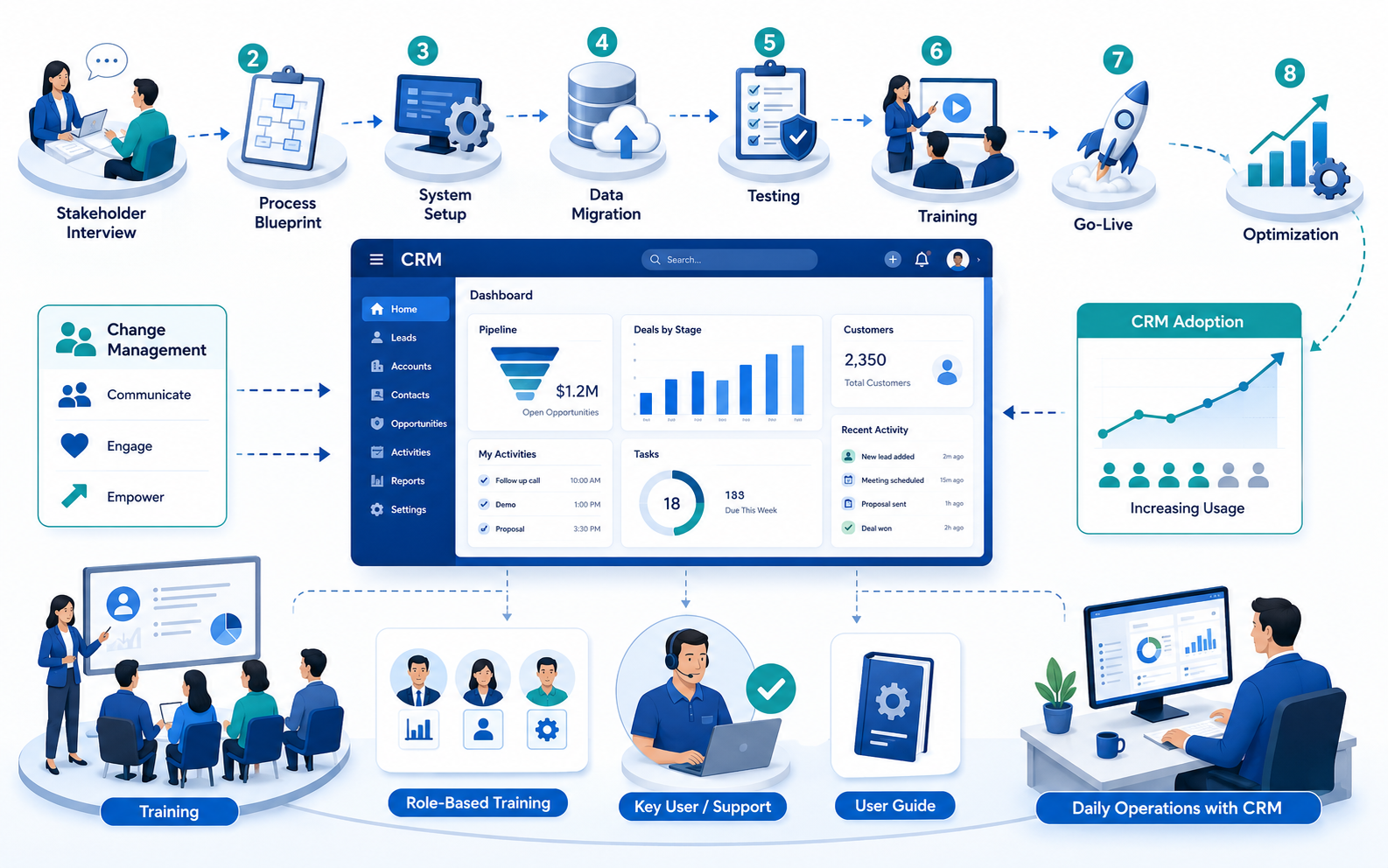
The challenge of CRM implementation often does not lie in the technology itself, but in whether the organization can accept a new way of working. After initial configuration, many enterprises encounter problems such as low adoption, incomplete data entry, or managers still asking for Excel reports. These issues all indicate that CRM has not truly been integrated into daily operations.
Therefore, the consulting firm needs a complete implementation methodology, including requirements interviews, process blueprints, system design, data migration, testing, training, go-live support, and ongoing optimization. More importantly, the firm should help the enterprise design user adoption strategies, such as role-based training, operating manuals, key user programs, usage metrics, and management meetings that use CRM as the basis for discussion and decision-making.
A CRM system can generate data only when teams actually use it. Data can form insights only when it continues to accumulate. CRM becomes a foundation for enterprise growth only when those insights are adopted by management.
9. Key Capability 7: Long-term operations, optimization, and consulting services
CRM implementation is not a one-time project. It is the establishment of a long-term operational capability. An enterprise’s products, sales model, customer channels, and market strategy will continue to change, and CRM must be optimized regularly as well.
When choosing a consulting firm, enterprises should confirm whether it has long-term service capabilities:

Post-launch support
Can the firm handle usage issues, system adjustments, and data exceptions?

Continuous process optimization
Will it adjust fields, rules, reports, and automation flows based on actual usage?

New feature adoption
Can it help evaluate new capabilities such as AI, social CRM, Data Cloud, or marketing automation?

Cross-platform integration experience
Can it connect CRM, CMS, CDP, MA, DAM, and e-commerce systems?

Local market understanding
Is it familiar with the data, language, and operational requirements of Taiwan, Hong Kong, Mainland China, or cross-border markets?
In addition to Salesforce CRM, LeadsTech also has experience with Adobe Experience Cloud, AEM, CDP, MA, DAM, and enterprise website development. This enables us to help enterprises build a more complete digital architecture across customer data, content experience, and sales-service processes.
10. Conclusion: CRM is a long-term foundation for customer relationship management
When choosing a CRM system and consulting firm, enterprises should not simply ask, “Which system is the best?” Instead, they should ask: “Which system best matches our business processes, data foundation, organizational maturity, and future growth direction?” At the same time, they must evaluate whether the consulting firm has complete capabilities across strategy, processes, data, integration, and long-term optimization.
A suitable CRM implementation can help enterprises build a unified customer view, standardize sales processes, improve team collaboration efficiency, and give management more accurate business insights. For enterprises that want to promote digital transformation, improve customer experience, and strengthen revenue management, CRM is not just a tool. It is the foundation of long-term customer relationship management capability.
If you would like to learn more about how Salesforce CRM supports sales, service, marketing, and customer data integration, please visit our Salesforce Customer 360 and Sales Cloud product pages to explore how different CRM capabilities apply to enterprise scenarios.
If your enterprise is evaluating CRM systems, planning a CRM upgrade, or looking for the right CRM consulting firm, you are welcome to contact us through the Contact Us page. The LeadsTech consulting team can help you build a practical and scalable CRM strategy, from needs assessment and platform selection to system implementation and long-term optimization.
11. Further Reading and References
- What Is CRM? A Core System for Enterprise Sales and Customer Data
- 2026 CRM System Selection Guide: How Enterprises Should Evaluate and Choose the Right CRM Platform
- Salesforce CRM Selection and Implementation: A B2B Global Sales Growth Guide
- Marketing Automation vs. CRM: Key Differences and Integration Recommendations
- Salesforce Customer 360 | CRM, Marketing, Service, and Customer Data Platform
- Salesforce Sales Cloud | Sales Management Platform and CRM Solution
Related Articles
Enterprise AI MarTech Trends Analysis 2024-2029 Outlook Report
From AI content productivity tools to a core engine for revenue growth and marketing transformation
*The PDF will be sent directly to your inbox.