
Top Cross-Border E-commerce Platforms: Adobe Commerce for B2B/B2C Growth
Adobe Commerce (Magento), e-commerce Platforms
23 June 2026
Summary
Cross-border e-commerce platform recommendations for global brands should not only look at website launch speed and initial cost. They should also assess whether the platform can support long-term brand operations, complex transaction models, multi-country market expansion, and customer data accumulation. This article focuses on Adobe Commerce and explains its core advantages in product management, B2B/B2C integration, pricing and quotation, system integration, and brand-owned operations, helping companies determine whether it is suitable as a long-term platform for global commerce.
1. Introduction: Why Global Brands Need to Reassess Their E-commerce Platform

In the early stage of global expansion, many companies prioritize third-party marketplaces or lightweight standalone websites because they are quick to launch, have a low entry barrier, and keep short-term validation costs under control. But once a brand enters the growth stage, challenges gradually emerge: product structures become more complex, more national markets are added, and membership, pricing, promotions, orders, inventory, and customer data all require more systematic management.
A cross-border e-commerce platform suitable for global brands should do more than enable online transactions. It must also support multi-market operations, mixed B2B/B2C transactions, system integration, and the accumulation of first-party customer data. For mature brands, a cross-border e-commerce platform is not just a transaction tool; it is a core system that carries brand experience, customer relationships, channel management, and data assets.
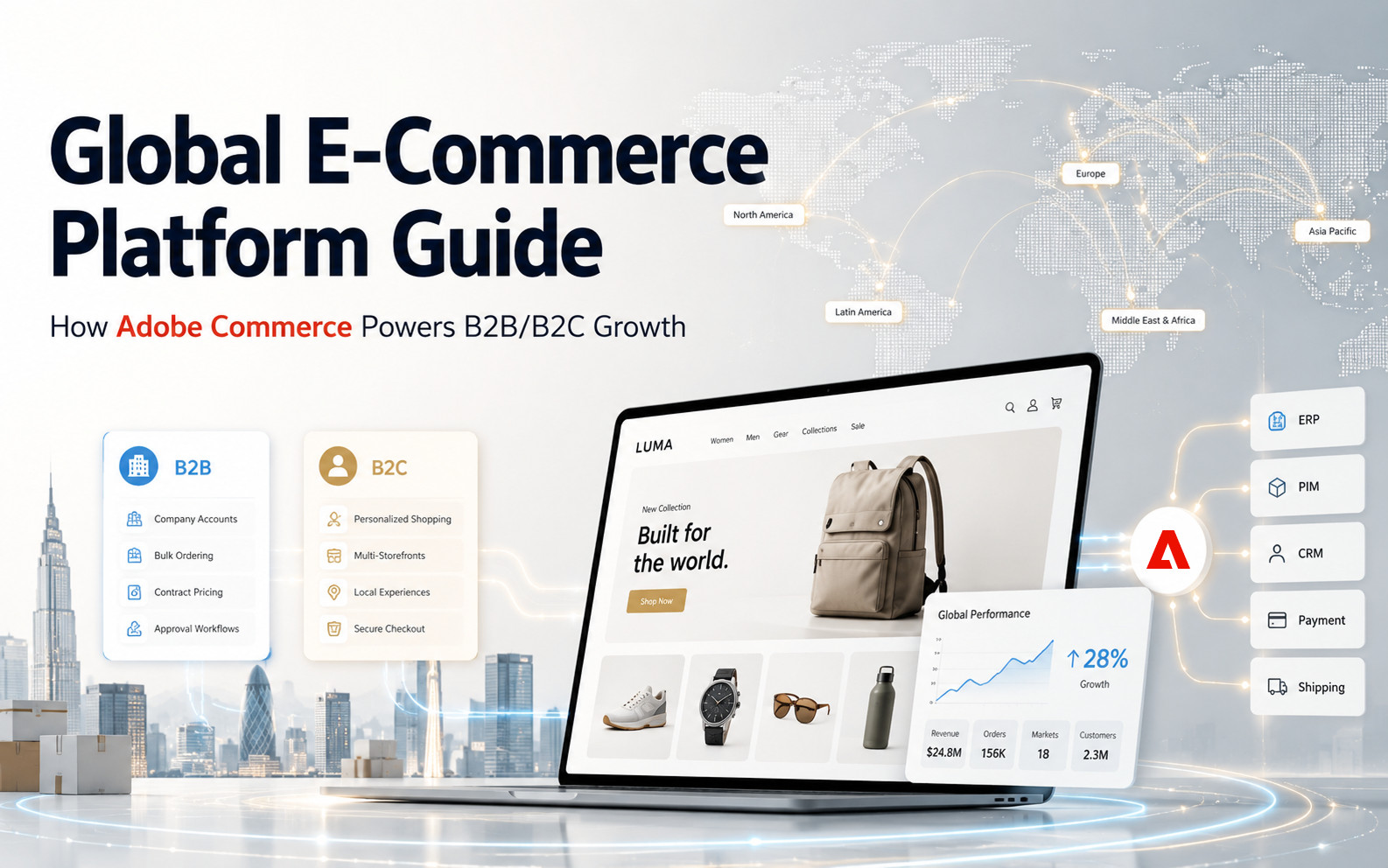
Adobe Commerce is well suited to these complex commerce requirements. Its B2B capabilities support company accounts, shared catalogs, quick orders, negotiable quotes, purchase order approvals, and requisition lists, while also supporting both B2B and B2C business scenarios.
2. Key Criteria for Choosing a Cross-Border E-commerce Platform
Recommendations for cross-border e-commerce platforms should not only compare templates, plugins, and monthly fees. The decision must return to the business complexity a company will face over the next three to five years.
An enterprise-grade platform should meet at least the following criteria:
Multi-market operation capabilities
- Support different countries, languages, currencies, and tax rules
- Support multi-site, multi-brand, or multi-region operations
- Configure products, pricing, and promotion strategies based on market differences
Complex product and transaction capabilities
- Support large SKU volumes, bundled products, configurable products, and multi-dimensional attributes
- Support B2B quotations, customer-specific pricing, and bulk ordering
- Adapt to wholesale, distribution, DTC, and hybrid B2B models
Controllable brand experience
- Deeply customize pages, product displays, content, and shopping journeys
- Avoid restrictions imposed by third-party marketplace rules
- Build owned customer relationships and repeat purchase mechanisms
System integration capabilities
- Connect ERP, CRM, PIM, DAM, payment, logistics, and analytics systems
- Support future marketing automation, membership operations, and customer segmentation
Therefore, for mid-sized and large brands, cross-border e-commerce platform recommendations should prioritize platform scalability, architectural stability, and business fit rather than focusing only on initial launch speed.
3. Core Advantages of Adobe Commerce for Global Brands
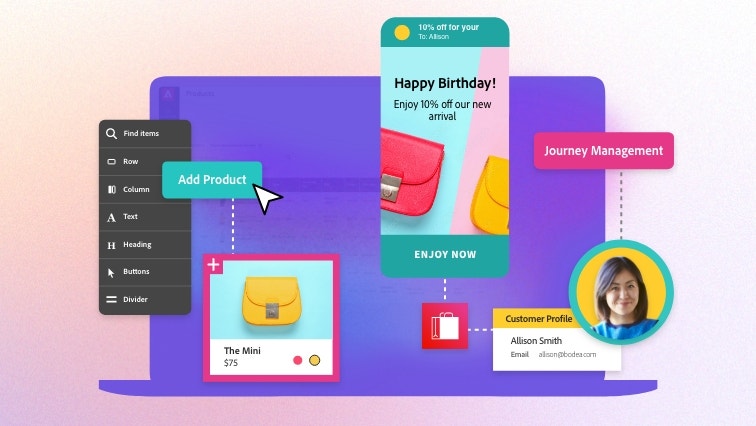
Adobe Commerce is more than an enterprise extension of Magento Open Source. It is better positioned as an enterprise-grade e-commerce platform for complex business models. For companies that need to build long-term owned brand assets, Adobe Commerce stands out for four main reasons.

Strong product and catalog management
Global brands often face challenges involving multiple product lines, many SKUs, and market-specific differences. Adobe Commerce can support complex product structures, flexible catalog configuration, and multi-level pricing, though the exact fit still depends on the product model, system integration, and implementation architecture.

Supports customer-specific pricing
In B2B business, different customers, agents, and distributors often require different prices, discounts, and product permissions. Adobe Commerce B2B documentation shows that shared catalogs can set custom product prices for different companies and use catalog permissions to control which products and prices are visible to specific companies or customer groups.

Supports quotation and negotiation workflows
Many cross-border B2B transactions do not start with direct checkout. They begin with inquiries, negotiation, discount confirmation, and then order creation. The Quotes feature in Adobe Commerce B2B supports price negotiations between sellers and company buyers.

Suitable for long-term expansion
As the business grows, a brand may need new regional sites, membership systems, dealer portals, subscription businesses, or after-sales service entrances. Compared with lightweight platforms, Adobe Commerce is better suited as a sustainably scalable enterprise e-commerce system.
This is why many companies evaluating Magento cross-border e-commerce architecture also consider whether Adobe Commerce is better suited to long-term brand operations.
4. B2B and B2C Integration: Built for Complex Global Commerce
Traditional e-commerce platforms often design B2B and B2C separately, but the real business of global brands is often hybrid: selling to end consumers while also serving wholesalers, distributors, enterprise customers, and regional agents.
This means cross-border e-commerce platform recommendations must pay close attention to hybrid transaction models.
Adobe Commerce delivers value in this area in several ways:
Serves both consumers and enterprise customers
- B2C users can browse, place orders, and pay directly
- B2B customers can use company accounts, shared catalogs, customer-specific pricing, negotiable quotes, quick ordering, purchase order approvals, requisition lists, and other capabilities
Supports complex organizational purchasing
- A single company account can include multiple users
- Different users can have different purchasing permissions
- Suitable for distributors, stores, group customers, and enterprise procurement scenarios
Supports quick orders and repeat purchasing
- For enterprise buyers familiar with SKUs, Quick Order reduces ordering steps
- Requisition List supports regular purchasing lists and repeat purchase needs
Adobe Commerce B2B capabilities are suitable for enterprise customers with complex organizational structures, multiple user roles, and different purchasing permissions.
Therefore, for brands operating DTC, wholesale, agency, and enterprise customer models at the same time, platform selection should not focus only on front-end shopping experience. It should also assess whether the platform can support complex customer relationships.
5. System Integration: Connecting Adobe Commerce with ERP, CRM, and Customer Data
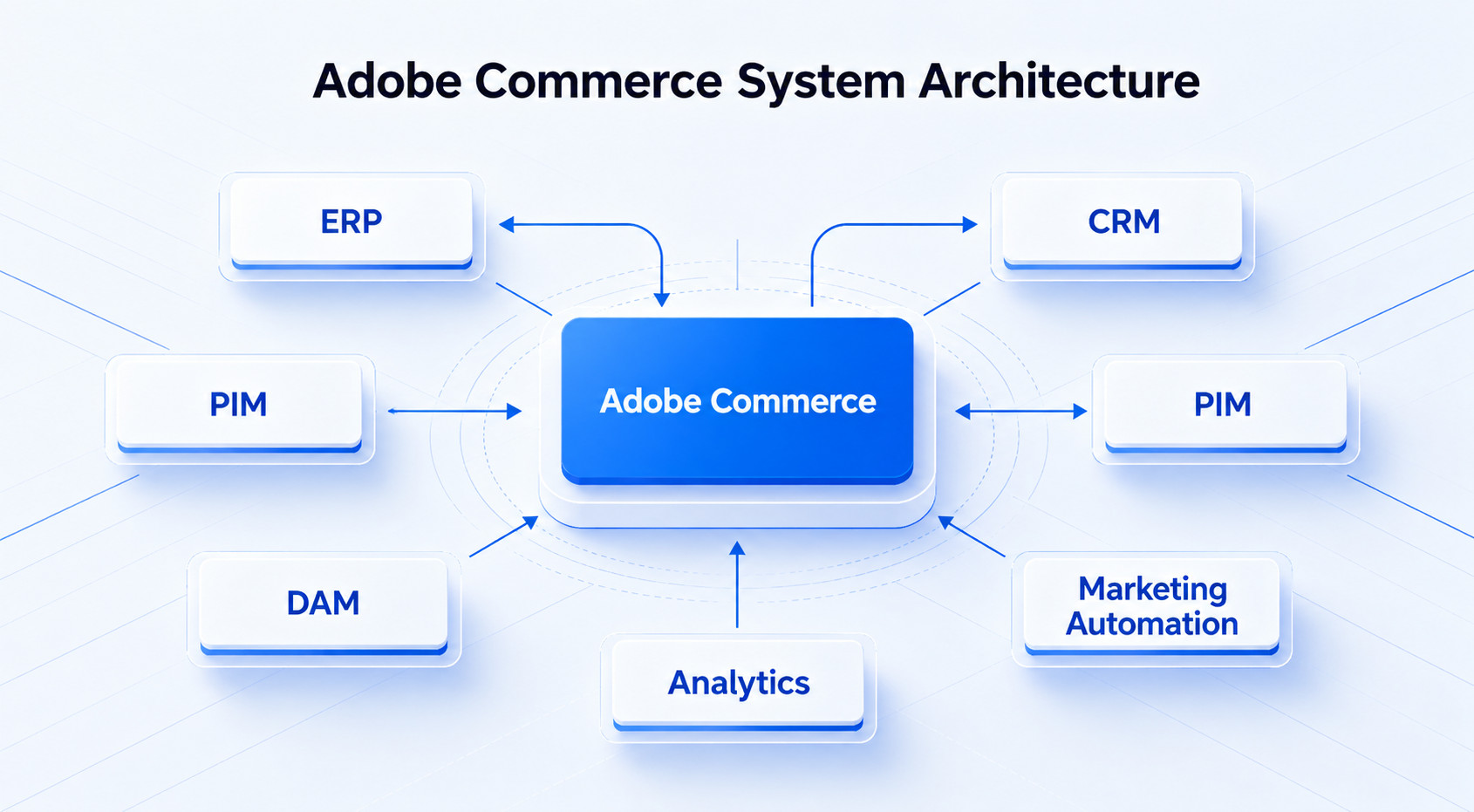 For mature brands, cross-border e-commerce is not just about online transactions. It also needs to connect supply chain, sales, customer service, content, and analytics. Otherwise, the e-commerce platform becomes another data silo.
One advantage of Adobe Commerce is that it can serve as part of an enterprise digital commerce architecture, working with ERP, PIM, OMS, CRM, DAM, analytics, and marketing automation systems.
Typical integration directions include:
ERP integration
Connect product information, inventory, pricing, or configuration data through APIs or middleware, and decide on real-time query, caching, or synchronization strategies based on business needs
CRM integration
Synchronize customer purchase and inquiry data with the sales team
PIM integration
Centrally manage product information, attributes, and multilingual content
DAM integration
Use product images, videos, and brand assets
Analytics integration
Analyze visits, carts, orders, and customer behavior
Marketing automation integration
Trigger repurchase, win-back, and recommendation campaigns based on purchase behavior
Once these systems are connected, the e-commerce platform can evolve from a single sales channel into an important entry point for owned customer data and transaction data. This is critical for companies that need to operate overseas customer assets over the long term.
6. What to Evaluate When Choosing an Implementation Partner
Adobe Commerce is powerful, but implementation can also be complex. Companies need to plan product models, pricing systems, tax rules, payment and logistics, permission architecture, performance, security, and third-party system integration in advance. Without clear architecture planning, projects can easily suffer from longer development cycles, plugin conflicts, performance issues, messy data structures, or difficult maintenance.
Therefore, cross-border e-commerce platform recommendations should not stop at the platform itself. They should also evaluate the capabilities of the implementation partner. When choosing an enterprise Magento service provider, focus on the following:

Understanding of cross-border business processes
- Familiarity with multi-market, multi-currency, multi-tax, and multi-logistics scenarios
- Understanding of the differences between B2B, B2C, and distribution businesses

System integration experience
- Ability to connect ERP, CRM, PIM, DAM, and Analytics
- Ability to design stable data synchronization mechanisms

Performance and security experience
- Ability to handle high concurrency, complex product catalogs, and major promotional events
- Ability to plan permissions, security, and operations mechanisms

Long-term optimization capability
A Magento project is not a one-off delivery. After launch, it still requires continuous optimization of conversion, performance, checkout flows, and customer experience.
A reliable Magento partner should do more than complete development tasks. It should help companies design their e-commerce platform as an operable, scalable, and growth-ready brand asset. LeadsTech focuses on enterprise digital transformation and MarTech solutions, and is a local Chinese-speaking partner with Adobe Experience Manager Specialized credentials. Companies can further evaluate LeadsTech’s service capabilities across Adobe Experience Cloud, CMS, e-commerce, CDP, marketing automation, and data analytics to determine whether it is a suitable implementation partner for global commerce.
7. Conclusion
For global brands, the choice of cross-border e-commerce platform determines more than short-term website launch efficiency. It also determines whether future brand, customer, transaction, and data assets can remain in the company’s own hands.
From the perspective of cross-border e-commerce platform recommendations for global brands, Adobe Commerce is better suited to companies that have entered the growth stage, have complex SKUs and diverse business models, need B2B/B2C integration, and want to build long-term owned commerce capabilities. Its value is not only in supporting online transactions, but also in helping brands build a sustainably scalable cross-border commerce system.
If you are evaluating Magento cross-border e-commerce, Adobe Commerce architecture, or enterprise-grade cross-border e-commerce platform development, you are welcome to learn more about our related services or visit Contact Usto discuss your global brand expansion goals, system architecture, and implementation roadmap with our consulting team.
8. Related Articles
- Cross-Border E-commerce Platform Solutions for Global Brands: Self-built Website vs Magento vs Adobe Commerce
Useful for comparing the use cases of different cross-border e-commerce platform models. - Chinese Companies Going Global: The Right Way to Build a Cross-Border E-commerce Independent Website
Useful for understanding the long-term value of independent websites from the perspectives of brand assets, content, transactions, and data. - Foreign Trade Cross-Border E-commerce Platform Recommendation: Self-built Website or Third-Party Marketplace? An Enterprise Decision Guide
Useful for further understanding the role differences between independent websites and third-party platforms in global brand expansion.
Related Articles

Enterprise AI MarTech Trends Analysis 2024-2029 Outlook Report
From AI content productivity tools to a core engine for revenue growth and marketing transformation
*The PDF will be sent directly to your inbox.