
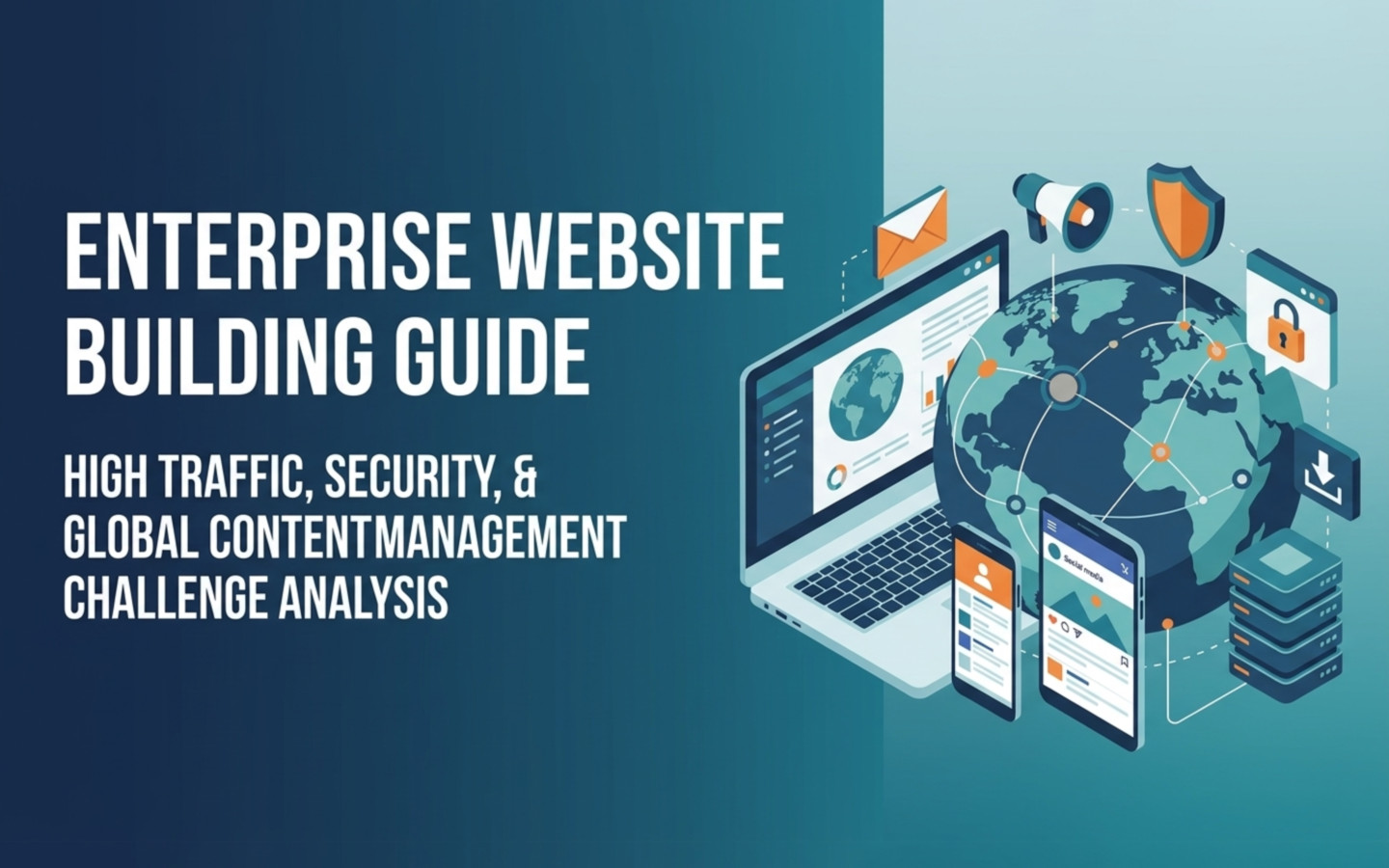
Enterprise Website Guide: Traffic, Security & Global Content Challenges
Content Management System (CMS)
31 March 2026
- Why Enterprise Website Development Is a “High-Difficulty Project”
- Typical Business Scenarios of Enterprise Websites
- Core Challenge 1: High Traffic and High Concurrency
- Core Challenge 2: Enterprise-Level Security and Compliance
- Core Challenge 3: Global Content Management and Multi-Organization Collaboration
- Key Principles of Enterprise Website Architecture Design
- The Core Role of Enterprise CMS in Large Websites
- Common Pitfalls in Enterprise Website Development
- Conclusion: The Website as Enterprise-Level Digital Infrastructure
- Further Reading and References
- Why Enterprise Website Development Is a “High-Difficulty Project”
- Typical Business Scenarios of Enterprise Websites
- Core Challenge 1: High Traffic and High Concurrency
- Core Challenge 2: Enterprise-Level Security and Compliance
- Core Challenge 3: Global Content Management and Multi-Organization Collaboration
- Key Principles of Enterprise Website Architecture Design
- The Core Role of Enterprise CMS in Large Websites
- Common Pitfalls in Enterprise Website Development
- Conclusion: The Website as Enterprise-Level Digital Infrastructure
- Further Reading and References
1. Why Enterprise Website Development Is a “High-Difficulty Project”
In large enterprises, websites often carry responsibilities far beyond “brand presentation”:
- A unified window for global brand image
- Entry point for multiple business lines and solutions
- A core node carrying massive traffic and critical business flows
- A central platform for external communication and internal collaboration
This makes enterprise website development inherently characterized by:
- High and fluctuating traffic
- Complex business and multiple organizational roles
- Strict security and compliance requirements
- Large-scale content and multiple languages
Therefore, enterprise website development is essentially a long-term, systematic, cross-department digital project.

2. Typical Business Scenarios of Enterprise Websites
In practice, enterprise websites usually need to support:
- Multi-country, multi-language global sites
- Parallel operation of multiple brands or business lines
- Marketing campaigns, content marketing, and lead conversion
- Investor relations, recruitment, news releases, and other functions
Combined, these scenarios make the website not just a single system, but the central hub of a complex digital ecosystem.
3. Core Challenge 1: High Traffic and High Concurrency
3.1 High Traffic Is Not a “One-Time Event”
For large enterprises, high traffic often comes from:
- Global brand campaigns
- New product launches
- Media coverage or sudden events
- Concentrated advertising and marketing efforts
If the website architecture is designed only for “daily traffic,” peak traffic will severely test system stability.
3.2 Technical Challenges Behind High Traffic
Common challenges include:
- Page response time drops sharply
- Core pages become inaccessible
- System performance is limited during content publishing
This requires the website to have at the architectural level:
- Efficient caching and content delivery mechanisms
- Horizontally scalable application architecture
- Deployment strategies optimized for global access
4. Core Challenge 2: Enterprise-Level Security and Compliance
4.1 Security Is Not Just an IT Issue
Security risks for enterprise websites include:
- Data leakage
- Website tampering
- Service interruptions
- Third-party attacks
Once a security incident occurs, the impact is often not only on the website itself but also on brand reputation and compliance risks.
4.2 Compliance Requirements Are Increasingly Strict
As enterprises globalize, websites also need to address:
- Data privacy and compliance requirements
- Differences in laws across countries
- Content auditing and access control
This requires robust permission management, logging, and compliance support.

5. Core Challenge 3: Global Content Management and Multi-Organization Collaboration
5.1 Risks of Uncontrolled Content Scale
Common issues in enterprise websites include:
- Large content volume without unified governance
- Multi-language version updates not synchronized
- Local teams manage content independently, reducing brand consistency
Without systematic content management, the website can easily become a “content silo.”
5.2 Complexity of Multi-Role Collaboration
Large websites usually involve:
- Headquarters brand and content teams
- Regional marketing teams
- Legal, IT, and security roles
The website system must support:
- Multi-level permissions
- Content approval workflows
- Localization flexibility under unified standards
6. Key Principles of Enterprise Website Architecture Design
Mature enterprise websites generally follow these principles:
- Architecture comes before page design
- Scalability is prioritized over one-time delivery
- Security and performance are built-in, not retrofitted
- Structured content to avoid over-customization
- Support long-term evolution rather than short-term projects
These principles determine whether the website can support growth over the next 3–5 years.
7. The Core Role of Enterprise CMS in Large Websites
In enterprise websites, CMS has long surpassed being just a “content editing tool.”
7.1 What Enterprise CMS Can Solve
- Unified management of multi-sites and multi-languages
- Content reuse and structured modeling
- Permissions, workflows, and governance
- Integration with analytics, marketing, and data platforms
7.2 CMS Determines "Long-Term Efficiency"
A suitable CMS affects not only launch speed but also:
- Content team productivity
- Global collaboration costs
- Technical maintenance burden
In the long run, CMS selection is often more important than front-end technology.

8. Common Pitfalls in Enterprise Website Development
- Treating the website as a one-time project
- Focusing only on design and ignoring architecture
- Underestimating content volume and multi-language complexity
- Delaying security and compliance considerations
- Sacrificing long-term scalability for short-term needs
These pitfalls usually surface after 1–2 years of website operation.
9. Conclusion: The Website as Enterprise-Level Digital Infrastructure
For large enterprises, the website is not just a marketing asset but also:
- Brand asset
- Data entry point
- Global communication platform
- Infrastructure for digital capabilities
The core goal of website development is not “fast launch,” but long-term stability, scalability, and governance.
Closing: From “Building a Website” to “Creating an Enterprise-Level Platform”
If you are facing:
- Continuously growing website traffic
- Complex multi-country content management
- Increasing security and compliance pressures
- Systems unable to support future expansion
Now is the critical time to review the overall website architecture and platform capabilities.
Feel free to contact us to evaluate how enterprise CMS and proper architecture can build a large enterprise website platform that truly supports global operations.
Contact Us: Discuss Enterprise Website Planning with Our Consultant Team
Services Page: Learn About Our Enterprise CMS and Global Website Development Services
Further Reading and References
Internal Reading
- Overseas trade website development is more than building a site: How professional CMS supports multi-language operations
- Comprehensive Guide to Choosing a Digital Partner for Global Expansion: From Website Development to CDP and Marketing Automation
- What is AEM as a Cloud Service? A Key Step in Cloud-Based Enterprise Content Platforms
External References
Related Articles

Enterprise AI MarTech Trends Analysis 2024-2029 Outlook Report
From AI content productivity tools to a core engine for revenue growth and marketing transformation
*The PDF will be sent directly to your inbox.
Email Error
Please enter a valid email address.
Thank You!
The whitepaper has been sent to your inbox. If you don’t see it, please check your spam or promotions folder.