
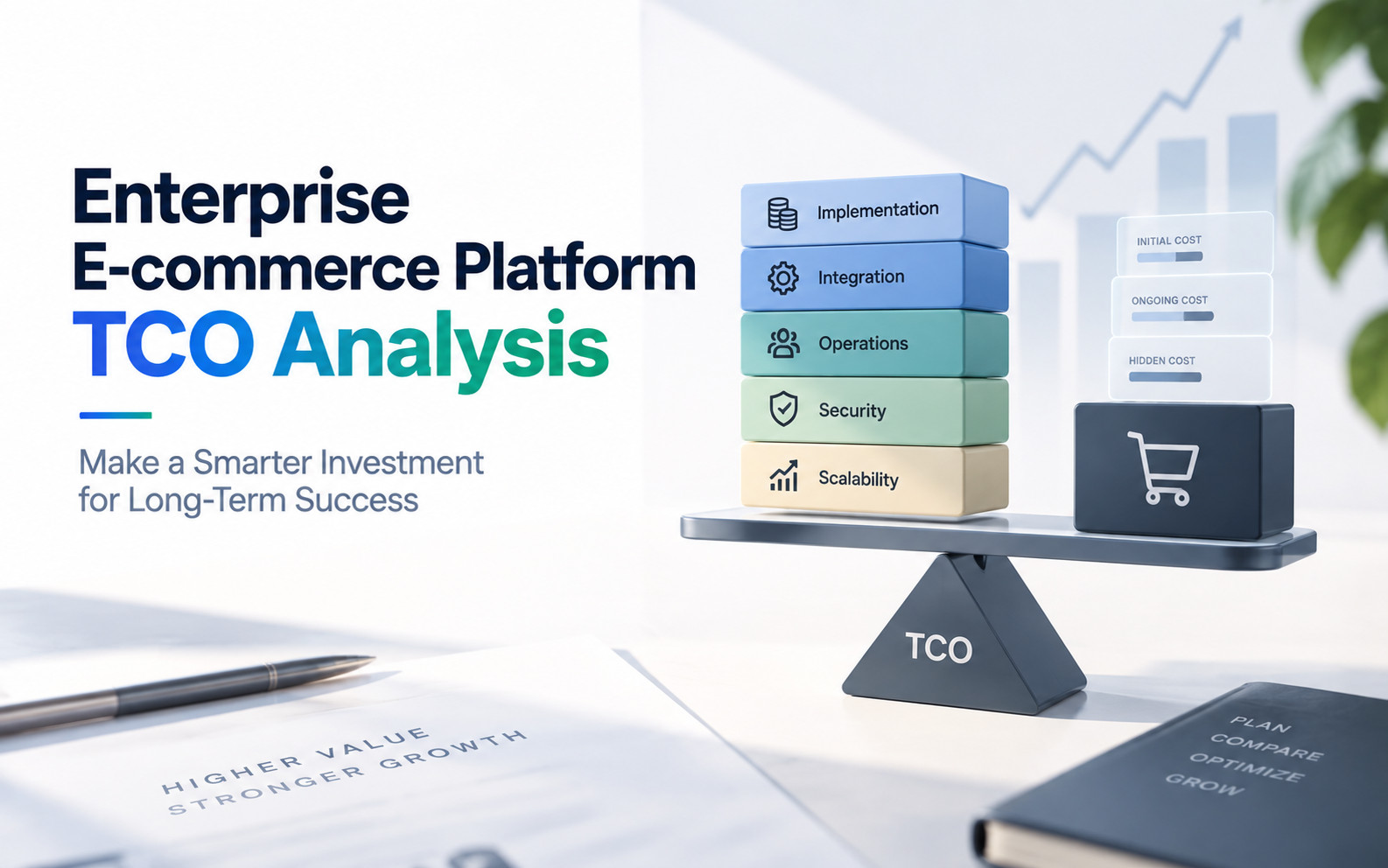
Total Cost of Ownership (TCO) Analysis for Enterprise E-commerce Platforms
AEM Sites, e-commerce Platforms
20 September 2026
When enterprises compare e-commerce platforms, they often look first at monthly fees, licence costs or an implementation quote. Yet the costs that shape return on investment are usually found in the three- to five-year total cost of ownership (TCO). LeadsTech’s enterprise e-commerce website development and systems integration services help organisations evaluate architecture, data connections, operating processes and long-term scalability together, instead of making a long-term decision from a short-term price.
This article breaks down build, integration, operations, security and growth costs, then provides a practical way to compare TCO.
1. What is e-commerce platform TCO?
TCO is the full cost an organisation incurs over a defined period to implement, use, maintain and extend a platform. It includes visible fees as well as people, integration, risk and opportunity costs that are easy to miss.
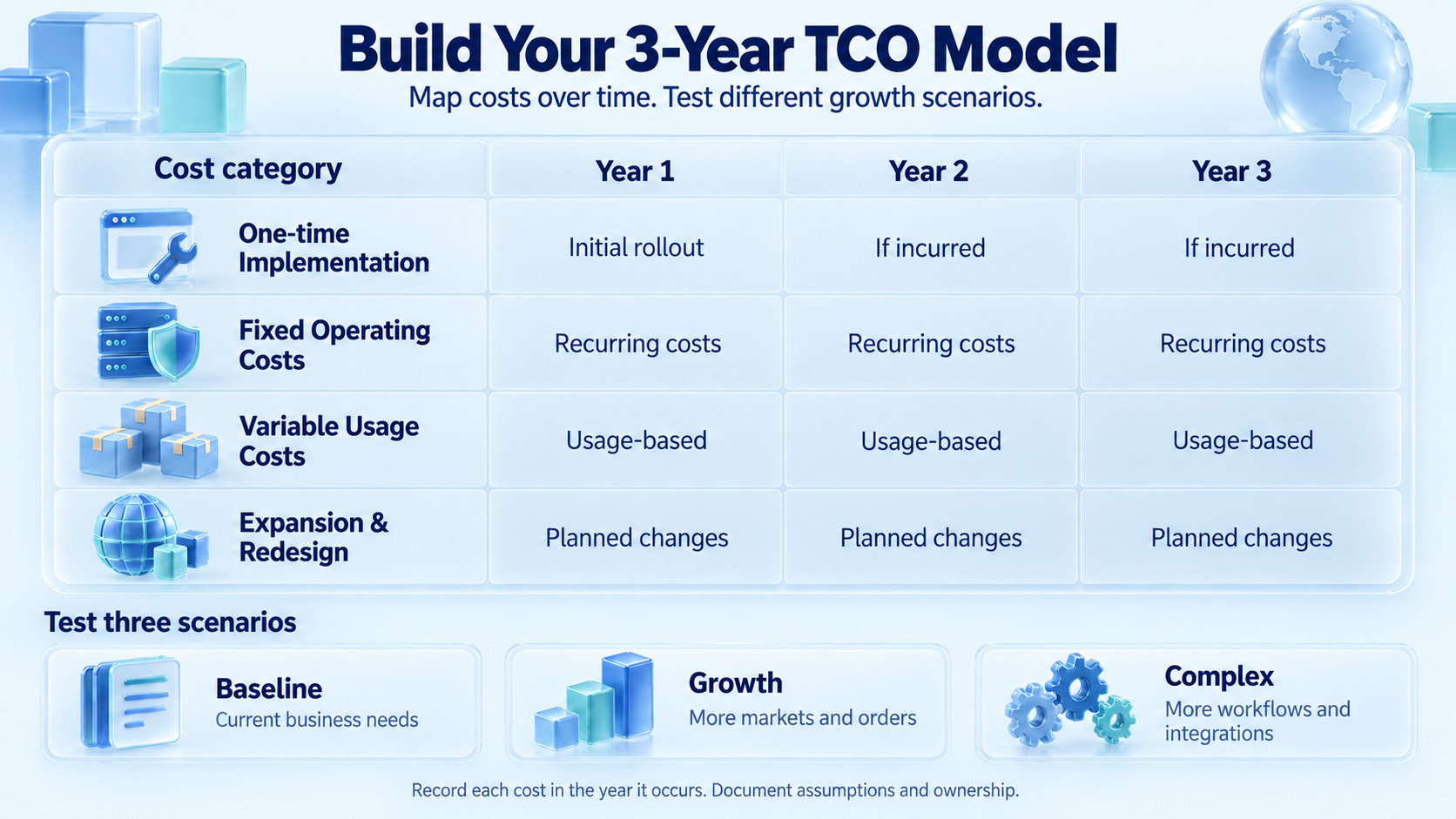
Three-year TCO = one-time implementation cost + three-year fixed operating cost + three-year variable usage cost + expected expansion and redesign cost
2. Which costs should enterprises calculate?
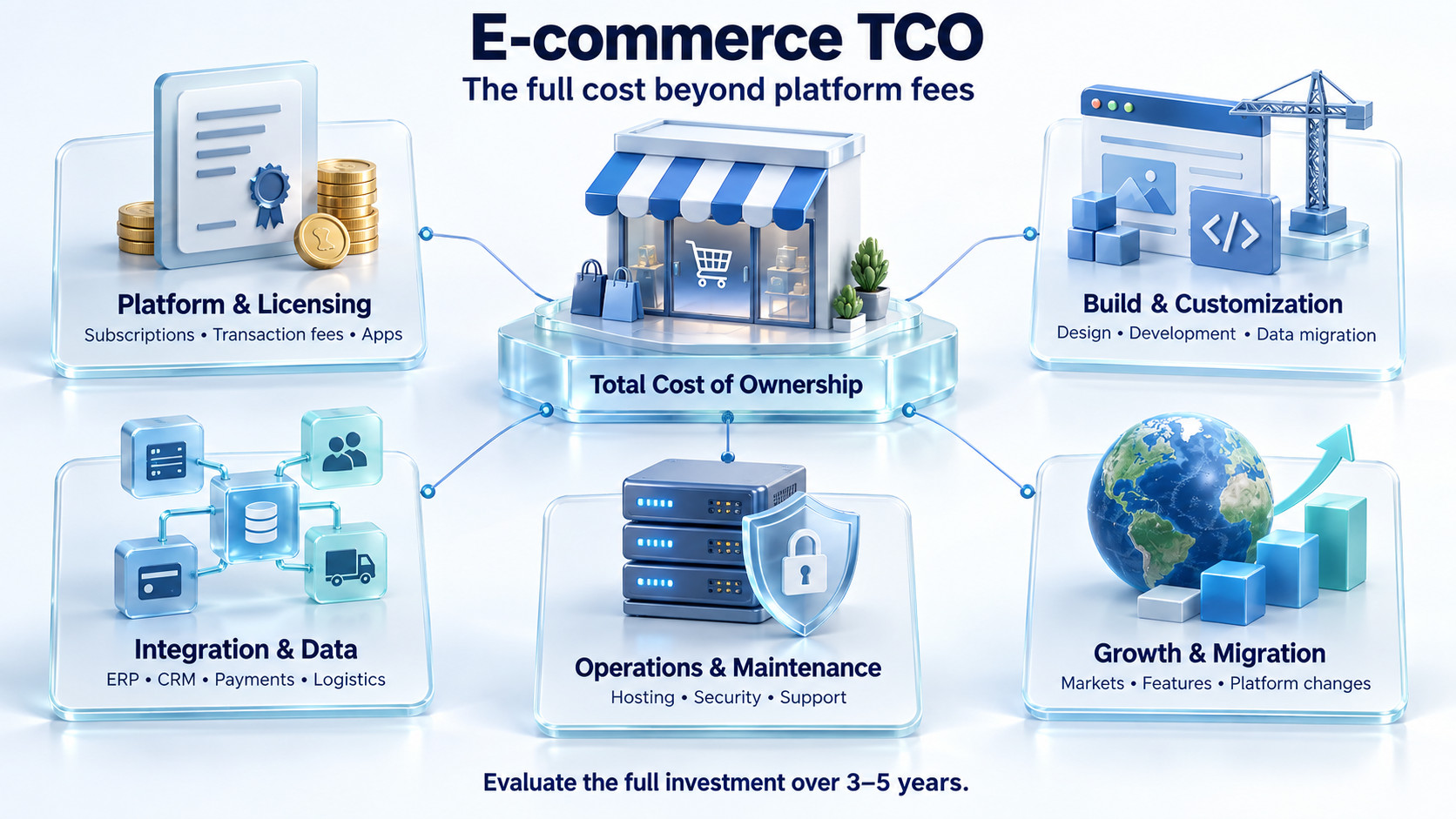
Platform and licensing
Model monthly or annual fees, upgrades, transaction charges and app costs across the expected operating period.
Build and customisation
Include discovery, UX, development, data migration, testing and launch, often the largest first-stage cost.
Integration and data
ERP, CRM, PIM, OMS, WMS, payment, logistics and analytics connections affect implementation and maintenance.
Operations and maintenance
Hosting, security, backups, monitoring, performance, content and support are recurring costs.
Growth and migration
New markets, languages, brands, capabilities and future platform migration belong in the long-term model.
If the spreadsheet only includes subscription fees, it will usually understate the real long-term investment.
Do not treat TCO as only a finance spreadsheet
TCO is most useful when it connects technology choices to operating outcomes. Beyond listing fees, ask whether the platform helps the team launch products faster, reduce manual order handling, and manage content, pricing and checkout rules across markets. If a platform reduces process friction, a higher upfront investment may still produce a better business result.
Record each cost with its accountable team, timing, scope and avoidability so the comparison goes beyond the quoted price.
3. How to build a TCO model
Start with a three- or five-year evaluation period and separate one-time, fixed, variable and expansion costs. Map each line item to a business process and accountable team so that finance and technology use the same assumptions.
Step 1: list business requirements
Confirm markets, product structure, B2B or B2C processes, payments, logistics, membership, content management and reporting.
Step 2: estimate recurring costs
Separate licensing, hosting, people, apps, integration and maintenance, and label each item by cycle.
Step 3: add growth scenarios
Build base, growth and complexity scenarios to test how new markets, traffic, orders or integrations change the cost profile.
4. TCO differences between platforms
SaaS platforms can reduce infrastructure and security operations, but subscriptions, transaction charges, apps and advanced plans must be modelled over time. Open-source platforms provide licensing flexibility, while hosting, plugin compatibility, upgrades and maintenance remain the responsibility of the organisation or its partner. Enterprise platforms may require higher upfront investment but can provide stronger control for complex B2B, multi-brand, multi-market and integration-heavy scenarios.
No platform is cheapest in every situation. The relevant comparison is which option can support stable operations and growth at an acceptable TCO.
5. Often-overlooked TCO costs
- Data cleansing, product restructuring and historical order migration.
- Cross-functional coordination, training, content production and process change.
- Third-party apps, plugins, API quotas and transaction charges.
- Performance, security, backup, monitoring and compliance.
- Workarounds caused by platform limits and future migration.
6. How to use TCO to select a platform
List non-negotiable requirements, then compare cost, flexibility, integration, operations, security and growth. Do not simply choose the lowest three-year total; test cost predictability, vendor dependency, internal capability and future change.
Combine TCO analysis with a proof of concept: validate product synchronisation, quoting, checkout, order return or multi-market management before committing to the full scope.
Compare a realistic growth scenario
An organisation may operate in Hong Kong in year one, add Taiwan and Singapore in year two, then introduce B2B quoting and ERP integration in year three. One option may have the lower initial build quote, but three-year TCO can change completely once languages, markets, permissions, quoting and data synchronisation are included.
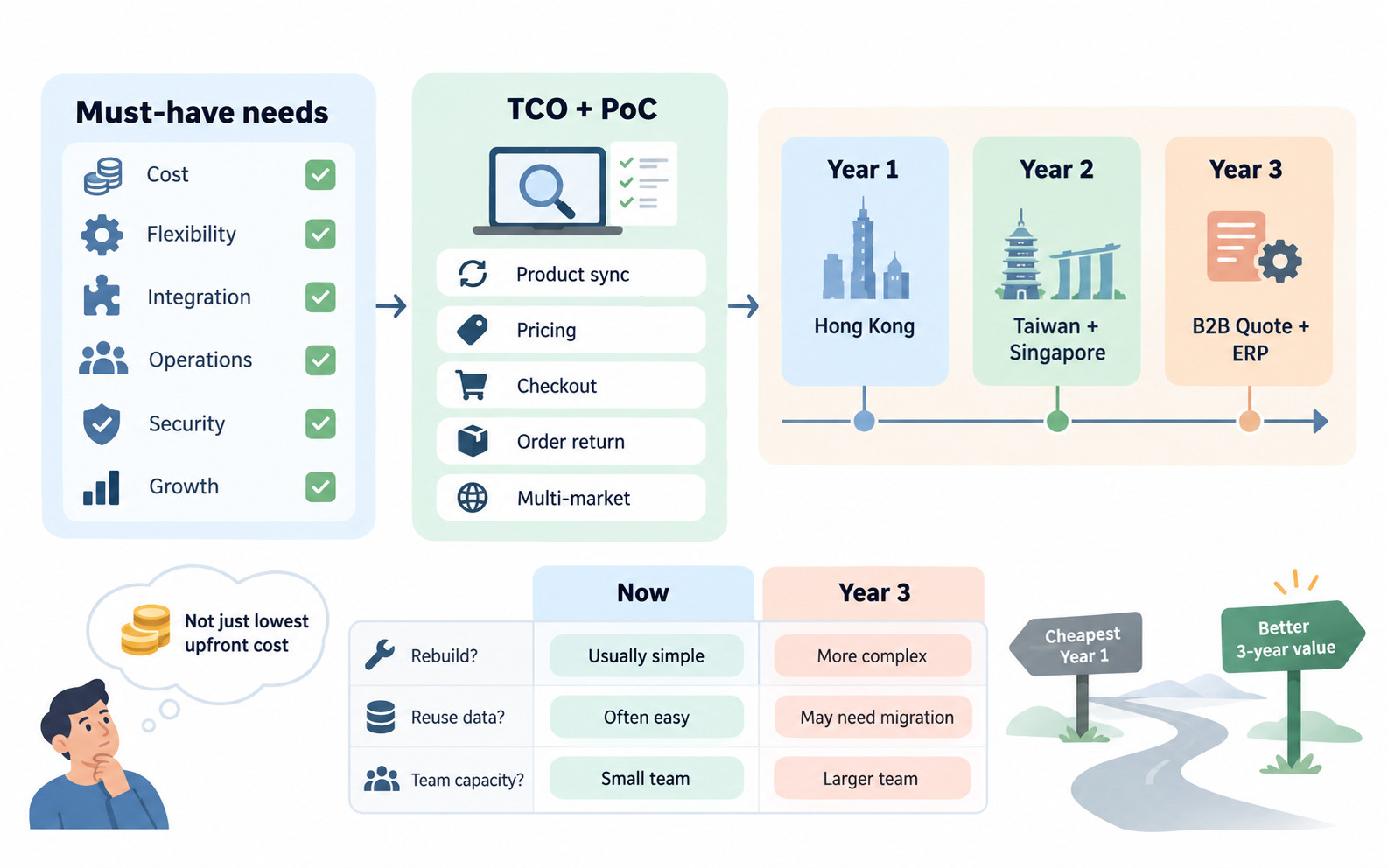
Platform comparisons should include both a “current requirements” view and a “three years from now” view. Check which capabilities need rebuilding, which data can be reused, and whether the team can support the operating model.
7. Frequently Asked Questions (FAQ)
Does the lowest platform price mean the lowest TCO?
Not necessarily. Extensive apps, manual work or custom workarounds can make the long-term cost higher.
Which teams should own TCO?
Finance, IT, e-commerce operations and business teams should build it together instead of using one department budget alone.
How should uncertain costs be handled?
Record assumptions, ranges and confidence levels, then model base, growth and complexity scenarios.
How often should the TCO model be updated?
Update it at requirements sign-off, PoC, launch and every major expansion so it reflects current evidence.
Turn TCO into decision thresholds
Set practical thresholds: a three-year cost ceiling, first-market launch time, critical integration coverage, the scope non-technical teams can manage themselves, and the marginal cost of adding another market. These thresholds align proposals, PoCs and project scope.
TCO should not be a one-time selection document. When order volume, product count, team size or market scope changes, revisit the assumptions and identify early whether the platform is approaching its capability limits.
8. Conclusion
Platform selection is not simply a comparison of monthly fees. It is a decision about the organisation’s operating model, systems architecture and room to grow. LeadsTech helps enterprises plan e-commerce platforms, build websites, integrate systems and improve SEO/GEO, creating a more controllable long-term investment.


Recommended Articles
Enterprise AI MarTech Trends Analysis 2024-2029 Outlook Report
From AI content productivity tools to a core engine for revenue growth and marketing transformation
*The PDF will be sent directly to your inbox.