
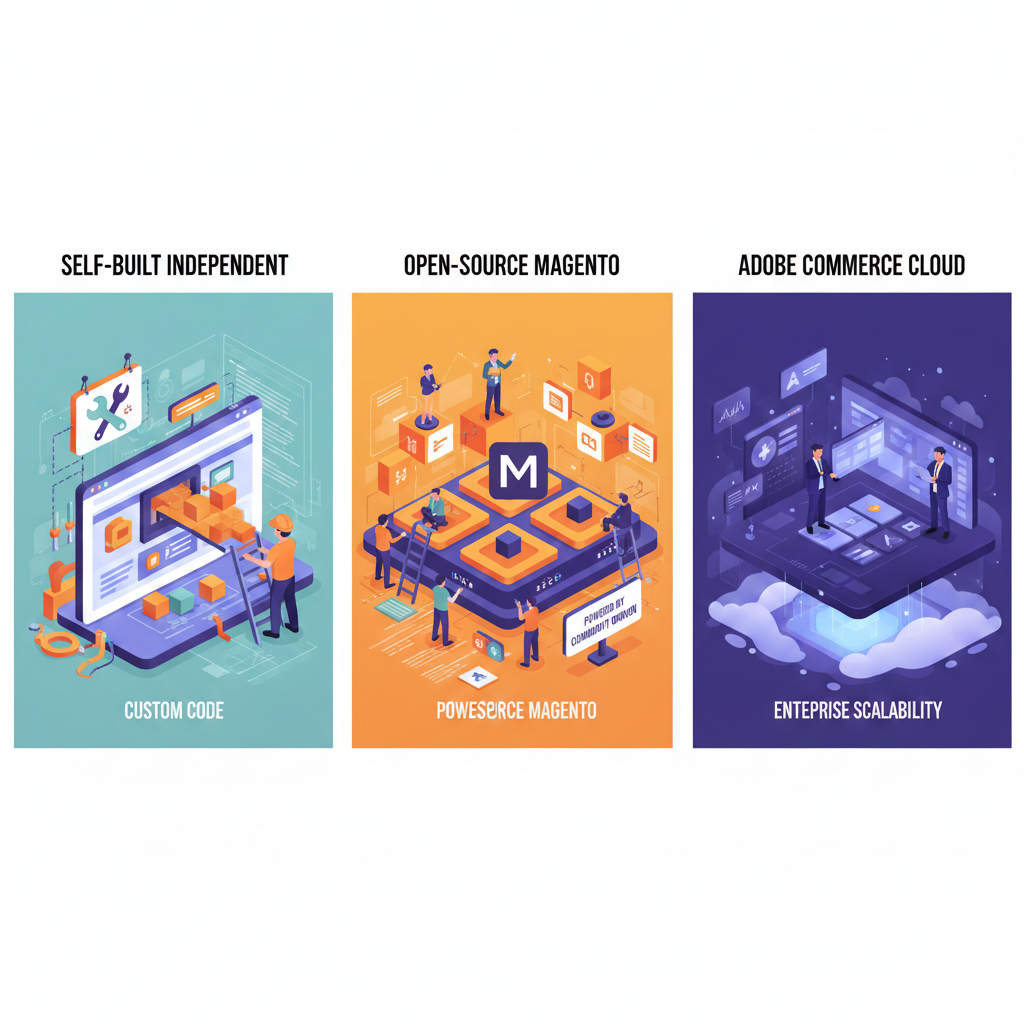
Cross-Border eCommerce Solutions: Custom Site vs Magento vs Adobe Commerce
Adobe Commerce (Magento), e-commerce Platforms
2 April 2026
- The Cross-Border eCommerce Platform Dilemma for Global Brands
- Overview of Three Main Cross-Border eCommerce Platform Models
- Custom-Built Website: Flexible but Execution-Dependent
- Magento Open Source: Powerful but Costly to Operate
- Adobe Commerce Cloud: Enterprise-Grade Platform
- Comprehensive Comparison Across Key Dimensions
- Platform Recommendations by Growth Stage
- Common Mistakes in Platform Selection
- Conclusion: Platform Choice Determines Growth Ceiling
- Further Reading & References
- The Cross-Border eCommerce Platform Dilemma for Global Brands
- Overview of Three Main Cross-Border eCommerce Platform Models
- Custom-Built Website: Flexible but Execution-Dependent
- Magento Open Source: Powerful but Costly to Operate
- Adobe Commerce Cloud: Enterprise-Grade Platform
- Comprehensive Comparison Across Key Dimensions
- Platform Recommendations by Growth Stage
- Common Mistakes in Platform Selection
- Conclusion: Platform Choice Determines Growth Ceiling
- Further Reading & References
1. The Cross-Border eCommerce Platform Dilemma for Global Brands
As more brands move from marketplace-driven sales to global expansion, “independent cross-border eCommerce websites” have become unavoidable.
However, when entering the platform selection phase, companies often face the following questions:
- Is a custom-built website enough?
- Is Magento powerful enough, and is it worth the investment?
- Is Adobe Commerce Cloud too enterprise-focused?
- How big will the gap be between these options in 2–3 years?
The core issue is not technology, but the role eCommerce plays in the company’s global strategy.
2. Overview of Three Main Cross-Border eCommerce Platform Models
Based on real-world practices, solutions can be categorized into three types:
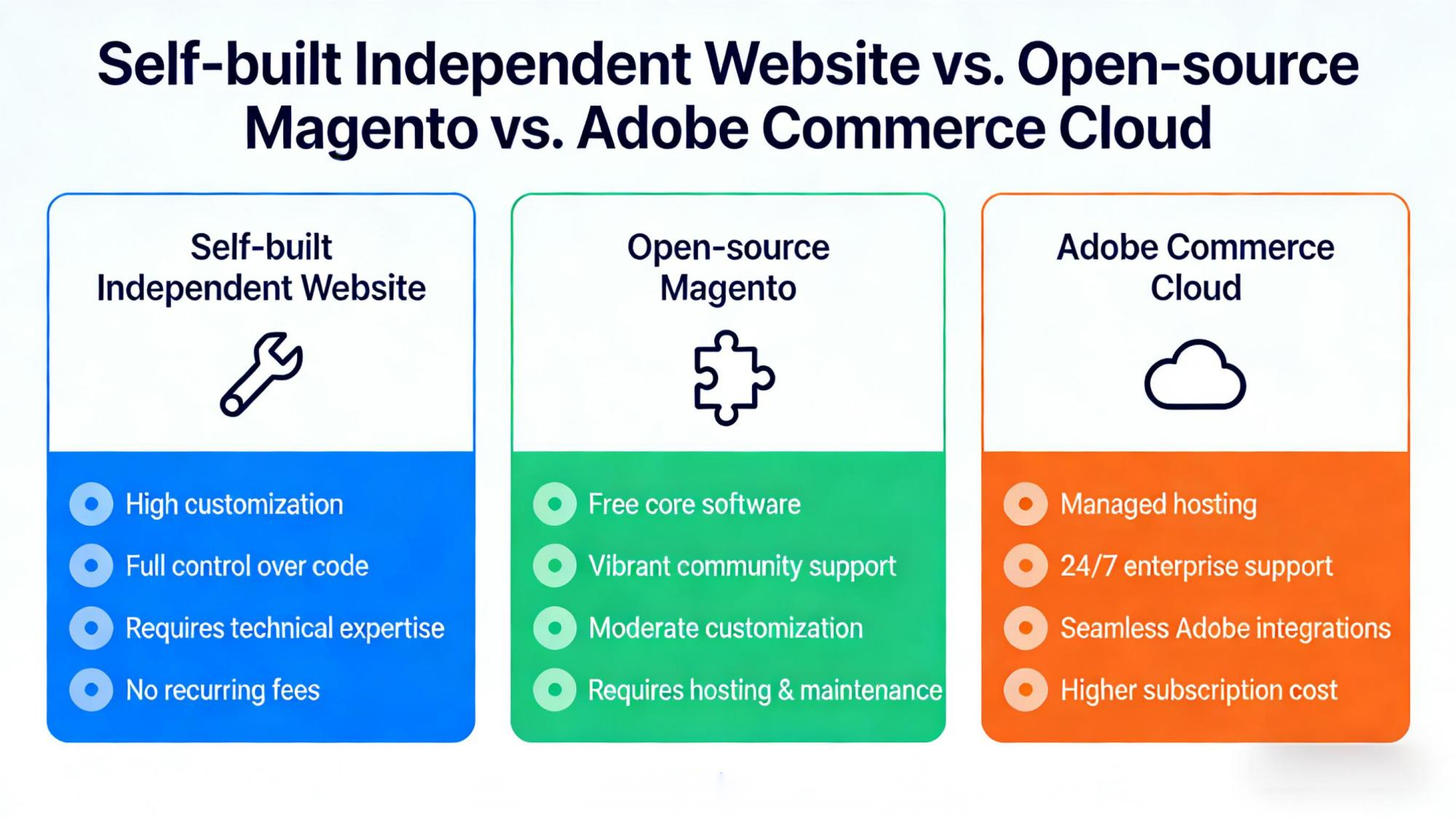
2.1 Custom-Built Website (Lightweight eCommerce Architecture)
Typically based on:
- WordPress + WooCommerce
- Headless frontend + lightweight backend
Key trait: controllable and flexible, but highly dependent on team capability.
2.2 Magento Open Source
Designed for brands with complex products and transaction logic, emphasizing high customization.
2.3 Adobe Commerce Cloud (formerly Magento Commerce)
Built on Magento capabilities with additional features:
- Cloud hosting
- Enterprise-grade security
- Business support and ecosystem integration
A typical enterprise-level cross-border eCommerce platform.
3. Custom-Built Website: Flexible but Execution-Dependent
3.1 Core Advantages

Full brand control
Frontend experience, content, and conversion paths are fully customizable.

Lower initial investment
Ideal for market validation or small-scale operations.

Strong integration with content-driven websites
Suitable for content-first brands.

3.2 Key Limitations
eCommerce capabilities can quickly hit a ceiling.
Common challenges include:
- Difficulty implementing complex promotion rules
- High cost of managing multi-warehouse, tax, and currency setups
- Limited scalability and performance under high traffic
- Strong reliance on technical teams
- System complexity grows rapidly with business expansion
3.3 Best Fit
- Early-stage global brands
- Limited SKU count
- eCommerce is not the core revenue driver
4. Magento Open Source: Powerful but Costly to Operate
4.1 Advantages of Magento Open Source
- Highly extensible functionality
- Multi-language and multi-currency support
- Support for complex product types
- Advanced and customizable pricing and promotion rules
- Mature global ecosystem
- Rich resources of plugins, developers, and solutions
4.2 Real-World Challenges
- High operational and maintenance costs
- Server management and performance optimization requirements
- Security patches and version upgrades
- Risks under high concurrency
- Long-term technical burden
- Without mature architecture and governance, complexity can quickly spiral out of control
4.3 Best Fit
- Complex product and transaction logic
- Strong in-house technical team
- Ability to handle long-term maintenance costs
5. Adobe Commerce Cloud: Enterprise-Grade Platform
Adobe Commerce Cloud builds on Magento to address many real-world enterprise challenges.
5.1 Core Advantages
Cloud hosting and enterprise-grade stability
- Official cloud infrastructure
- Auto-scaling and high availability
- Security and compliance assurance
Enhanced business support
- Official technical support
- Clear product roadmap
- Enterprise-level SLA
Deep integration with Adobe ecosystem
- Seamless integration with AEM Sites for content + commerce
- Supports personalization, analytics, and experience optimization
- Ideal for brand-level and enterprise-level global commerce
5.2 Key Differences from Magento Open Source
| Dimension | Magento Open Source | Adobe Commerce Cloud |
|---|---|---|
| Deployment & Operations | Self-managed | Adobe-managed cloud |
| Security & Compliance | Self-maintained | Built-in enterprise-grade |
| Business Support | Community-driven | Official support |
| Scalability & Ecosystem | Strong | More stable and predictable |
5.3 Best Fit
- eCommerce as a core growth engine
- Multi-country and multi-market operations
- High requirements for stability, security, and experience
6. Comprehensive Comparison Across Key Dimensions
| Dimension | Custom Site | Magento Open Source | Adobe Commerce Cloud |
|---|---|---|---|
| Initial Cost | Low | Medium | High |
| Long-Term Scalability | Medium | High | Very High |
| Operational Complexity | Medium | High | Low |
| Enterprise Capability | Weak | Medium | Strong |
| Multi-country Support | Limited | Strong | Strong |
| Brand & Experience | High | High | Very High |
7. Platform Recommendations by Growth Stage
Stage 1: Market Entry
- Goal: Market validation
- Recommendation: Custom-built website
Stage 2: Scaling
- Goal: Improve transaction complexity and efficiency
- Recommendation: Magento Open Source or upgrade planning
Stage 3: Branding & Global Operations
- Goal: Sustainable long-term growth
- Recommendation: Adobe Commerce Cloud + enterprise CMS
8. Common Mistakes in Platform Selection
- Focusing only on initial cost while ignoring long-term technical debt
- Using lightweight solutions for core eCommerce operations
- Overestimating internal maintenance and governance capabilities
- Ignoring the importance of content, experience, and commerce integration
9. Conclusion: Platform Choice Determines Growth Ceiling
There is no one-size-fits-all answer for cross-border eCommerce platforms.
The right choice should be based on:
- Company size and growth pace
- The role of eCommerce in the overall global strategy
- Requirements for stability, experience, and scalability
For mid-to-large global brands, platform selection is not just a cost issue—it defines the upper limit of growth.
Final Thoughts: From “Selling” to “Sustainable Growth”
If you are evaluating:
- Whether to upgrade from a lightweight site
- Whether to move from Magento Open Source to enterprise solutions
- How to integrate content, brand, and commerce experience
Now is the critical time to systematically assess your cross-border eCommerce architecture.
We welcome you to contact us to explore whether Adobe Commerce Cloud fits your global strategy.
Contact Us: Talk to our consultants about your platform strategy
Product Page: Learn more about Adobe Commerce Cloud and enterprise eCommerce solutions
Further Reading & References
Further Reading
- Build vs Platform: A Complete Comparison for Global Website Strategy
- Key Elements of International Website Development: From Architecture to Content Strategy
- What is AEM as a Cloud Service? A Key Step Toward Cloud-Based Content Platforms
References
Related Articles
Enterprise AI MarTech Trends Analysis 2024-2029 Outlook Report
From AI content productivity tools to a core engine for revenue growth and marketing transformation
*The PDF will be sent directly to your inbox.
Email Error
Please enter a valid email address.
Thank You!
The whitepaper has been sent to your inbox. If you don’t see it, please check your spam or promotions folder.