

Choosing an Adobe Commerce (Magento) Partner: Experience, Scalability & Solutions
Adobe Commerce (Magento), e-commerce Platforms
20 April 2026
- Why Choosing the Wrong Partner Is More Dangerous Than Choosing the Wrong Platform
- The Complexity of Adobe Commerce (Magento) Implementation
- Partner Consideration #1: Implementation Experience and Depth of Platform Understanding
- Partner Consideration #2: Architecture Design and Scalability
- Partner Consideration #3: Industry Knowledge and Solution Capabilities
- Partner Consideration #4: Integration Capabilities with the Adobe Ecosystem
- Partner Consideration #5: Globalization and Multi-Market Implementation Experience
- Common Pitfalls in Choosing an Adobe Commerce (Magento) Partner
- How to Build a Scientific Partner Evaluation Framework
- Conclusion: The Right Partner Determines the Growth Ceiling of E-commerce
- Why Choosing the Wrong Partner Is More Dangerous Than Choosing the Wrong Platform
- The Complexity of Adobe Commerce (Magento) Implementation
- Partner Consideration #1: Implementation Experience and Depth of Platform Understanding
- Partner Consideration #2: Architecture Design and Scalability
- Partner Consideration #3: Industry Knowledge and Solution Capabilities
- Partner Consideration #4: Integration Capabilities with the Adobe Ecosystem
- Partner Consideration #5: Globalization and Multi-Market Implementation Experience
- Common Pitfalls in Choosing an Adobe Commerce (Magento) Partner
- How to Build a Scientific Partner Evaluation Framework
- Conclusion: The Right Partner Determines the Growth Ceiling of E-commerce
1. Why Choosing the Wrong Partner Is More Dangerous Than Choosing the Wrong Platform
In enterprise e-commerce platform projects, the platform matters — but the implementation partner is what truly determines success or failure.
Adobe Commerce (Magento) comes with powerful features and extensibility. However, if:
-
Architecture design is poor
-
Extension module management is chaotic
-
Data and content are not integrated
-
Project governance is weak
…even the right platform will fail to deliver value.
Therefore, when evaluating Adobe Commerce (Magento) projects, enterprises must place “partner capabilities” at the core of their assessment.
2. The Complexity of Adobe Commerce (Magento) Implementation
Unlike lightweight e-commerce platforms, Adobe Commerce (Magento) is best suited for:
-
Large-scale SKU catalogs
-
Multi-country, multi-currency, multi-warehouse operations
-
Complex pricing and promotion rules
-
Deep integration with ERP, CRM, CMS, CDP, and other systems
This means the project is not merely “building a website” — it is architecting an enterprise-grade e-commerce platform.
As a result, partners must possess system-level capabilities, not just development skills.
3. Adobe Commerce (Magento) Partner Consideration #1: Implementation Experience & Platform Expertise

3.1 Does the Partner Have Real Adobe Commerce (Magento) Project Experience?
Key areas to evaluate:
Experience with Mid-to-Large Scale Projects
Project scale and complexity determine the depth of the team's capabilities.
Experience with Complex Business Scenarios
B2B quoting, multi-store, multi-currency, and other complex scenario experience.
Cross-System Integration Experience
Integration capabilities with enterprise systems such as ERP, CRM, and DAM.
Having only “website development experience” does not equate to e-commerce implementation capability.
3.2 Understanding of Platform Capability Boundaries
Mature partners should be able to clearly explain:
-
The boundary between native features and custom development
-
Which requirements are best met through extensions
-
Which design decisions will impact future upgrades
Lack of deep platform understanding easily leads to technical debt.
4. Adobe Commerce (Magento) Partner Consideration #2: Architecture Design & Scalability
The strength of Adobe Commerce (Magento) lies in its extensibility — but this also means architecture design is critical.
4.1 Modular Architecture & Extension Governance
Including extension and plugin governance, interface standards for third-party systems, version upgrade compatibility, and long-term maintenance sustainability.
4.2 Headless / API-Driven Experience
Common requirements include integration with AEM and other CMS platforms, multi-frontend experience support, cross-channel product data access, and Headless / API-driven architecture design. If the project involves AEM and Adobe Commerce (Magento) integration, partners should also be evaluated on their familiarity with Adobe's currently recommended Edge Delivery Services + Adobe Commerce (Magento) Storefront architecture, as well as maintenance and migration strategies for existing CIF architectures.
5. Adobe Commerce (Magento) Partner Consideration #3: Industry Understanding & Solution Capabilities
Different industries have vastly different e-commerce needs.
For example:
-
B2B companies emphasize custom quoting and account hierarchies
-
D2C brands prioritize user experience and personalization
-
Manufacturers may focus more on channel and distribution management
Mature partners should possess:
-
Industry scenario understanding
-
Proven case experience
-
Reusable solution frameworks
-
Business process understanding
— not just technical implementation skills.
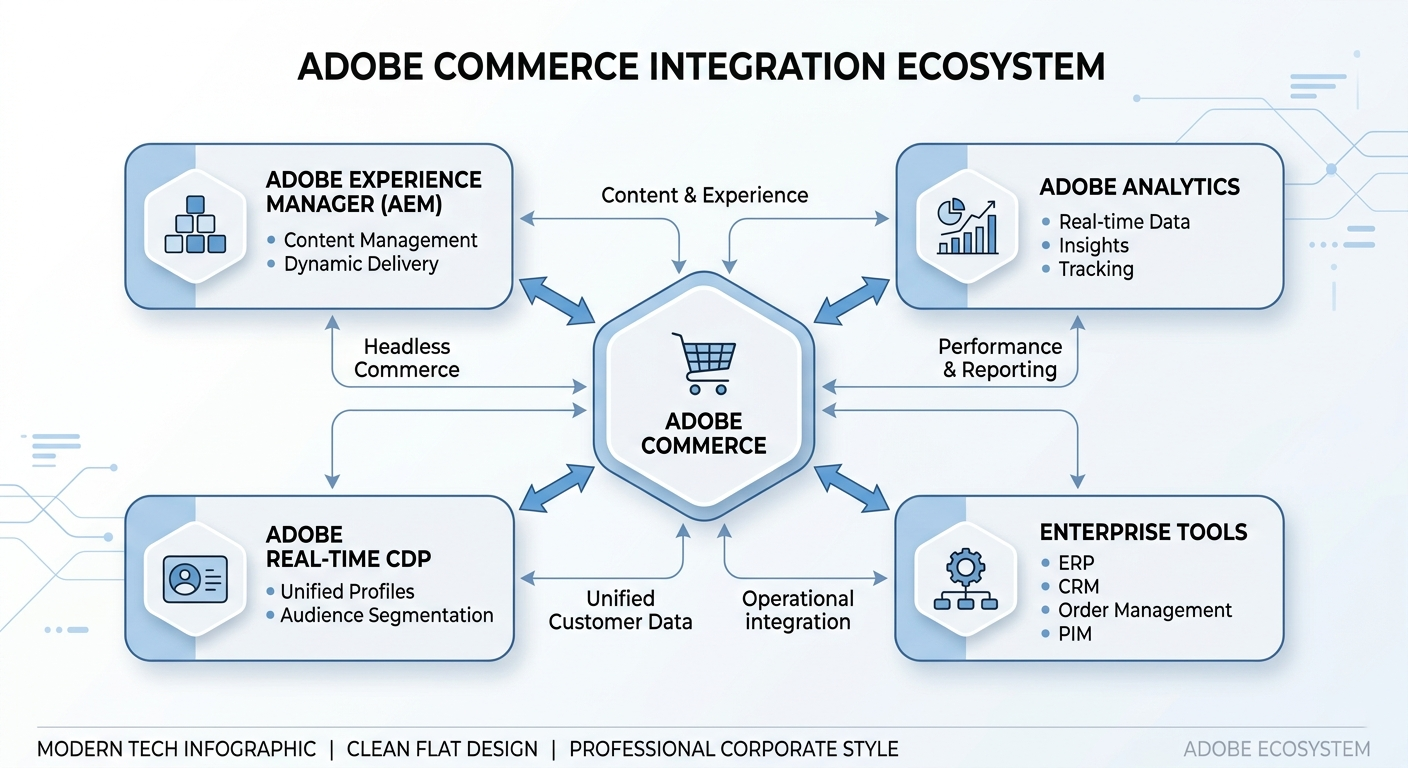
6. Adobe Commerce (Magento) Partner Consideration #4: Adobe Ecosystem Integration
The value of Adobe Commerce (Magento) lies in its ecosystem integration capabilities.
Key questions include:
-
Can it integrate content and commerce experiences with AEM?
-
Can it achieve deep integration with Adobe Analytics?
-
Does the partner have CDP and marketing automation integration experience?
Truly mature partners should be able to design the overall architecture of “commerce + content + data” — not deploy the commerce system in isolation.
7. Adobe Commerce (Magento) Partner Consideration #5: Globalization & Multi-Market Experience
For brands expanding internationally, key evaluation areas include:
-
Multi-language and multi-currency implementation experience
-
International payment and tax integration capabilities
-
Understanding of different countries’ compliance requirements
Teams without globalization experience often underestimate implementation complexity.
8. Common Pitfalls in Adobe Commerce (Magento) Partner Selection
-
Focusing only on price, not architectural capabilities
-
Treating a development team as a strategic partner
-
Ignoring long-term upgrade and maintenance costs
-
Failing to evaluate cross-system integration experience
-
Over-customizing and ignoring native platform capabilities
These pitfalls create ongoing costs in later stages of the project.
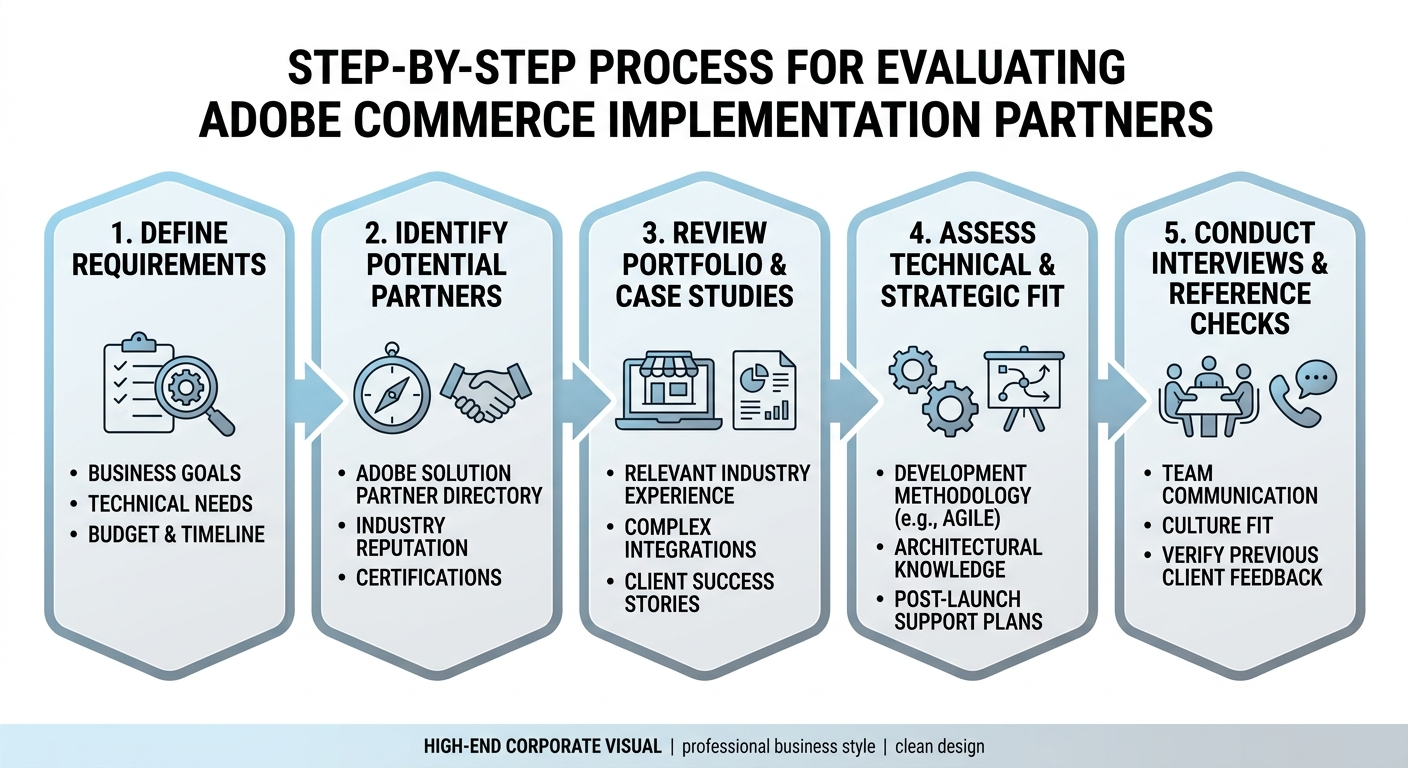
9. How to Build a Scientific Partner Evaluation Framework
It is recommended to establish an evaluation model based on the following dimensions:
-
Platform certifications and official partnership levels
-
Industry cases and complex project experience
-
Architecture design capability demonstrations
-
Data and ecosystem integration capabilities
-
Long-term service and support capabilities
Through structured evaluation, avoid single-dimensional judgment.
10. Conclusion: Your Partner Sets the Ceiling for Your E-Commerce Growth
Adobe Commerce (Magento) is a powerful enterprise-grade e-commerce platform — but the extent to which its value is realized depends on the capability boundaries of your partner.
A partner truly worth choosing should possess:
-
Deep platform understanding
-
Architecture and scalability capabilities
-
Industry solution experience
-
Ecosystem integration capabilities
-
A long-term commitment to your success
Choosing the right partner is essentially choosing the growth ceiling for your e-commerce business over the next 3–5 years.
Closing: From “System Launch” to “Long-Term Growth Architecture”
If you are evaluating:
-
Adobe Commerce (Magento) implementation plans
-
Enterprise e-commerce platform upgrades
-
Integration of e-commerce, website, and data systems
then now is the critical moment to systematically evaluate partner capabilities.
Contact Us: Discuss your Adobe Commerce (Magento) plans with our consulting team
Product Page: Learn more about Adobe Commerce (Magento) and enterprise e-commerce platform solutions
Related Articles

Enterprise AI MarTech Trends Analysis 2024-2029 Outlook Report
From AI content productivity tools to a core engine for revenue growth and marketing transformation
*The PDF will be sent directly to your inbox.
Email Error
Please enter a valid email address.
Thank You!
The whitepaper has been sent to your inbox. If you don’t see it, please check your spam or promotions folder.