
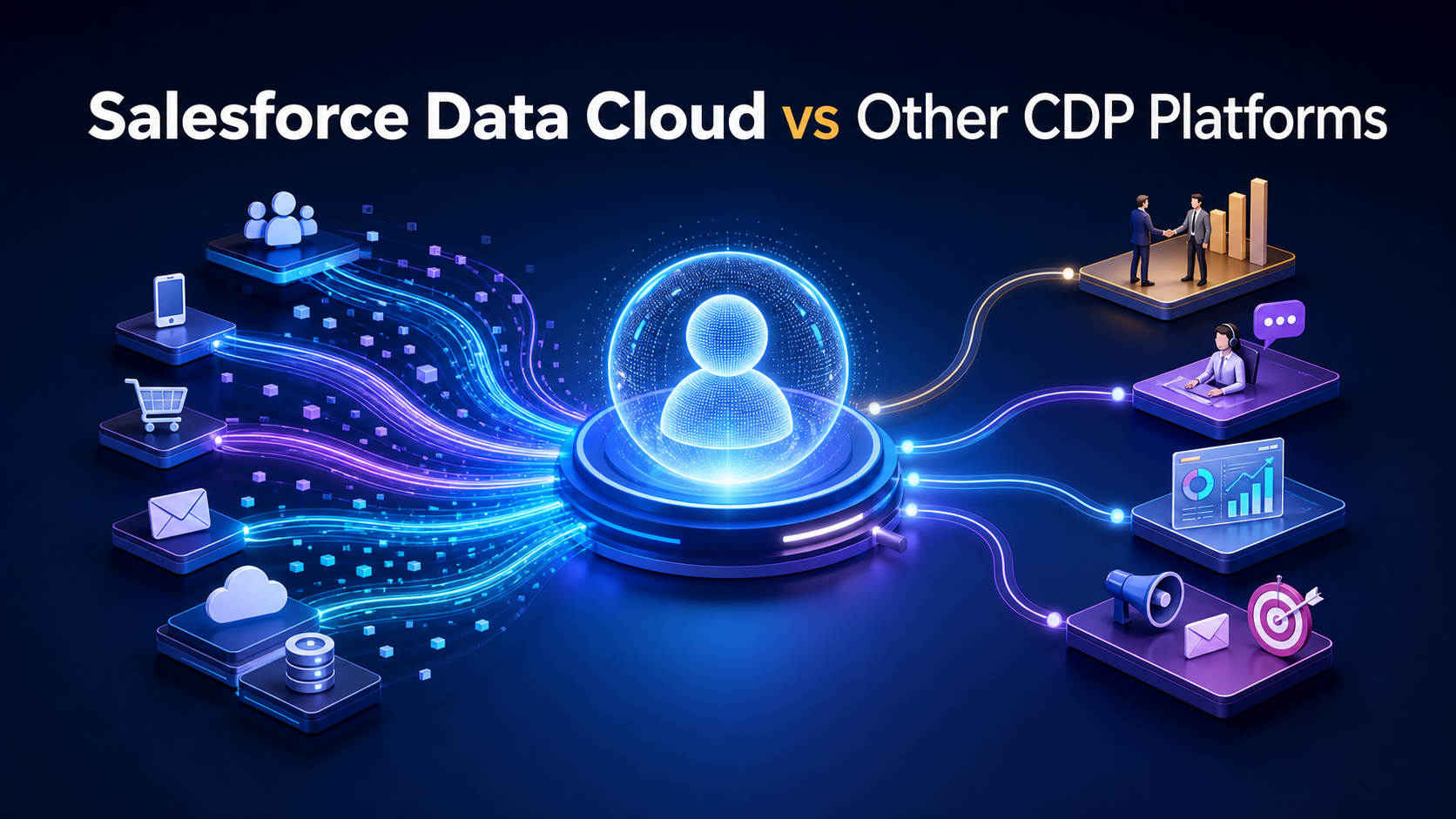
When choosing a customer data platform, companies are often swayed by feature lists, connector counts, and promises of “real time,” while overlooking their existing CRM, data warehouse, marketing tools, and team capabilities. This article compares the approaches of Salesforce Data Cloud and other CDP platforms and provides a practical framework for selection and evaluation.
1. Key Takeaways
- Salesforce Data Cloud is well suited to companies that already use Salesforce as the core of their sales, service, or marketing operations and want to bring unified customer data directly into frontline workflows.
- Adobe Real-Time CDP is more closely aligned with audience management and cross-channel activation across Adobe Experience Cloud, while event-driven CDPs are generally better suited to teams that prioritize flexible data collection and developer workflows.
- CDP selection should go beyond feature comparisons to assess identity resolution, data architecture, activation goals, privacy governance, usage costs, and internal operating capabilities.
- The most practical approach is to run a proof of concept for one high-value use case, then use data match rates, audience activation time, and business adoption to decide whether to scale.
2. Before Choosing a CDP, Define the Problem
A customer data platform (CDP) organizes website behavior, CRM data, transactions, customer service records, and other first-party data into customer views that can be analyzed and activated. A CDP is not simply a place to “put all the data together.” Its real value comes from identity resolution, audience creation, permission governance, and the ability to send results back to sales, service, or marketing channels.
Companies should first document their three most important use cases, such as identifying anonymous visitors and known customers, reducing duplicate leads, building high-value audiences, or helping service teams understand a customer’s recent purchases and complaints. Without clear use cases, even a comprehensive platform can become an expensive data storage layer.
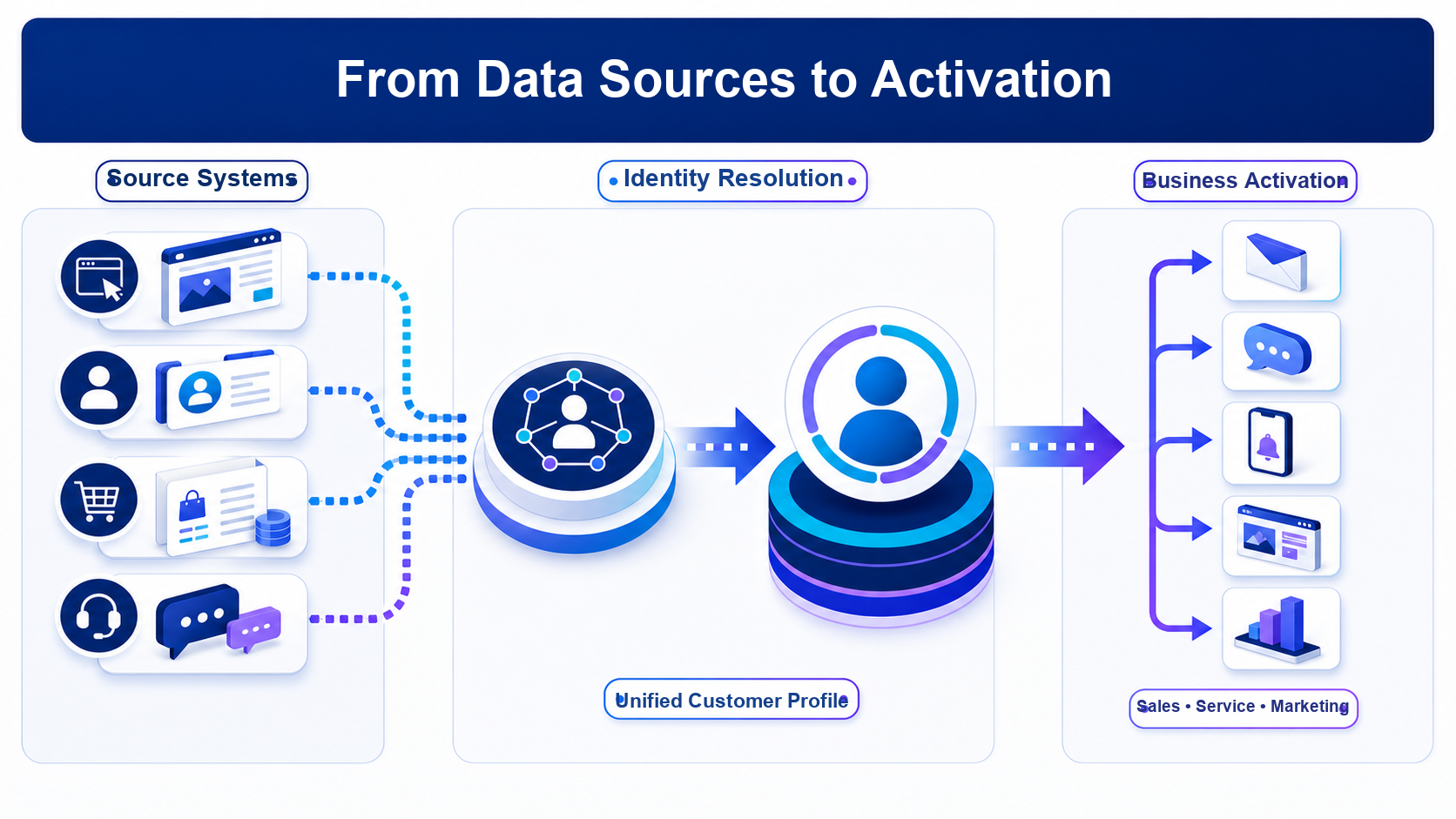
Figure: A CDP uses identity resolution to unify website, CRM, transaction, and service data into a single view, then activates it across business channels.
3. Salesforce Data Cloud: Core Positioning and Strengths
Salesforce renamed Data Cloud to Data 360 in October 2025; this article retains the Data Cloud name used in the source title. A clear advantage of Salesforce Data Cloud is that unified data can remain close to Salesforce CRM workflows. Companies can map disconnected sources to a data model, use identity resolution to create unified individual or account views, and then use audiences and calculated insights to support sales, service, and marketing. Salesforce documentation also emphasizes that a unified view is a reference that links source records; it does not overwrite each source system as a single “golden record.” This distinction is important for data governance.
For companies with a large base of Salesforce users, frontline teams do not have to switch to another analytics tool to see customer context. This often makes it easier to bring data into follow-up, service, and automation workflows. Data Cloud also supports zero-copy connection patterns, allowing some data warehouse information to be used without duplicating data movement. However, supported scope, query patterns, latency, and costs must still be verified for each source.
Data ingestion, identity resolution, segmentation, and other processing may also consume usage capacity or credits. Platform evaluation should therefore go beyond license names and build a cost model based on expected data volumes, update frequency, number of rules, and activation methods.
4. How Does Salesforce Data Cloud Differ from Other CDP Platforms?
1. Salesforce Data Cloud: Prioritizing CRM and Frontline Workflows
Best for organizations bringing unified data into Salesforce sales, service, and automation. Assess ecosystem fit, data model alignment, and frontline adoption.

2. Adobe Real-Time CDP: Prioritizing Experiences and Cross-Channel Activation
Built on Adobe Experience Platform, it suits organizations using Experience Cloud for audience activation. Verify destinations, batch or streaming support, and licensing.

3. Event-Driven or Composable CDP: Prioritizing Data Engineering Flexibility
Event-driven platforms such as Twilio Segment prioritize flexible event collection and routing. They suit mature data teams but require stronger internal governance.
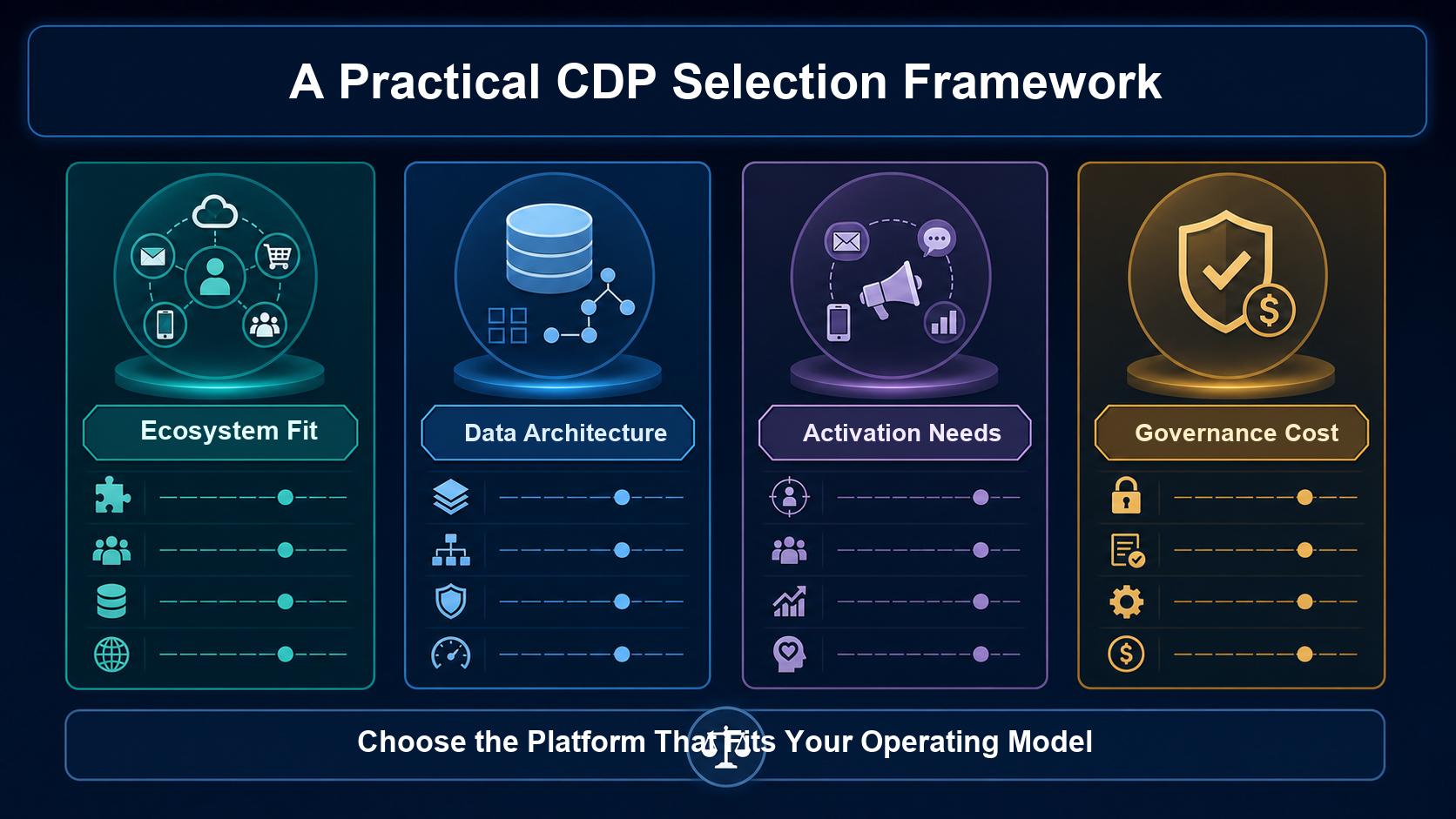
Figure: Replace simple feature comparisons with an assessment of ecosystem fit, data architecture, activation needs, and governance costs.
5. Business Scenario: From Disconnected Lists to an Actionable Customer View
Consider an industrial equipment exporter that uses Salesforce to manage opportunities, runs its website on a separate CMS, and stores trade show lists, after-sales records, and ERP orders in different systems. The marketing team can see who downloaded a white paper but may not know whether that person is already associated with an opportunity. Sales may also be unaware that a customer has repeatedly viewed maintenance content.
The company could start with one use case: match website interactions, CRM contacts, and order data using consented email addresses, customer IDs, or account relationships; build an audience of customers who have shown recent purchase signals but have not yet been contacted; and send that audience back to CRM for sales review. This is a proof of concept, so the company should not connect every data source at the outset.
Metrics should include source data success rates, identity match rates, duplicate data rates, time required to build an audience, audience delivery success rates, sales adoption, and the time from the appearance of a signal to the first follow-up. Conversion rate can be a long-term metric, but market conditions, sales cycles, and campaign differences must also be considered.
6. 7 Steps for Selecting and Implementing a CDP Platform
Step 1
Define one to three measurable, high-value use cases. Clearly document the users, trigger conditions, required data, and expected actions.
Step 2
Inventory data sources, owners, update frequency, identifiers, consent status, and data retention requirements.
Step 3
Design identity resolution rules. Separate deterministic from probabilistic matching, and test the risks of mismatches and excessive profile merging.
Step 4
Compare the existing ecosystem: determine whether the CRM, data warehouse, CMS, analytics, marketing automation, and advertising destinations offer maintainable integrations.
Step 5
Run a proof of concept with real but protected samples to validate data latency, match quality, activation workflows, and permissions.
Step 6
Build a three-year cost model that includes licensing, usage, connectors, storage, consulting and implementation, maintenance, and internal staffing.
Step 7
Define operating responsibilities: who approves new data, maintains rules, handles deletion requests, monitors failed jobs, and reviews performance.
7. How Should You Measure CDP Implementation Success?
CDP performance should be measured at three levels. At the data level, track completeness, match rates, duplicate rates, and update latency. At the operational level, track the time required to build audiences, the number of manual exports, activation success rates, and issue resolution time. At the business level, measure lead response time, opportunity conversion, retention, or campaign lift. Establish a pre-implementation baseline first so improvements can be attributed to the CDP rather than concurrent campaigns or market changes.
8. Frequently Asked Questions (FAQ)
Is Salesforce Data Cloud Right for Every Company?
No. If Salesforce is not central or the use case is unclear, another CDP or an existing data warehouse may be a better fit.
How Is Salesforce Data Cloud Different from a CRM?
CRM manages customer relationships and sales or service workflows. Data Cloud unifies and activates cross-system customer data; the two are complementary.
Does Data Cloud Zero-Copy Mean There Are No Data Costs?
No. Zero-copy can reduce duplication, but processing, identity resolution, segmentation, activation, and architecture may still generate costs.
How Should You Choose Between Adobe Real-Time CDP and Salesforce Data Cloud?
Choose based on your operating ecosystem and priority use case, then compare both platforms through a proof of concept using the same data and metrics.
What Is the Most Important Preparation Before Implementing a CDP?
Start with a data and identity inventory covering ownership, identifiers, consent, and activation-ready fields. This prevents governance issues from blocking implementation.
9. Conclusion
There is no single winner in a comparison of Salesforce Data Cloud and other CDP platforms. The right platform should fit the company’s existing ecosystem, data architecture, activation goals, and operating capabilities while remaining sustainable in terms of cost and governance. Companies can start with one high-value use case, establish a data baseline, and run a proof of concept before deciding how broadly to scale.
If you need help planning identity resolution, CDP architecture, and an implementation roadmap, learn more about LeadsTech’s Customer Data Platform (CDP) services or contact LeadsTech for a consultant-led assessment.


10. Further Reading
- CRM vs CDP: How Should Companies Choose a Customer Data Platform?
Learn more about the distinct roles of CRM and CDP. - What Is a Customer Data Platform (CDP)? Value and Applications
Understand the core capabilities and business value of a CDP. - Salesforce Sales Cloud: A Complete Guide to CRM Sales Management
Explore Salesforce sales processes and CRM applications.
Related Articles
Enterprise AI MarTech Trends Analysis 2024-2029 Outlook Report
From AI content productivity tools to a core engine for revenue growth and marketing transformation
*The PDF will be sent directly to your inbox.