
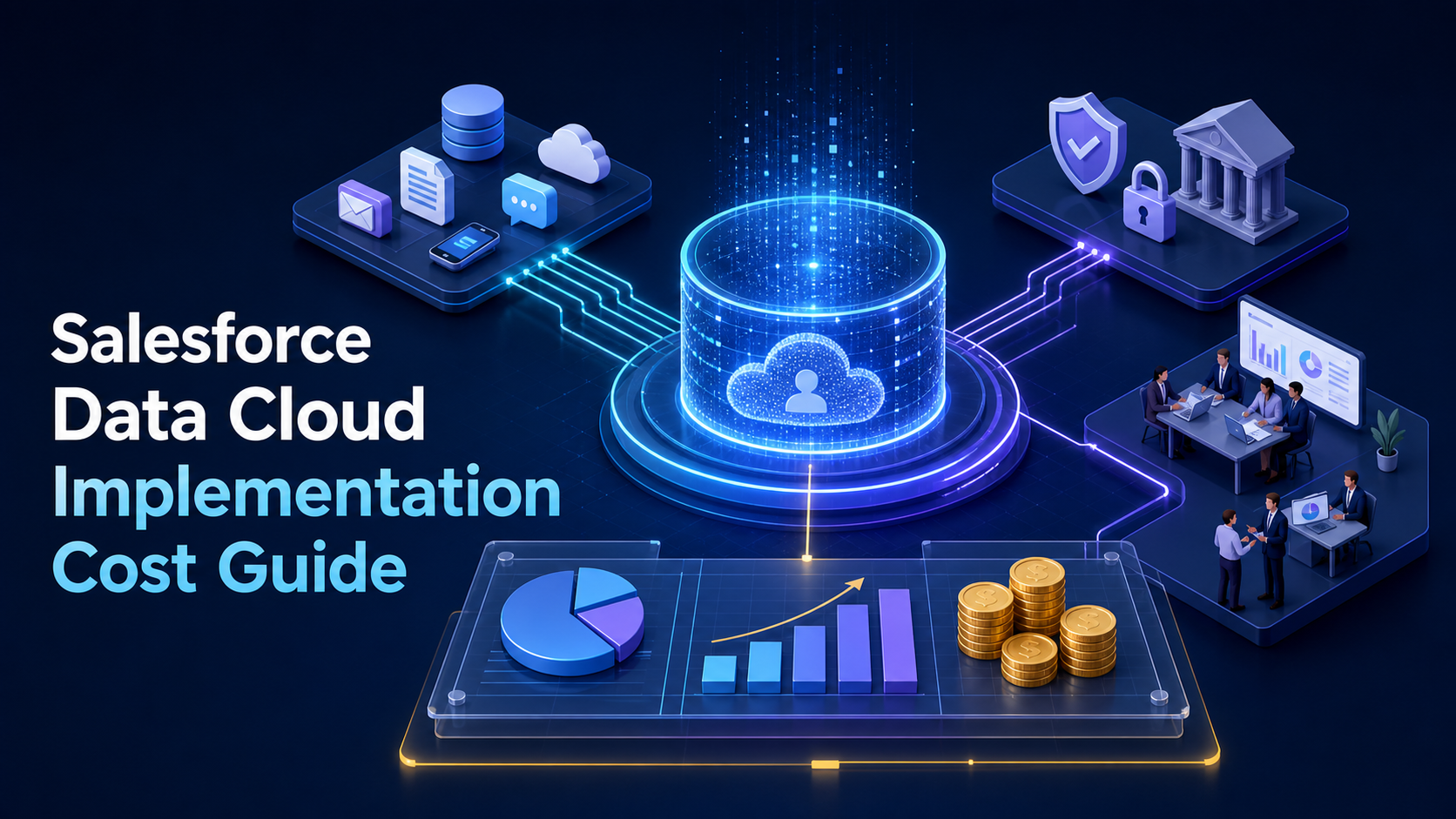
When evaluating Salesforce Data Cloud, the question leaders ask most often is, “How much should we budget?” Platform fees are only one part of the answer. Data volume, identity resolution, integration complexity, activation frequency, and ongoing operations all affect total cost. This guide provides a practical budgeting framework to help decision-makers understand the investment, risks, and expected returns before making a purchase.
1. Key Takeaways
- Salesforce Data Cloud is now called Data 360. Your implementation budget should include platform licensing or usage, data integration, implementation services, internal resources, and ongoing optimization.
- As of July 2026, Salesforce’s public pricing includes options such as Flex Credits and profile-based pricing. Actual contracts, regional pricing, discounts, and feature bundles must still be confirmed with the vendor.
- Data processing volume and frequency, identity resolution rules, streaming requirements, and activation channels often affect costs more than the number of connected data sources alone.
- The safest approach is to validate one high-value use case through a proof of concept, measure credit consumption, data match rates, and business adoption, and then build a three-year total cost of ownership model.
2. What Does a Salesforce Data Cloud Implementation Cost Include?
A complete budget has five parts. First, platform costs include the SKU, profiles, or consumption credits. Second, data work covers source connections, modeling, cleansing, and identity resolution. Third, usage is generated by segmentation, calculated insights, queries, activation, and real-time processing. Fourth, implementation services include solution design, development, testing, training, and go-live support. Fifth, post-launch operations include monitoring, governance, and optimization.
Data Cloud should not be treated as a one-time IT project. Data sources change, identity rules need adjustment, and business teams add new audiences and channels. A budget that covers only the initial launch can significantly underestimate second-year operating costs.
3. How Should You Interpret Salesforce Data 360 List Pricing?
Salesforce has been transitioning the Data Cloud brand to Data 360. As of July 2026, its public pricing page lists several models, including $500 per 100,000 Flex Credits, $240 per year for every 1,000 Profiles, and $420 per year for every 1,000 Enterprise Profiles. These figures are useful for setting an initial benchmark, but they do not represent a final enterprise quote.
First determine whether your org uses Flex Credits, earlier Data Services credits, or profile-based pricing. Usage rules may vary by purchase or renewal date, contract entitlements, and feature bundle. Digital Wallet can help monitor actual consumption, and your budget model should also account for growth and peak usage.
4. Six Key Factors That Affect Salesforce Data Cloud Costs
Data Scale
Source records, event volume, profile count, and historical retention period.
Data Complexity
Field mapping, format cleansing, cross-system primary keys, and data quality.
Identity Resolution
Active rulesets, records processed, and update frequency; multiple rulesets may increase consumption.
Processing Speed
Daily batch, streaming, and sub-second real-time processing require different architectures and usage levels.
Activation Scope
Audience creation, downstream destinations, queries, calculated insights, and automation frequency.
Governance and Operations
Permissions, consent management, data spaces, monitoring, incident response, and continuous optimization.
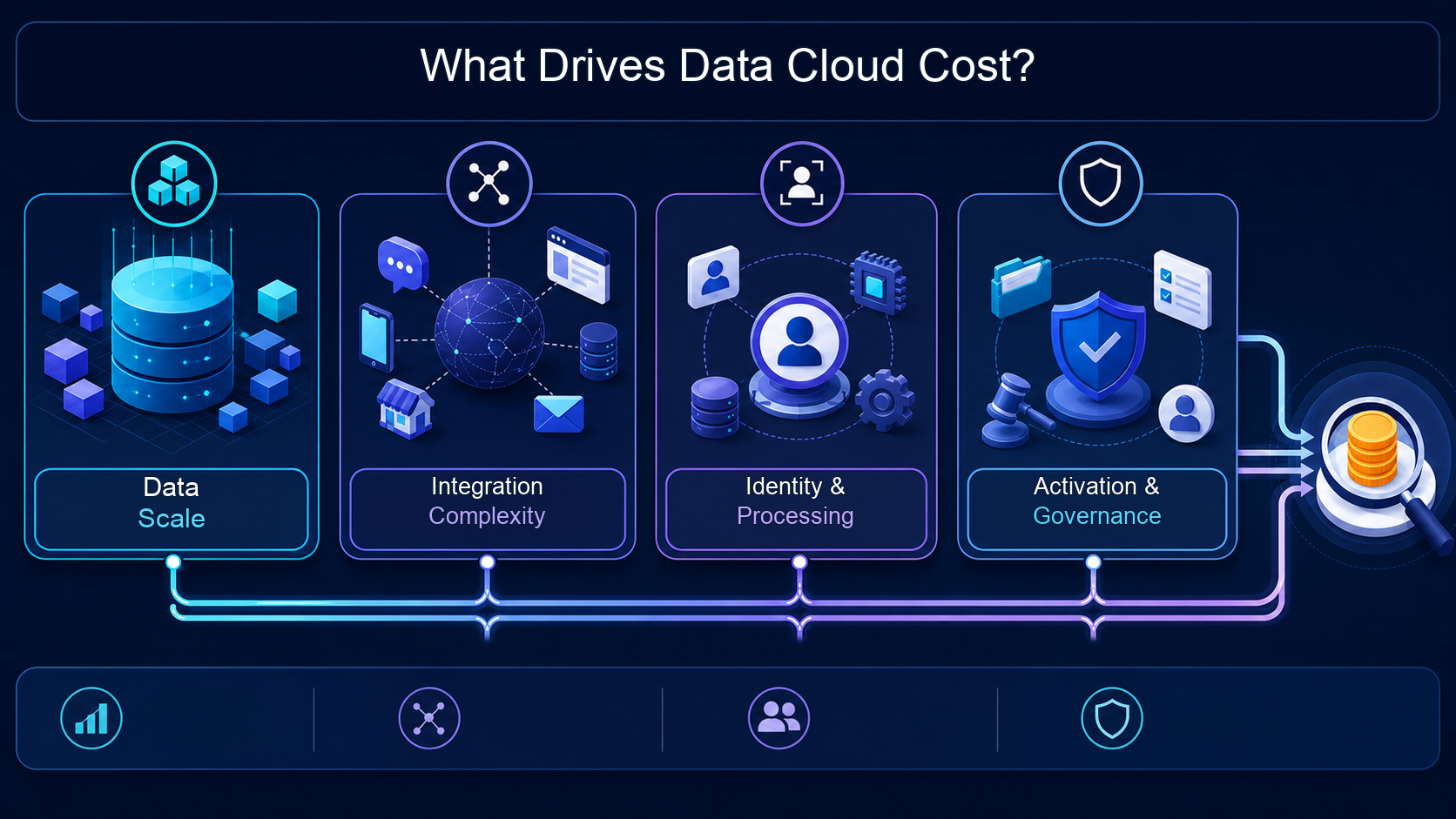
Figure: Combine data volume, integration, identity resolution, processing frequency, activation, and governance in one cost model.
5. Enterprise Scenario: Why Can Budgets for the Same Platform Vary So Widely?
Consider two B2B companies, each with 500,000 CRM contacts. Company A only needs a daily integration between its CRM and ERP to build one high-value audience for sales follow-up. Company B needs to ingest streaming events from its website and app, unify anonymous and known identities, and then sync data to multiple advertising, email, and customer service channels. Even with similar profile counts, Company B has higher data processing frequency, more integrations, and greater operating requirements.
Company A can begin by measuring data synchronization success, identity match rates, audience build time, and sales adoption. Company B must also track consumption per million events, streaming latency, destination delivery rates, and peak usage. Cost estimates should reflect real use cases rather than simply multiplying the number of CRM contacts by a unit price.
6. How Can You Control Data Cloud Implementation Costs in Four Phases?
Readiness Assessment
Inventory data sources, identifiers, consent status, use cases, and the existing Salesforce architecture.
Proof of Concept
Choose one measurable use case and use a controlled data sample to validate integration, identity resolution, audiences, and actual credit consumption.
Production Launch
Add security, monitoring, error handling, data retention, and user training, then expand to additional channels in phases.
Continuous Optimization
Use Digital Wallet and business metrics to identify low-value processes, idle rulesets, overly frequent updates, and unnecessary queries.
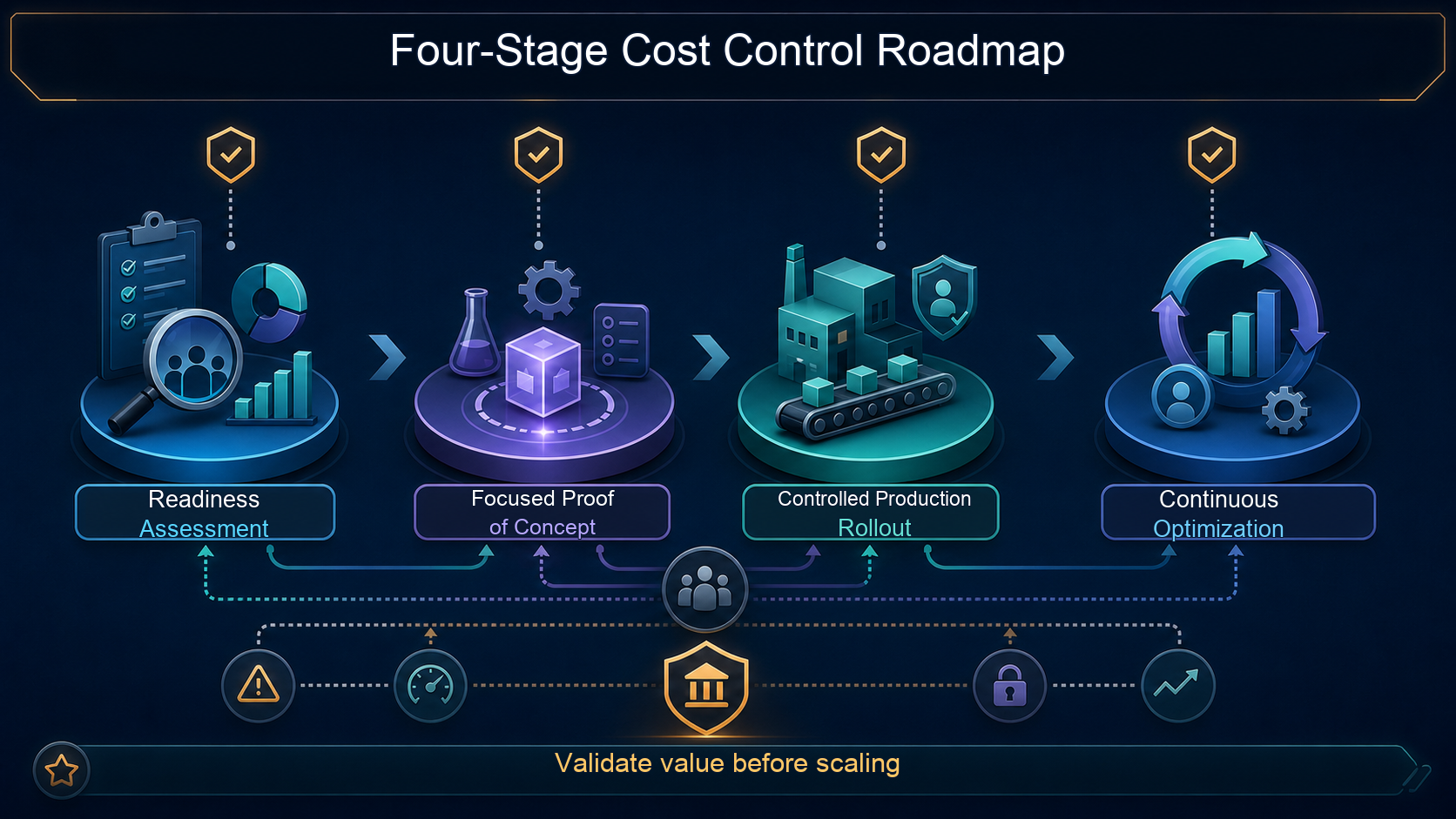
Figure: Control costs and risks through four phases: assessment, proof of concept, production launch, and continuous optimization.
7. Build a Three-Year TCO and ROI Model
Total cost of ownership (TCO) should be broken down by year and include platform fees and credits, storage and add-on features, implementation services, internal resources, training, maintenance, and a risk contingency. The first year is usually weighted toward design and integration. For years two and three, account for growth in data and use cases rather than simply copying the first-year figures.
ROI should be defined with more precision than “better personalization.” Set verifiable metrics, such as reducing audience creation from several days to a specific number of hours, lowering manual export frequency, reducing duplicate Lead rates, improving first-response time for sales, increasing campaign reach rates, and generating incremental opportunities. Establish a pre-implementation baseline and separate the platform’s impact from concurrent marketing activities.
8. Pre-Implementation Data Cloud Checklist
- Have you selected one to three use cases with accountable owners and measurable KPIs?
- Do you know the record count, daily increment, event volume, and retention period for each source?
- Have you defined identity matching rules and acceptable mismatch and unmatched rates?
- Have you confirmed whether batch, streaming, or real-time processing is required?
- Have you obtained the applicable contract’s SKU, rate card, credit allowances, and overage fees?
- Does the budget include consulting services, internal resources, testing, governance, and second-year operations?
- Have you defined stop criteria and expansion thresholds for the proof of concept?
9. Frequently Asked Questions (FAQ)
Is There a Fixed Price for a Salesforce Data Cloud Implementation?
No. The platform may be priced through credits, profiles, or other models. Final costs also depend on data volume, features, processing frequency, contract terms, and implementation scope. Use Salesforce’s official calculators and a formal quote to validate your estimate.
Does Data 360 List Pricing Represent the Full Project Budget?
No. Published prices do not include every additional credit, add-on feature, integration, consulting service, or internal operating cost. They are only an initial reference point for the platform budget.
Can Zero Copy Significantly Reduce Every Cost?
Not necessarily. Zero Copy can reduce some data replication and pipeline work, but data access, queries, unification, segmentation, and activation may still generate usage. You must also evaluate source support, latency, governance, and maintenance.
How Long Should a Proof of Concept Run, and How Much Data Should It Include?
The goal is to validate one real use case, not connect every data source. The scope should be large enough to test data quality, identity resolution, usage, and business workflows. The timeline will depend on source readiness and security approvals.
How Can You Prevent Credit Overruns After Data Cloud Goes Live?
Establish usage baselines, alerts, and regular reviews. Remove unnecessary rulesets, reduce update frequency when there is no business need, control query and activation scope, and track Digital Wallet consumption by business unit.
10. Conclusion
Salesforce Data Cloud implementation costs cannot be assessed from a single licensing figure. Build one model that accounts for data scale, processing methods, identity resolution, activation use cases, governance, and ongoing operations. Start with a controlled proof of concept to measure actual consumption before committing to a production investment.
For help evaluating your data architecture, cost model, and implementation roadmap, explore LeadsTech’s Salesforce Data Cloud solution or contact LeadsTech to schedule a consulting assessment.


11. Further Reading
- CRM System Selection Guide: Features, Costs, and Implementation Priorities
Learn more about enterprise software budgeting and selection methods. - CRM vs. CDP: How Should You Choose an Enterprise Customer Data Platform?
Clarify the roles of CRM and CDP and define the boundaries of each investment. - CRM for Global B2B Companies: A Salesforce Implementation Guide
Understand Salesforce architecture and cross-market implementation considerations.
Related Articles
Enterprise AI MarTech Trends Analysis 2024-2029 Outlook Report
From AI content productivity tools to a core engine for revenue growth and marketing transformation
*The PDF will be sent directly to your inbox.