
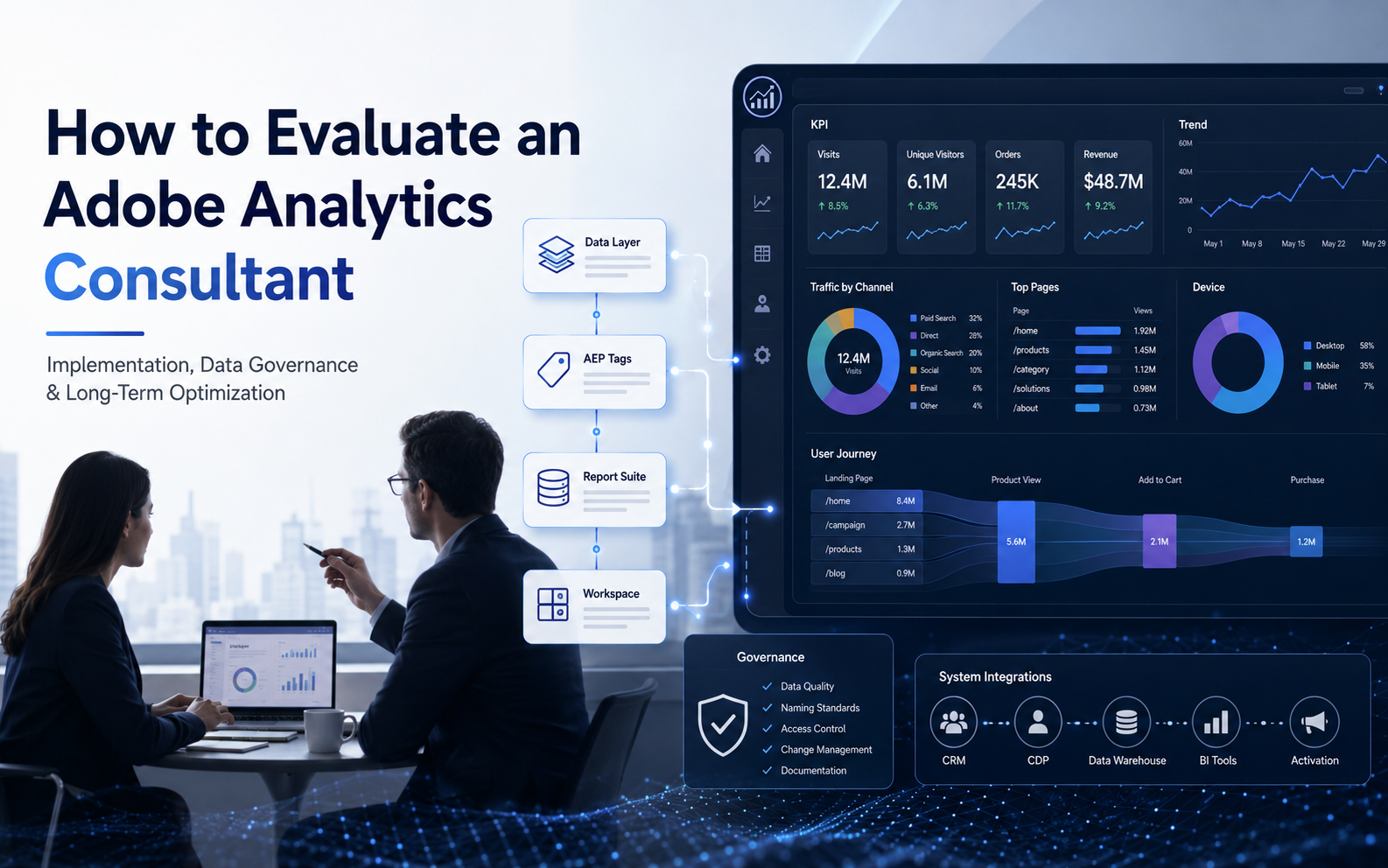
How to Choose the Right Adobe Analytics Consultant & Service Provider?
Adobe Analytics, Adobe Experience Cloud, Martech, Website Analytics
23 July 2026
- Key Takeaways
- What Problems Can an Adobe Analytics Consultant Solve?
- Common Adobe Analytics Implementation Challenges
- Core Capabilities to Look for in an Adobe Analytics Consultant
- The Different Roles of Adobe Analytics, CJA, and CDP
- What Should Enterprises Prepare Before Implementation?
- Frequently Asked Questions
- Conclusion
- Key Takeaways
- What Problems Can an Adobe Analytics Consultant Solve?
- Common Adobe Analytics Implementation Challenges
- Core Capabilities to Look for in an Adobe Analytics Consultant
- The Different Roles of Adobe Analytics, CJA, and CDP
- What Should Enterprises Prepare Before Implementation?
- Frequently Asked Questions
- Conclusion
1. Key Takeaways
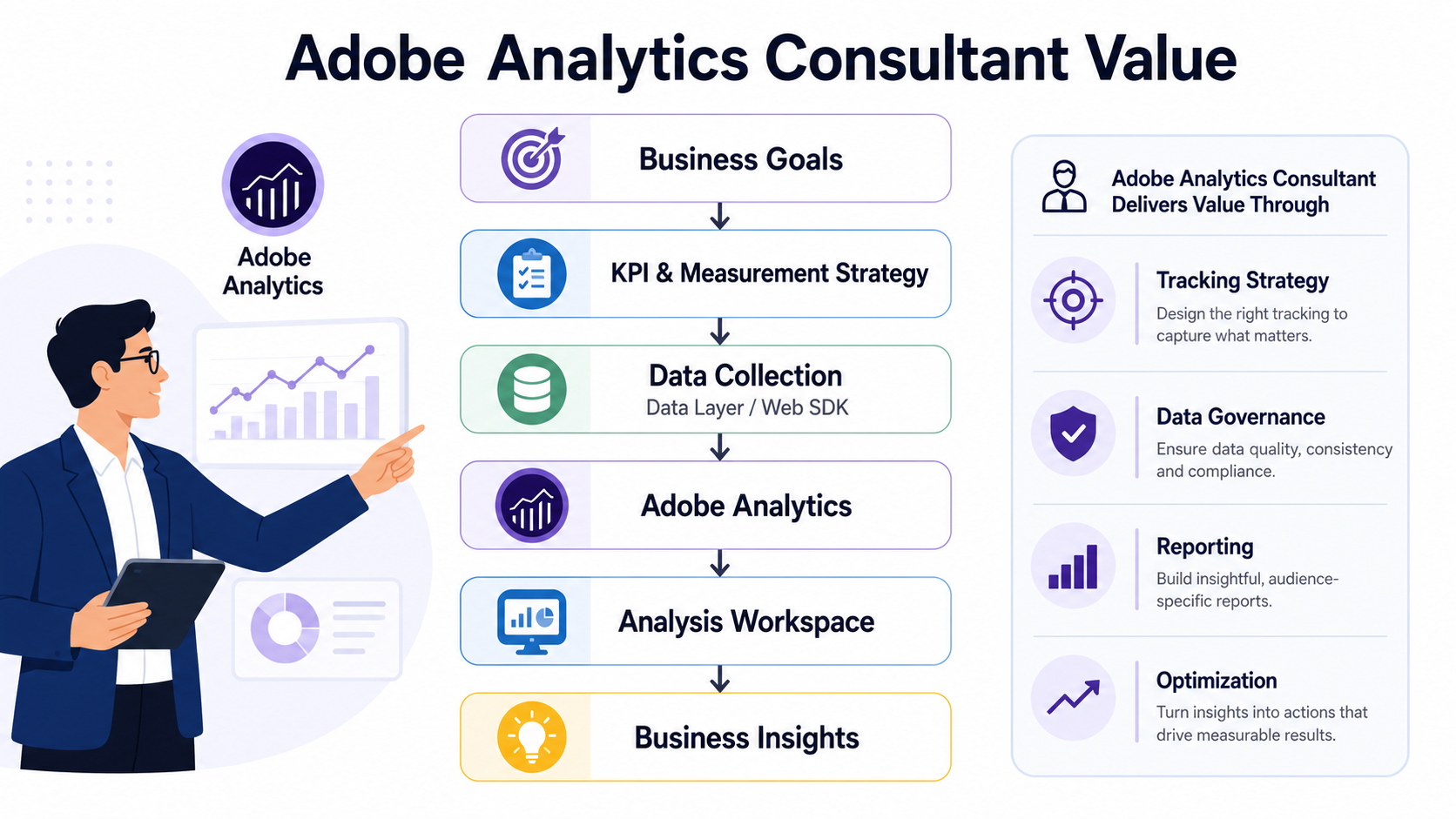
- The value of an Adobe Analytics consultant goes beyond configuring the tool. A consultant helps connect KPIs, the data layer, report suites, events and variables, Analysis Workspace reports, and data governance into an analytics framework that can be maintained over the long term.
- When selecting a service provider, enterprises should assess its capabilities in AEP Tags / Web SDK implementation, data-layer planning, report-suite design, cross-system integration, and industry understanding.
- Before implementing Adobe Analytics, enterprises should clarify their business objectives, tracking requirements, report users, and data-driven decision-making processes.
- Adobe Analytics is mainly used to analyze websites, apps, and digital channels. For cross-system, cross-identity, and end-to-end customer journey analysis, enterprises may also evaluate AEP, Customer Journey Analytics (CJA), or Real-Time CDP.
- The right consultant should not only complete a one-time deployment, but also help establish data governance, training, report maintenance, and continuous optimization mechanisms.
2. What Problems Can an Adobe Analytics Consultant Solve?
An Adobe Analytics consultant helps enterprises plan, implement, govern, and optimize Adobe Analytics. The role is not limited to installing a tool; it involves translating business questions into a data architecture that can be tracked, analyzed, and acted upon.
Enterprises typically need consultants to address the following questions:
- How should business objectives be translated into KPIs and analytics metrics?
- Which user behaviors are worth tracking?
- Which fields should the data layer contain?
- How should report suites be structured?
- How should eVars, props, and events be designed?
- How should tracking be implemented through AEP Tags, Web SDK, or AppMeasurement?
- How should Analysis Workspace reports be designed?
- How can marketing, product, content, IT, and management teams use a shared data language?
A strong Adobe Analytics consultant is more than a technical implementer. The consultant should also help the enterprise establish analytics methods, data-governance standards, and long-term optimization processes.
3. Common Adobe Analytics Implementation Challenges
For many enterprises implementing Adobe Analytics, the biggest problem is not the capability of the tool but incomplete upfront planning. Without clearly defined business objectives, data models, and tracking logic, even large volumes of collected data may fail to produce actionable insights.
Common challenges fall into three categories.
First, KPIs and analytics objectives are unclear. Content-focused websites may care about CTA clicks and lead generation, e-commerce sites about add-to-cart activity and checkout abandonment, and B2B sites about white-paper downloads, form submissions, and lead quality. The consultant must understand the business questions before designing the tracking solution.
Second, data-layer planning is insufficient. The data layer carries information about pages, events, user states, products, forms, campaigns, and conversions. If field naming, data sources, or maintenance responsibilities are unclear, report quality may suffer even after AEP Tags or Web SDK has been deployed.
Third, report-suite and variable design is unclear. Settings for report suites, eVars, props, events, Processing Rules, and Classifications directly affect analytical capabilities. Ad hoc variable design can lead to inconsistent event naming, dimensions that do not support segmentation, and reports that show traffic but not the reasons behind conversions.
Adobe Analytics also requires QA after implementation to verify Page Views, Events, eVars / props, Campaign Tracking, Form Submits, e-commerce events, and report-suite data. Without a testing process, enterprises may discover only after launch that their data cannot be trusted.
4. Core Capabilities to Look for in an Adobe Analytics Consultant
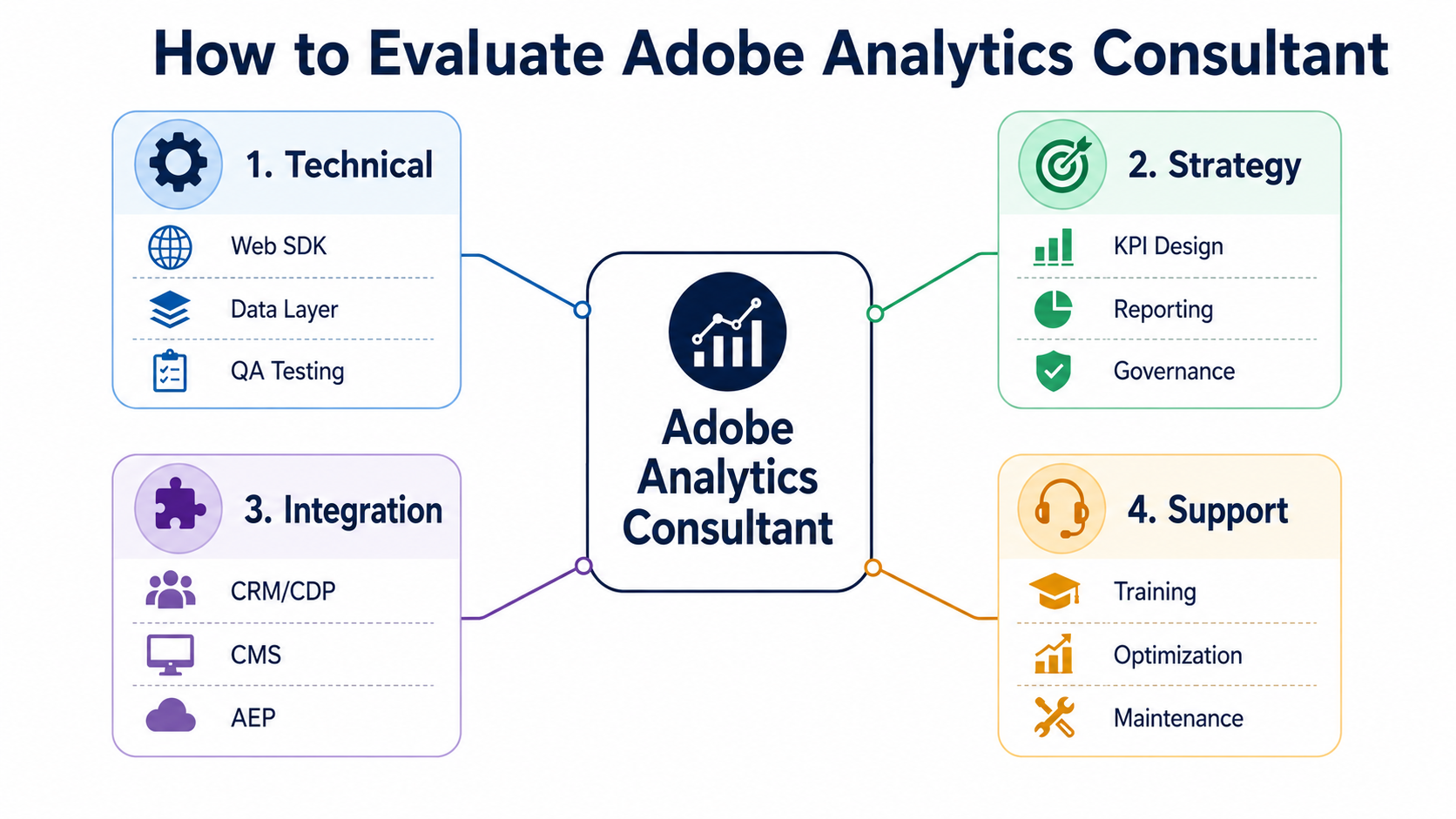
Enterprises can evaluate an Adobe Analytics consultant or service provider across five capabilities.
First, the provider should have strong Adobe Analytics implementation expertise. It should be familiar with report suites, eVars, props, events, Segments, Calculated Metrics, Analysis Workspace, AEP Tags, Adobe Web SDK / AppMeasurement, debugging, and QA testing.
Second, it should understand KPIs and business analytics. Adobe Analytics is not merely an IT tool; it also supports marketing and business decisions. The consultant should help determine which KPIs align with business objectives, which user behaviors represent high-value engagement, and which reports each department needs.
Third, it should be able to establish a data layer and Tracking Plan. The consultant should clearly define how every page, component, form, event, and conversion will be tracked, including trigger conditions, data-layer fields, mapped variables, testing methods, and responsible teams.
Fourth, it should be capable of designing Analysis Workspace reports. Good reports should do more than display numbers; they should help management, marketing, product, content, and data teams answer specific questions.
Fifth, it should have system-integration and data-governance capabilities. Modern enterprises rarely use Adobe Analytics in isolation. It is typically connected with a CMS, CRM, CDP, e-commerce platform, BI tool, or other Adobe Experience Cloud solutions. The consultant must understand data flows between these systems and help establish naming conventions, event management, access control, reporting standards, tracking change logs, and pre-launch QA processes.
5. The Different Roles of Adobe Analytics, CJA, and CDP
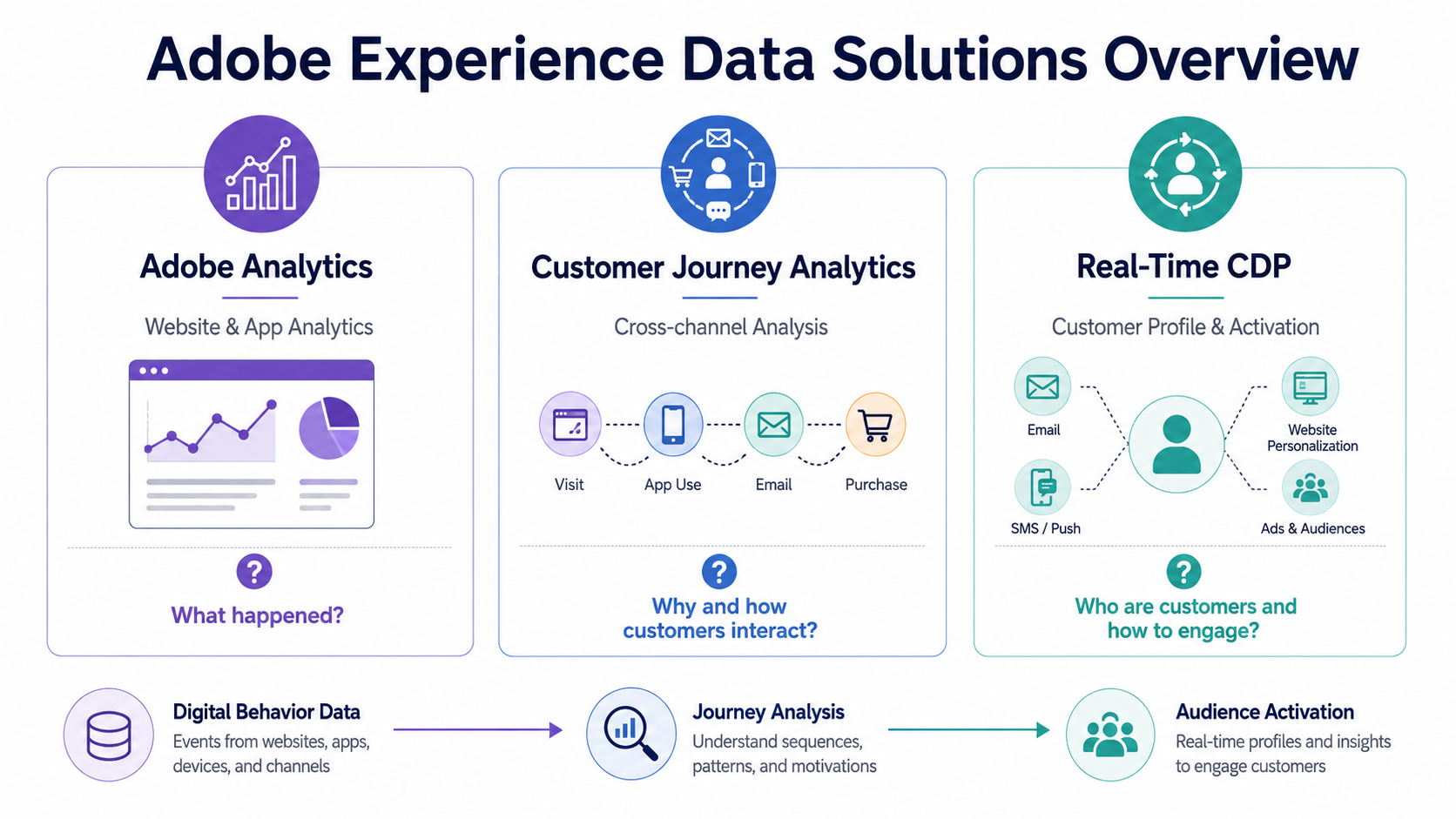
When evaluating an Adobe Analytics consultant, enterprises often also encounter Customer Journey Analytics (CJA), Adobe Experience Platform (AEP), or Real-Time CDP. These products all involve data, but they serve different roles.
| Platform | Primary Role | Questions It Addresses |
|---|---|---|
| Adobe Analytics | Website, app, and digital-channel analytics | How do users browse the website? Which content and campaigns drive conversions? |
| Customer Journey Analytics | Cross-channel customer journey analytics | How do customers interact across touchpoints? Which journeys influence conversions? |
| Real-Time CDP | Customer data integration and audience activation | How can customer data be unified, audiences created, and personalized marketing activated? |
Enterprises should therefore not treat Adobe Analytics as a CDP or try to solve every customer journey analytics requirement within Adobe Analytics. The right consultant should assess the enterprise’s data maturity, system architecture, and business objectives to determine whether to use Adobe Analytics, CJA, RTCDP, or a coordinated combination of these tools.
6. What Should Enterprises Prepare Before Implementation?
Before speaking with a consultant, enterprises can prepare the following information to make requirements discovery and estimation more accurate:
- Business objectives and KPIs: What problems should Adobe Analytics solve?
- Website and app architecture: Current websites, apps, language versions, primary markets, CMS platforms, and page types.
- Primary conversion actions: Form submissions, demo bookings, white-paper downloads, add-to-cart actions, completed purchases, member logins, CTA clicks, and more.
- Existing analytics tools: Are GA4, Adobe Analytics, AEP Tags, GTM, Web SDK, or AppMeasurement already in use?
- System-integration requirements: Does Adobe Analytics need to connect with a CMS, CRM, CDP, e-commerce platform, data warehouse, BI tool, or marketing automation platform?
- Internal user roles: Which reports are needed by management, marketing, content, product, e-commerce, or data teams?
- Budget and timeline: Have implementation, data governance, QA testing, report design, training, and ongoing maintenance been considered?
7. Frequently Asked Questions
What Does an Adobe Analytics Consultant Do?
An Adobe Analytics consultant helps enterprises plan, implement, and optimize Adobe Analytics, including KPI design, data-layer and report-suite planning, events and variables, AEP Tags / Web SDK implementation, Analysis Workspace report design, QA testing, data governance, and system integration.
Does Every Enterprise Need an Adobe Analytics Consultant?
Not necessarily. An internal team may be able to manage very simple tracking requirements. However, enterprises with multiple websites, multiple languages, apps, e-commerce, CRM / CDP integrations, or complex reporting needs typically benefit from a consultant who can reduce implementation risk.
How Do Adobe Analytics and Customer Journey Analytics Differ?
Adobe Analytics primarily analyzes websites, apps, and digital channels. Customer Journey Analytics focuses more on cross-channel and cross-system data analysis and is usually built on Adobe Experience Platform. Enterprises seeking end-to-end customer journey analysis may need to evaluate both CJA and an AEP architecture.
Can Adobe Analytics Integrate with Other Enterprise Systems?
Yes. Adobe Analytics can work with CMS, CRM, CDP, e-commerce, and BI platforms, as well as other Adobe Experience Cloud solutions. The appropriate integration approach depends on the enterprise data architecture, identity strategy, tracking requirements, and system configuration.
8. Conclusion
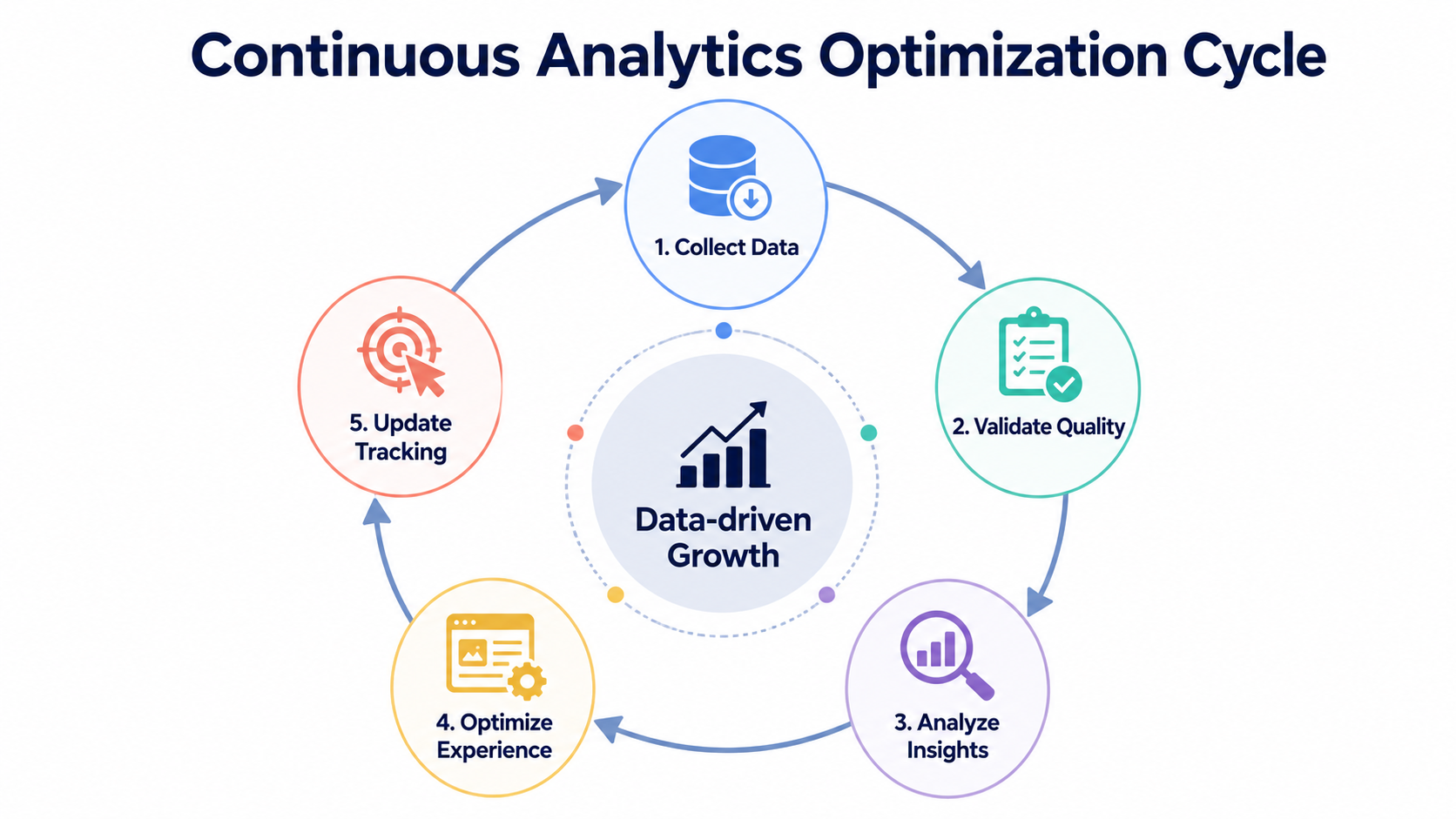
Selecting the right Adobe Analytics consultant and service provider is an important step toward building data-driven operational capabilities. An effective Adobe Analytics project does more than configure the platform; it establishes a complete process spanning KPIs, the data layer, events and variables, reporting, data governance, and business improvement.
LeadsTech provides Adobe Experience Cloud consulting, implementation, and integration services. We help enterprises move from requirements discovery and technical architecture planning to system integration, building digital analytics capabilities aligned with business objectives. To explore an Adobe Analytics implementation approach, contact the LeadsTech team to discuss your requirements:

For more information about Adobe Analytics products and related services, see: