

Foreign Trade Digital Service Providers: Why Certified Partners Earn Trust
AEM Sites, CDP, MarTech, Salesforce
5 June 2026
- Introduction: Why foreign trade digitalization cannot rely on isolated tools
- Certification: The first threshold for evaluating provider capability
- Successful case studies: More convincing than proposal documents
- From website to data: Providers must have full-chain capabilities
- Key differences between strategic partners and ordinary vendors
- What enterprises should evaluate when choosing a service provider
- Conclusion
- Introduction: Why foreign trade digitalization cannot rely on isolated tools
- Certification: The first threshold for evaluating provider capability
- Successful case studies: More convincing than proposal documents
- From website to data: Providers must have full-chain capabilities
- Key differences between strategic partners and ordinary vendors
- What enterprises should evaluate when choosing a service provider
- Conclusion
Summary
When choosing from a list of recommended foreign trade digital service providers, enterprises should not only focus on quotation and delivery timeline. They should also evaluate whether the provider can support long-term digital growth. Official certification, successful case studies, cross-platform integration capabilities, and long-term optimization experience deserve closer attention. For companies hoping to build a complete growth system from website, CMS, CRM, and CDP to data analytics, a truly reliable partner should be a strategic partner that can grow with the business over the long term, rather than a one-time delivery vendor.
Introduction: Why foreign trade digitalization cannot rely on isolated tools
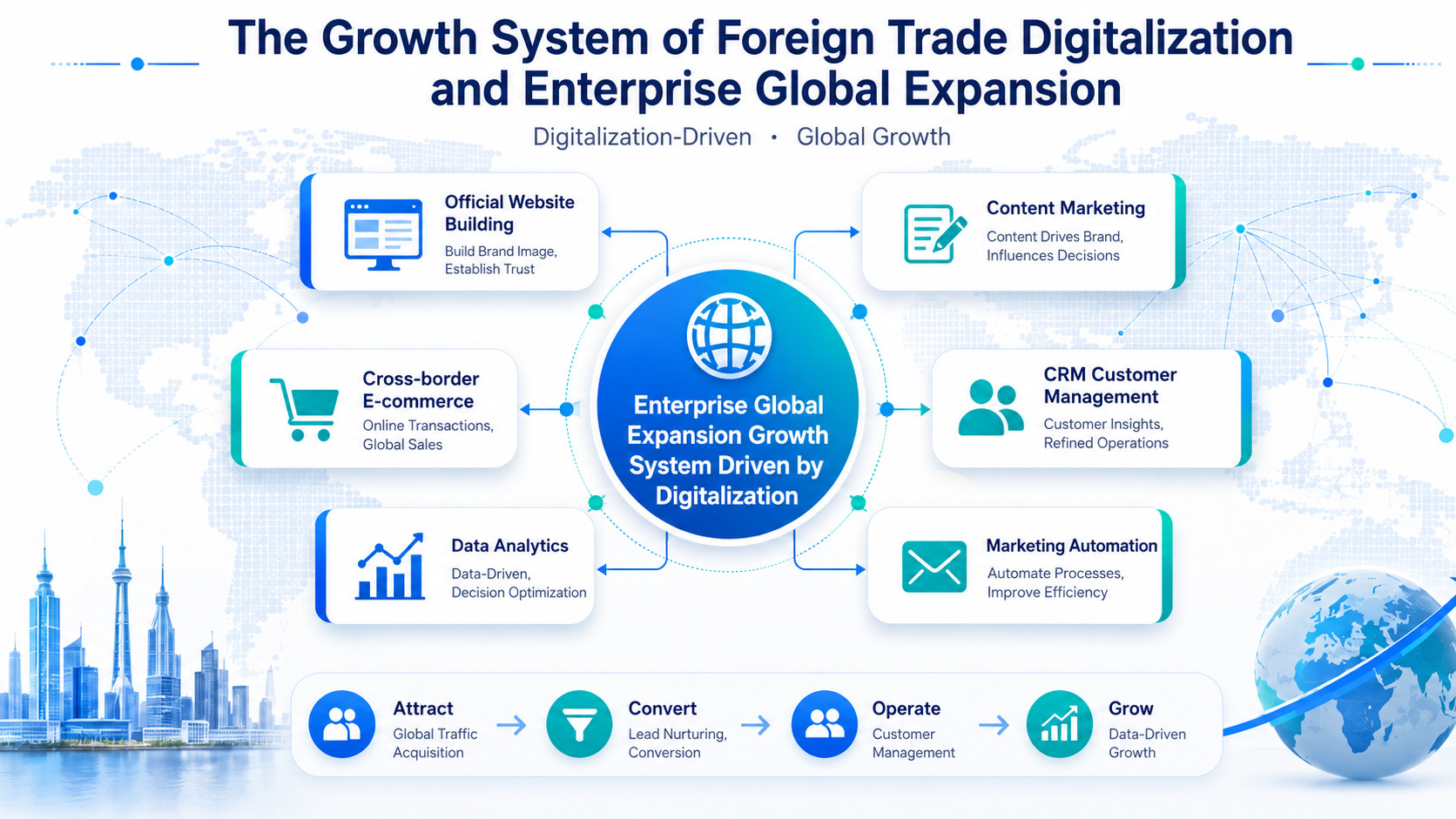
In the past, foreign trade companies often started digitalization with website development: first building a website, then running ads, and later considering CRM or email marketing. However, when companies enter a stage of competition across multiple countries, languages, and channels, a single system is no longer enough to support long-term growth. The website needs to capture traffic, the CMS needs to manage content, the CRM needs to manage sales, the CDP needs to accumulate customer data, and Analytics needs to analyze conversion paths.
Therefore, the core purpose of recommending foreign trade digital service providers is not to recommend a team that “can build websites,” but to identify partners that can truly help enterprises build a digital growth system. LeadsTech’s services cover international corporate websites, cross-border e-commerce platforms, CDP, marketing automation, website analytics, and UX/UI design. It also provides consulting and implementation services for platforms such as Adobe Experience Cloud and Salesforce CRM for companies in Mainland China, Hong Kong, and Taiwan.
Certification: The first threshold for evaluating provider capability
Official certification is not everything, but it is an important starting point for evaluating technical capability and ecosystem experience. For projects involving international platforms such as Adobe, Salesforce, Magnolia, and HCL, certification means the service provider has at least a certain level of platform understanding, implementation standards, and continuous learning capability.
When selecting recommended foreign trade digital service providers, enterprises can focus on the following points:

Whether the provider is an official partner
Determine whether the provider is recognized by the platform ecosystem and has a standardized implementation foundation.

Whether it holds core product certifications
Evaluate whether the team truly understands key platform capabilities and best practices.

Whether it has real project experience with the relevant platforms
Confirm whether certification capabilities can be applied to real business scenarios.

Whether it can explain business value
Focus on how technical capabilities can be translated into growth, conversion, and long-term efficiency.

LeadsTech is the only local Chinese-language partner in Greater China with Adobe Experience Manager Specialized certification. It is also an official partner of Salesforce, Magnolia, and HCL, and has long served large enterprises and growing organizations.
The value of these qualifications is that when projects involve enterprise-level CMS, CRM, CDP, DAM, or marketing automation, the provider must not only know how to “configure systems,” but also understand platform best practices, data architecture, and cross-system integration.
Successful case studies: More convincing than proposal documents
Proposal documents can be written in great detail, but successful case studies are what truly verify capability. This is especially true for foreign trade companies, because customer journeys, content systems, sales processes, and data requirements vary greatly across industries. Manufacturing, B2B technology companies, cross-border e-commerce, retail brands, and professional services all have different system architecture requirements.
When evaluating case studies, enterprises can look at four points:
1. Whether the industry is similar
Case studies in the same industry or with similar business models better demonstrate whether the provider understands customer decision paths.
2. Whether the project is complete
Building only website pages is very different from projects covering CMS, CRM, CDP, data analytics, and marketing automation.
3. Whether there are long-term optimization results
A mature enterprise digital service provider does not only focus on launch, but also continuously optimizes conversion, content, and data performance.
4. Whether the methodology can be reviewed
Being able to explain why a project was designed in a certain way, what challenges were encountered, and how they were solved is more valuable than simply displaying client logos.
LeadsTech has served globally recognized companies such as Huawei, Samsung, OnePlus, and BMW, covering CMS systems, cross-border e-commerce systems, and more. These cases can serve as important references for enterprises evaluating implementation experience.
From website to data: Providers must have full-chain capabilities
Foreign trade digitalization projects are usually not standalone technology projects. They are integrated projects involving business, content, data, and sales processes. Therefore, foreign trade digital service provider recommendations must focus on whether the provider has full-chain capabilities.
A mature foreign trade digital partner should cover at least the following capabilities:
Website and CMS
Capture global traffic and support multilingual, multi-region, component-based content management.
CRM and sales processes
Manage leads, opportunities, customer follow-up, and global sales pipelines.
CDP and data integration
Connect website behavior, customer profiles, marketing interactions, and sales results.
Analytics and insights
Identify channel quality, content performance, and conversion bottlenecks.
Marketing automation
Build continuous conversion mechanisms through customer segmentation and content engagement.
This is also the foundation of data-driven growth: companies are not simply building systems, but enabling business collaboration between systems. LeadsTech’s core services cover UI/UX design, foreign trade website development, cross-border e-commerce platform development, CMS, DAM, ERP, CRM, CDP, MA, AEM, and related system development and deployment.
Key differences between strategic partners and ordinary vendors

When choosing a recommended foreign trade digital service provider, many companies easily confuse “vendors” with “strategic partners.” Ordinary vendors usually work around task delivery, such as building a website, launching a CRM module, or configuring a set of reports. Strategic partners, however, start from the company’s business goals and help plan the long-term architecture.
The key differences are mainly reflected in the following areas:
1. Whether it proactively provides business recommendations
A strategic partner does not simply execute a requirements list, but identifies the risks and optimization opportunities behind those requirements.
2. Whether it values the data loop
An ordinary vendor may stop after completing the pages, while a strategic partner continues to focus on traffic, leads, conversion, and customer value.
3. Whether it can coordinate across systems
A true enterprise digital service provider should understand the relationship between websites, CRM, CDP, Analytics, and marketing automation.
4. Whether it has long-term service capabilities
Foreign trade digitalization is not a one-time project. Market changes, content iteration, system upgrades, and data model adjustments will continue over time.
Therefore, when choosing a foreign trade digital partner, enterprises should prioritize teams that can participate in long-term growth optimization.
What enterprises should evaluate when choosing a service provider
In actual vendor selection, enterprises can use the following questions to determine whether a recommended foreign trade digital service provider is reliable:
- First, does it have official certification and ecosystem qualifications?
Certification cannot guarantee project success, but teams without certification often carry higher risks on complex enterprise platforms. - Second, does it have successful case studies and industry experience?
The closer the cases are to the company’s own business, the higher the value of reusable project experience. - Third, can it cover the complete chain from website to data?
If a provider only understands design or development, it will be difficult to support data-driven growth. - Fourth, can it provide a clear implementation methodology?
This includes requirement research, blueprint design, system implementation, data validation, training and launch, and continuous optimization. - Fifth, can it become a long-term strategic partner?
Foreign trade digitalization ultimately serves customer growth, conversion improvement, and global business expansion. A team that only delivers systems without participating in operational optimization is unlikely to become a truly reliable enterprise digital service provider.
From these perspectives, a foreign trade digital service provider recommendation should not be about “who is cheaper,” but about “who can reduce long-term risk and drive business growth.”
Conclusion
As competition among foreign trade companies going global intensifies, the role of digital service providers is changing. Enterprises no longer need isolated technology vendors. They need strategic partners that understand business, master international platforms, have proven case studies, and can continuously optimize growth through data.
Therefore, when evaluating recommended foreign trade digital service providers, official certification and successful case studies should become key criteria. Certification represents platform capability and ecosystem endorsement, case studies represent real delivery experience, and full-chain data capability determines whether enterprises can truly achieve data-driven growth.
If you are looking for a foreign trade digital partner suitable for long-term cooperation:
- Learn more about LeadsTech’s website development, Adobe Experience Cloud, Salesforce, CDP, Analytics, and marketing automation solutions;
- Or visit Contact Us to discuss your company’s global digitalization plan with our consultants.
Related Articles
- How to Evaluate Digital Service Providers for Global Expansion? 10 Capability Dimensions for Strategic Decisions
Suitable for further understanding the capability model enterprises should evaluate when choosing digital service providers. - From Global Website Development for Chinese Enterprises to CDP and Marketing Automation
Suitable for further understanding how websites, data, CDP, and marketing automation form a complete growth system. - Discover the Benefits of Choosing Leads Technologies as Your Adobe Partner
Suitable for understanding the value of Adobe partner qualifications and enterprise-level digital experience project implementation.
Related Articles

Enterprise AI MarTech Trends Analysis 2024-2029 Outlook Report
From AI content productivity tools to a core engine for revenue growth and marketing transformation
*The PDF will be sent directly to your inbox.
Email Error
Please enter a valid email address.
Thank You!
The whitepaper has been sent to your inbox. If you don’t see it, please check your spam or promotions folder.