
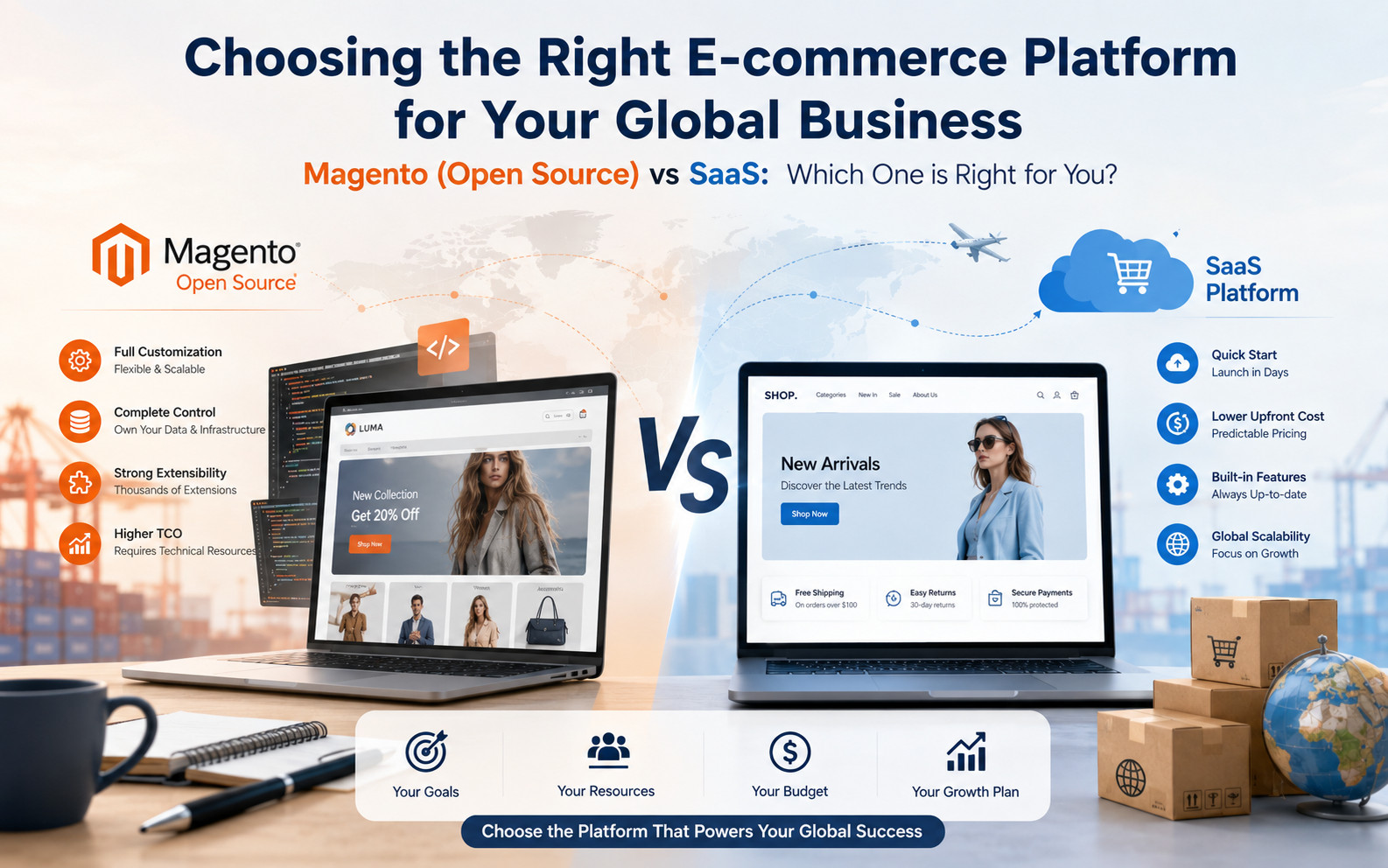
Magento vs SaaS: Choosing the Right Cross-Border eCommerce Platform
Adobe Commerce (Magento), B2B Marketing, E-Commerce, e-commerce Platforms, Shopify
17 May 2026
- Introduction: Independent Sites as the Core of Cross-Border E-Commerce
- Two Strategic Paths for Cross-Border E-Commerce Platforms
- Open Source Leader: Magento’s Strengths and Challenges
- SaaS Solutions: Rapid Deployment and Standardization
- Magento vs. SaaS: A Cross-Border E-Commerce Platform Comparison
- How to Choose the Right Platform for Your Business
- Common Pitfalls and Implementation Best Practices
- Conclusion
- Introduction: Independent Sites as the Core of Cross-Border E-Commerce
- Two Strategic Paths for Cross-Border E-Commerce Platforms
- Open Source Leader: Magento’s Strengths and Challenges
- SaaS Solutions: Rapid Deployment and Standardization
- Magento vs. SaaS: A Cross-Border E-Commerce Platform Comparison
- How to Choose the Right Platform for Your Business
- Common Pitfalls and Implementation Best Practices
- Conclusion
Executive Summary
This article provides an in-depth analysis of cross-border e-commerce platform recommendations, comparing the open-source system Magento with mainstream SaaS solutions. It helps businesses select the most suitable platform architecture based on their growth stage, technical capabilities, and long-term objectives.
1. Introduction: Independent Sites as the Core of Cross-Border E-Commerce
As third-party platform traffic costs continue to rise, an increasing number of enterprises are investing in independent online stores to gain full control over their brand and customer data. In this evolving landscape, selecting the right cross-border e-commerce platform has become a critical strategic decision.
Unlike relying on third-party marketplaces, independent stores emphasize long-term asset accumulation. Therefore, businesses must carefully evaluate both technical architecture and operational requirements when choosing a platform.
2. Two Strategic Paths for Cross-Border E-Commerce Platforms
In the current market, the leading cross-border e-commerce platform recommendations fall into two primary categories:

Open Source Systems
- Example: Magento
- Key Features: Highly customizable, flexible scalability

SaaS Platforms (Software as a Service)
- Examples: Shopify, BigCommerce
- Key Features: Rapid launch, low maintenance overhead
In practice, businesses typically need to conduct a thorough cross-border e-commerce platform comparison to identify the solution that best aligns with their current growth stage.
3. Open Source Leader: Magento’s Strengths and Challenges
In most cross-border e-commerce platform recommendations, Magento (within the Adobe Commerce ecosystem) stands out as one of the world’s leading scalable e-commerce platforms, offering both open-source and enterprise commercial editions.

Highly Customizable
- Flexible development tailored to business requirements
- Supports complex B2B and B2C scenarios

Powerful Extensibility
- Supports multiple languages and currencies
- Integrates with ERP, CRM, and other enterprise systems

Built for Long-Term Growth
- Supports complex product structures and business logic
However, Magento also presents several challenges:
High Implementation Complexity
- Requires a professional team for Magento implementation
Higher Total Cost of Ownership
- Includes development, maintenance, and infrastructure costs
Strong Technical Dependency
- Businesses need in-house technical expertise
Therefore, in a comprehensive cross-border e-commerce platform comparison, Magento is better suited for mid-to-large enterprises or brands with long-term strategic plans.
4. SaaS Solutions: Rapid Deployment and Standardization
Compared to open-source systems, SaaS platforms are often the preferred choice in cross-border e-commerce recommendations for businesses looking to launch quickly.

Rapid Launch
- Launch a website without custom development

Low Maintenance Costs
- Platform handles system updates and security

User-Friendly Operation
- Manageable by non-technical teams
This is why many businesses prioritize SaaS solutions when evaluating cross-border e-commerce platforms.
However, SaaS platforms also have limitations:
Limited Customization
- Difficult to accommodate complex business requirements
High Platform Dependency
- Features and extensions are constrained by the platform
Data and Cost Concerns
- Long-term costs can be significant
Therefore, in a full cross-border e-commerce platform comparison, SaaS is more suitable for early-stage or small-to-medium-sized businesses.
5. Magento vs. SaaS: A Cross-Border E-Commerce Platform Comparison
When evaluating cross-border e-commerce platforms, the most critical decision businesses face is choosing between Magento and SaaS.
The following dimensions provide a structured framework for comparison:
| Dimension | Magento | SaaS |
|---|---|---|
| Flexibility | Highly Customizable | Standardized |
| Time to Market | Longer | Rapid |
| Cost Structure | High upfront investment, predictable long-term costs | Low upfront, ongoing subscription fees |
| Technical Requirements | Requires a professional development team (Magento implementation) | Minimal technical expertise needed |
| Scalability | Strong | Limited |
Ultimately, the core of this cross-border e-commerce platform recommendation is not to choose the “better” option, but the one that is the best fit.
6. How to Choose the Right Platform for Your Business
Businesses can follow this decision framework when evaluating cross-border e-commerce platforms:
1. Define Your Business Stage
- Startup Phase: Prioritize SaaS
- Growth Phase: Evaluate Magento
- Maturity Phase: Lean toward Magento or a hybrid architecture
2. Assess Your Resource Capabilities
- Do you have an in-house technical team?
- Is there budget for long-term investment?
3. Clarify Your Growth Objectives
- Is high-level customization required?
- Is brand and data asset ownership a priority?
4. Consider Long-Term Strategy
- Will you expand into multiple countries or business lines?
By evaluating these dimensions, businesses can make a more informed and strategic cross-border e-commerce platform decision.
7. Common Pitfalls and Implementation Best Practices
Common mistakes businesses make when selecting a platform include:
Focusing Only on Short-Term Costs
- Overlooking long-term scalability
Underestimating Implementation Complexity
- Particularly for Magento projects
Over-Reliance on the Platform
- SaaS limitations can hinder long-term growth
Lack of Technical Planning
- Leads to costly rework later
We recommend that businesses complete a comprehensive business and technical plan before undertaking a Magento implementation or selecting a SaaS platform.
8. Conclusion
In today’s competitive environment, independent online stores have become a critical channel for global expansion. Different platforms represent different strategic paths — there is no absolute best choice, only the one that best fits your business.
LeadsTech brings over a decade of experience in global market services. Through systematic cross-border e-commerce platform recommendations and in-depth platform comparisons, we help businesses identify the solution that best matches their growth stage and achieve sustainable long-term success.
If you are currently evaluating an independent store platform:
- Visit our service page to explore our full range of e-commerce solutions
- Or contact us to discuss your business requirements with our consulting team
Further Reading
- Custom Development vs. Website Builders: A Comprehensive Guide for Businesses Going Global
Understanding the differences between independent stores and platform-based solutions from a development perspective can inform your platform selection. - B2B E-Commerce Solutions: An Integrated Brand Globalization Platform Powered by Adobe Commerce and AEM
Learn how Magento (Adobe Commerce) integrates with content platforms to build a comprehensive e-commerce and brand experience ecosystem. - Cross-Border E-Commerce Platform Guide: Independent Store vs. Third-Party Marketplace — An Enterprise Decision Framework
Gain deeper insight into the strategic role of independent stores within your overall cross-border e-commerce strategy.
Related Articles

Enterprise AI MarTech Trends Analysis 2024-2029 Outlook Report
From AI content productivity tools to a core engine for revenue growth and marketing transformation
*The PDF will be sent directly to your inbox.
Email Error
Please enter a valid email address.
Thank You!
The whitepaper has been sent to your inbox. If you don’t see it, please check your spam or promotions folder.