
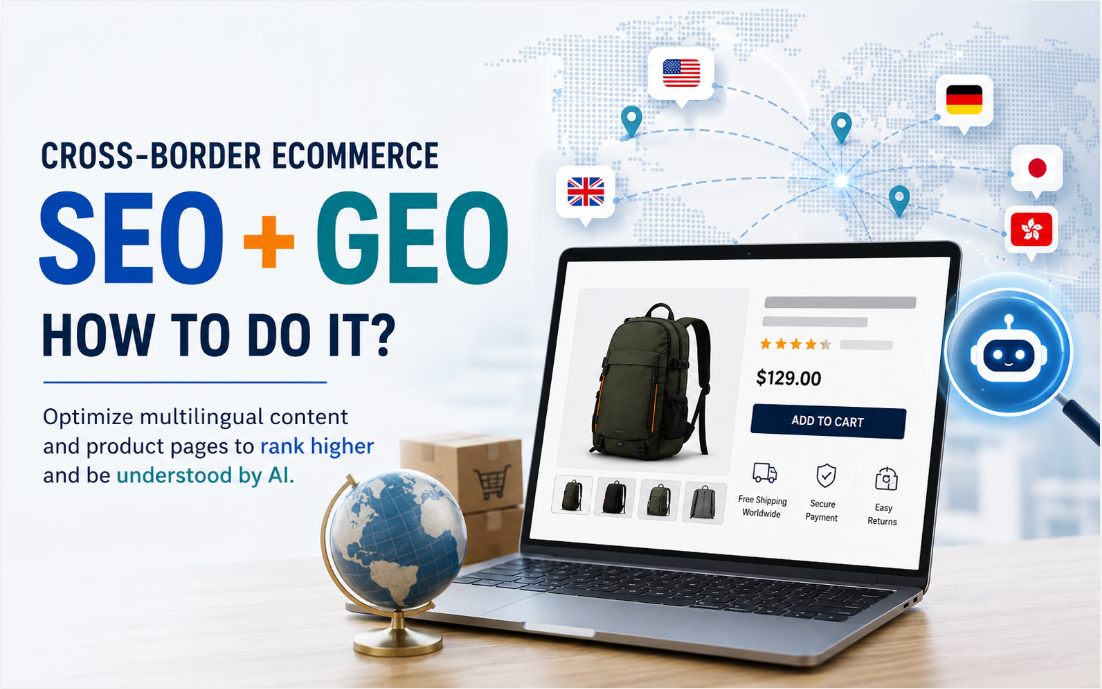
Cross-Border E-Commerce SEO and GEO Guide for Multilingual Sites
AEM Sites, Content Management System (CMS), E-Commerce, e-commerce Platforms
8 July 2026
1. Introduction: Cross-Border E-Commerce Search Is Moving from SEO to GEO
Competition among cross-border e-commerce independent websites is no longer just about who can spend more on ads or achieve a lower CPC. It is about which brand can be understood more accurately by consumers and AI across different markets, languages, and search contexts.
This article explains how cross-border e-commerce brands can combine SEO and GEO—from multilingual content and technical architecture to product page optimization—to build a more stable organic traffic foundation and improve how AI search understands their brands and products.
In the past, SEO focused on getting products and content to appear in Google search results. Today, users also learn about brands through AI search, conversational Q&A, and shopping comparison tools. This means independent website content must not only rank well, but also be easier for generative AI to understand, organize, and present accurately.
For cross-border e-commerce brands, SEO and GEO do not replace each other; they complement each other. SEO helps search engines find the brand, while GEO helps brand content provide clearer semantic structure, product information, and credible context in AI search and generative answers.
2. Why Independent Websites Cannot Rely Only on Ads and Marketplace Traffic
Many cross-border e-commerce brands initially grow through ads, marketplaces, or social traffic. But as the market expands, traffic costs, data ownership, and brand trust become constraints. The value of an independent website is that it gives the brand its own content assets, customer data, and conversion paths.
Combining SEO and GEO helps an independent website evolve from a set of transaction pages into a brand content hub that can be searched, understood, and organized.
When consumers search for “sunscreen recommendations for sensitive skin,” “home decor brands that ship to Europe,” or “how to choose a certain type of product,” a brand with only product listings will often struggle to be recognized by search engines and AI as a credible source.
To build long-term organic traffic, a cross-border e-commerce independent website cannot rely only on promotion pages and product pages. It also needs the following content assets:

Category Content
For example, product category pages, buying guides, use-case explanations, and comparison content help users understand how to choose products.

Product Knowledge
For example, materials, functions, sizes, care instructions, usage scenarios, limitations, and safety notes.

Brand Credibility Content
For example, brand stories, certifications, media coverage, customer reviews, after-sales policies, and delivery information.

Cross-Market Localization Content
For example, language usage, size standards, payment habits, delivery times, and return/exchange rules across different regions.
This content serves SEO and also makes it easier for AI to understand who the brand is, who the product is for, and how it differs from other options.

3. Cross-Border E-Commerce SEO Basics: Keywords, URLs, hreflang, and Structured Data
Cross-border e-commerce SEO is not simply about translating a website. It is about making sure each market’s content, products, and technical signals can be identified correctly.
Keyword Strategy: Distinguish Search Intent
Consumers in different markets use different terms. The same product category may be described differently in the United States, the United Kingdom, Taiwan, or Hong Kong. Keyword research should cover brand terms, category terms, question-based searches, comparison searches, and purchase-decision searches.
For example, a cross-border e-commerce website can plan for:
- Category terms: such as luggage, skincare, and home decor
- Question terms: such as how to choose and best for sensitive skin
- Comparison terms: such as product A vs product B
- Purchase-intent terms: such as free shipping, delivery to Hong Kong, and warranty
- Brand terms: brand names, series names, and product models
Website Architecture: Clearly Separate Languages and Regions
A multilingual website should use a clear and crawlable URL structure, such as /en-us/, /zh-tw/, or /zh-hk/, together with hreflang, canonical tags, and sitemap management to help search engines understand the relationship between different language and regional versions.
For cross-border e-commerce, URL architecture is not just an SEO issue. It also affects future content governance, product data management, and market expansion. Without clear planning at the start, adding new markets later can easily lead to duplicate content, incorrect canonical tags, confused language versions, or indexing errors.
Technical SEO: Ensure Crawlability and Indexability
Product pages, category pages, content pages, images, and structured data all need to remain consistent. Common technical issues in cross-border e-commerce include:
- Duplicate content
- Incorrect canonical tags
- Missing hreflang tags or incorrect reciprocal references
- Sitemaps that do not include important product pages or language versions
- Poor pagination handling
- Large numbers of 404 pages for out-of-stock products
- No suitable replacement pages or redirects after products are discontinued
- Oversized images that slow down loading speed
- JavaScript rendering that affects crawling and indexing
Structured Data: Help Google Understand Product Information
Cross-border e-commerce product pages should present product data in a consistent format whenever possible. Price, inventory, reviews, and delivery information can be paired with Product structured data to help Google understand product information more accurately and potentially display it more richly in search results.
Common data points to plan include:
- Product name
- Brand
- SKU or product model
- Price
- Currency
- Inventory status
- Reviews
- Images
- Delivery information
- Return policy
- Product description
If the company also uses Google Merchant Center, it should ensure that the product feed, product page data, and website structured data are consistent to avoid mismatches in price, inventory, language, or delivery information that affect search and shopping experiences.
Conversion-Oriented: SEO Should Not Focus Only on Traffic
Good SEO does more than bring visitors; it helps users understand products faster, build trust, and complete purchases.
Product information, delivery policies, return and exchange instructions, reviews, FAQs, and after-sales service are all important factors that influence search and conversion. For cross-border customers, this information often reduces purchase concerns more effectively than promotional copy.
4. Multilingual Content Optimization: Serving Both Search Engines and AI Search
Multilingual content is at the core of cross-border e-commerce SEO + GEO. Many brands directly machine-translate Chinese or English content into other languages, but this usually only completes “language conversion,” not “market communication.”
Truly effective multilingual content should start from local search intent. Users in different markets may care about price, materials, brand origin, delivery time, warranty, sustainability, payment methods, or usage methods. If every market uses the same narrative, the content will struggle to answer local needs and will be less likely to be judged by AI as contextually valuable.
For GEO, multilingual content also needs a stable semantic structure. For example, each market should clearly describe:
- Product positioning
- Target users
- Core specifications
- Usage scenarios
- Delivery policy
- Return and exchange rules
- After-sales support
- FAQs
- Differences from other products
When organizing answers, AI tends to prefer clear, complete, and verifiable information. Brands should therefore avoid overly slogan-like copy and clearly explain who the product is for, what problems it solves, and how it differs from other options.
Multilingual Content Is Not Just Translation; It Is Localization
For example, the same product page may need different supporting content in different markets:
Hong Kong Market
May care about delivery time, payment methods, and Traditional Chinese customer service.
Taiwan Market
May care about warranty, returns/exchanges, and local reviews.
U.S. Market
May place more emphasis on product comparisons, review volume, and use cases.
European Market
May care about materials, sustainability, compliance certifications, and return policies.
Therefore, a multilingual content strategy should incorporate SEO keywords, local language habits, cultural context, and purchase concerns—not just translate the original page.
5. Product Page SEO + GEO Optimization: From Rankings and Clicks to AI Understanding
Product pages are the most important conversion pages on cross-border e-commerce independent websites and a key scenario for GEO optimization. If AI needs to answer “which product is suitable for a certain need,” it must understand product entity data such as category, SKU, material, size, functions, target users, usage limitations, price, delivery regions, warranty, and differences from other products.
Titles and Descriptions: Make Product Positioning Clear at a Glance
Product titles should not include only the brand and model. They should also include the core category, main features, and usage context.
For example, instead of writing only “Model X,” describe the product type and use case, such as “Model X Lightweight Waterproof Travel Backpack | Suitable for Short Business Trips and Urban Commuting.”
Product descriptions should avoid vague adjectives and instead use specific information:
- Materials
- Functions
- Size
- Target users
- How to use
- Usage limitations
- Suitable markets
- Differences from other models
Specification Data and Structured Data: Help Search Engines Understand Product Information More Accurately
Size, weight, color, ingredients, warranty, origin, inventory, and price should be presented in a consistent format.
Price, inventory, reviews, and delivery information can be paired with Product structured data to help Google understand product data more accurately and potentially present it more richly in search results.
For AI search, clear specification data also helps models understand product attributes and suitable scenarios, reducing the risk of product misunderstanding or incomplete information.
FAQ Sections: Capture Long-Tail Searches and AI Q&A
Product pages can include FAQs such as:
- Is it suitable for sensitive skin?
- How long does delivery to Hong Kong take?
- How should I choose the size?
- Are returns and exchanges supported?
- How should it be maintained or cleaned?
- How is it different from another product?
This content answers real purchase concerns and helps generative search understand product context. Companies can also include FAQs in a consistent content model and structured data plan so that different product pages maintain the same information structure.
Reviews and Trust Signals: Strengthen Brand Credibility
Reviews, cases, media exposure, certifications, after-sales policies, and return/exchange information are all important trust factors in cross-border purchase decisions.
For a new market, trust signals are often more valuable than promotional copy. Brands should clearly present:
- Customer reviews
- Brand certifications
- Media coverage
- Logistics and delivery information
- After-sales and return/exchange policies
- Secure payment methods
- Customer service contact methods
Comparison Content: Help Users and AI Understand Differences Between Choices
Cross-border e-commerce product pages can also include comparison content, such as:
- Who is this product suitable for?
- How is it different from the entry-level model?
- How is it different from the high-end model?
- Which use cases is it better suited for?
- Which markets have faster delivery?
Comparison content not only helps users make decisions, but also helps AI understand product positioning more accurately when answering questions such as “how to choose” or “which one is right for me.”
6. What Is GEO, and What Does It Mean for Cross-Border E-Commerce?
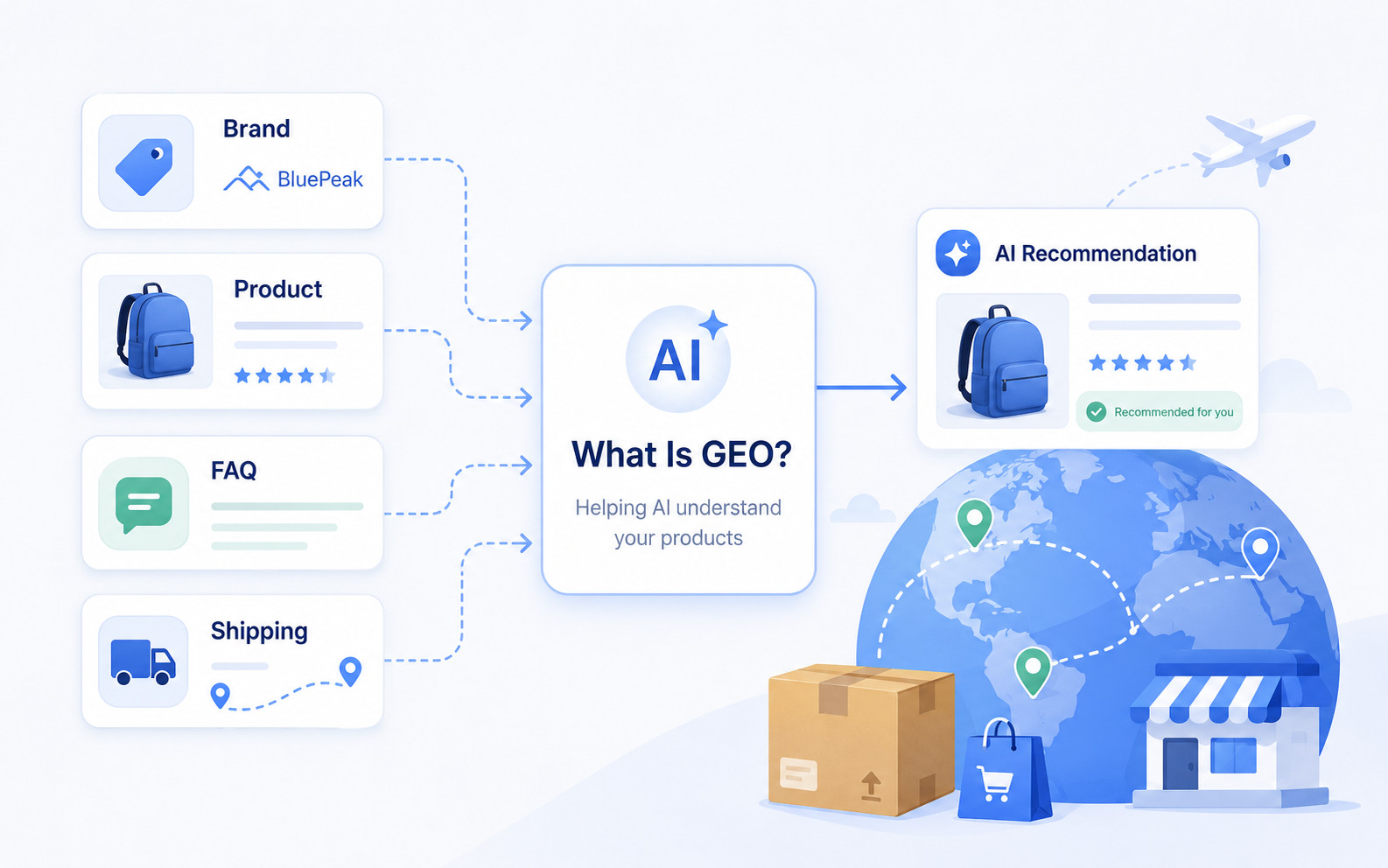
GEO (Generative Engine Optimization) can be understood as a set of content and technical optimization methods that make content easier for generative AI, AI search, and large language models to understand, organize, and present accurately.
For cross-border e-commerce, this is not just a new content marketing term; it is a necessary capability as search entry points change.
When consumers ask AI questions like “What high-quality luggage brands support overseas delivery?” or “How is this type of health product different from regular products?”, AI integrates multiple sources to generate answers. If brands want to increase the chances of being correctly understood and mentioned, they need sufficiently clear, structured, and consistent content assets.
The focus of GEO is not keyword stuffing, but building brand and product knowledge that AI can understand, including:
- Brand positioning
- Product attributes
- Applicable scenarios
- Usage limitations
- FAQs
- Comparison content
- Buying guides
- Delivery and after-sales policies
- Credible sources and brand evidence
The clearer the content, the less likely AI is to misunderstand the brand. Conversely, if product pages only contain slogans, promotional copy, and brief specifications, AI will struggle to determine who the product is truly for and to organize brand information correctly in comparison and recommendation contexts.
7. The Key Role of Technical SEO, CMS, and Content Governance
To do SEO + GEO well, cross-border e-commerce cannot rely only on a single article or adjustments to a few product pages. It needs a stable CMS, content workflows, and data governance.
Multi-Site Management: Support Content Differences Across Markets
Cross-border brands need to manage multilingual, multi-region, and campaign pages at the same time. If the CMS cannot support permissions, versions, translation, and review workflows, content quality can easily become difficult to control.
For example, product pages in different markets may need different copy, FAQs, delivery information, and promotional content. Without a consistent content model and workflow management, version confusion can occur over time.
Digital Asset Management: Ensure Image and Asset Consistency
Product images, lifestyle images, videos, and brand assets should follow unified management rules to prevent different markets from using outdated assets or incorrect versions that affect brand consistency.
Cross-border e-commerce teams should also plan image sizes, alt text, compression strategies, and asset naming rules for different markets and channels to prevent images from negatively affecting SEO, speed, and brand experience.
Structured Content: Make Content Reusable and Scalable
Breaking product information, FAQs, brand introductions, specifications, and policies into manageable modules helps search engines and AI read the content and improves content update efficiency.
For example, companies can build the following content models:
- Product specification module
- FAQ module
- Delivery policy module
- Return and exchange module
- Review module
- Comparison module
- Brand introduction module
This structured content helps maintain a consistent format across different markets, languages, and product pages, while also helping AI understand page semantics.
Performance and Experience: Speed Remains a Basic Requirement
Cross-border websites serving users in different regions must pay attention to loading speed, mobile experience, and stability. If pages are too slow, even strong content may lose ranking and conversion opportunities.
Companies should continuously check:
- Core Web Vitals
- Image compression
- CDN
- JavaScript loading
- Mobile experience
- Checkout process
- Product page stability
- Access speed across regions
AEM Sites and Content Governance
With Adobe Experience Manager (AEM) Sites, companies can more effectively manage multilingual content, content models, page governance, and cross-market website experiences. When combined with DAM, Analytics, structured data, and technical SEO workflows, it can build a more stable content foundation for SEO and AI search.
This is especially important for cross-border e-commerce brands that need to manage multiple markets, languages, brands, and large volumes of product content.
8. How Marketing Teams Can Start Implementing an SEO + GEO Workflow
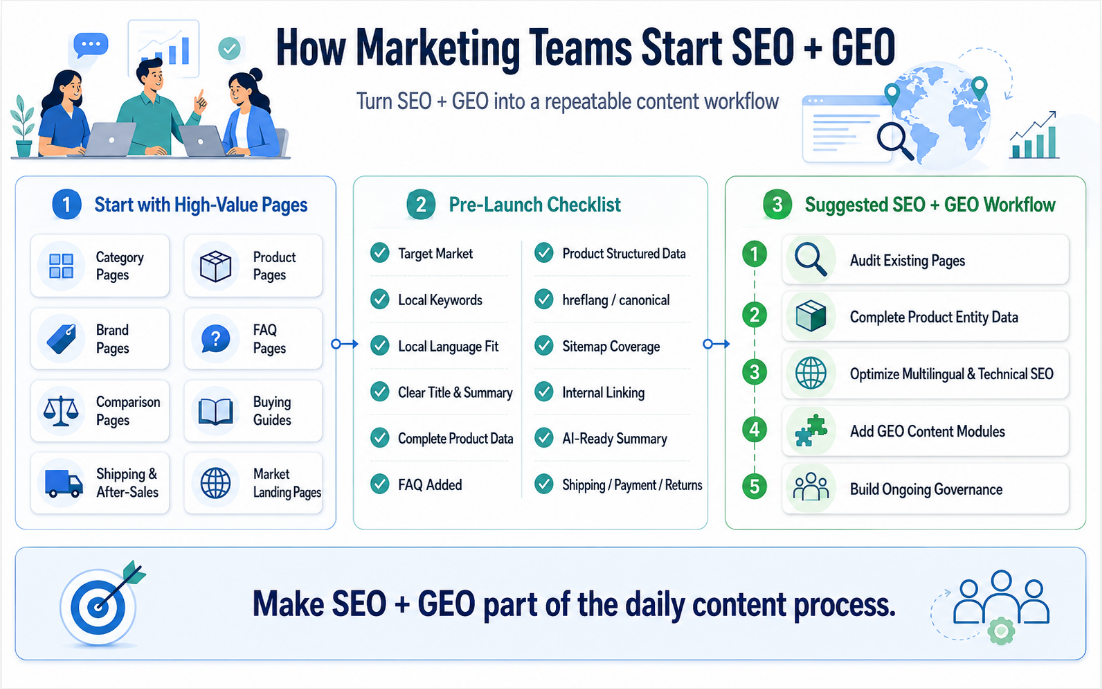
Companies do not need to rebuild all content at once. They can start with the pages that have the highest commercial value. It is recommended to first audit:
- High-traffic category pages
- High-converting product pages
- Brand introduction pages
- FAQ pages
- Product comparison pages
- Buying guides
- Delivery and after-sales policy pages
- Multilingual market entry pages
Next, marketing teams should establish a fixed checklist. Before each new page goes live, they should confirm:
- Whether there is a clearly defined target market
- Whether localized keyword research has been completed
- Whether the content matches local language habits
- Whether there are clear titles and summaries
- Whether complete product entity data is available
- Whether FAQs have been added
- Whether Product structured data has been added
- Whether hreflang / canonical settings are configured
- Whether the page is correctly included in the sitemap
- Whether it is interlinked with relevant category, product, and content pages
- Whether there are clear paragraphs that AI can summarize
- Whether delivery, payment, return/exchange, and after-sales information is clearly presented
Only when SEO and GEO are built into daily content workflows, rather than fixed after launch, can an independent website accumulate long-term advantages.
Recommended SEO + GEO Implementation Workflow
Step 1: Audit Existing Pages
Identify category pages, product pages, and content pages with high traffic, high conversion, and high commercial value.
Step 2: Complete Product Entity Data
Check whether each product page has complete brand, SKU, specifications, usage, target users, delivery, warranty, and FAQ information.
Step 3: Optimize Multilingual and Technical SEO
Check URLs, hreflang, canonical tags, sitemaps, structured data, and page speed.
Step 4: Add GEO Content Modules
Add comparison content, buying guides, FAQs, brand evidence, and applicable scenario descriptions.
Step 5: Establish an Ongoing Governance Workflow
Enable SEO, content, product, e-commerce operations, and technical teams to jointly maintain content quality.
9. Conclusion: Make Your Brand Searchable and Easier for AI to Understand Correctly
The next stage of competition for cross-border e-commerce independent websites will not only happen on search results pages, but also in AI answers, product comparisons, and purchase recommendations. SEO helps brands be found, while GEO further improves the chances of being understood, organized, and presented accurately.
If your team is planning a cross-border e-commerce independent website, multilingual website, or enterprise content platform, it is recommended to consider content architecture, product page data, technical SEO, and GEO governance together.
With Adobe Experience Manager (AEM) Sites, companies can more effectively manage multilingual content, content models, page governance, and cross-market website experiences. Combined with DAM, Analytics, structured data, and technical SEO workflows, it can build a more stable content foundation for SEO and AI search.
Visit Contact Us to connect with the LeadsTech consulting team. We can help assess the SEO + GEO maturity of your current independent website and plan a content and technology roadmap suitable for cross-border growth.
Related Articles
Enterprise AI MarTech Trends Analysis 2024-2029 Outlook Report
From AI content productivity tools to a core engine for revenue growth and marketing transformation
*The PDF will be sent directly to your inbox.
Email Error
Please enter a valid email address.
Thank You!
The whitepaper has been sent to your inbox. If you don’t see it, please check your spam or promotions folder.