

Enterprise Website & E-commerce Integration: A Unified Customer View Strategy
Adobe Commerce (Magento), AEM Sites, CDP, e-commerce Platforms, Website Analytics
2 June 2026
- Introduction: Why global brands can no longer build websites and ecommerce separately
- Why websites, ecommerce, and customer data easily become data silos
- What capabilities should website–ecommerce integration provide?
- How a unified customer view drives conversion growth
- Implementation roadmap for an integrated enterprise platform
- Common pitfalls and optimization recommendations
- Conclusion
- Introduction: Why global brands can no longer build websites and ecommerce separately
- Why websites, ecommerce, and customer data easily become data silos
- What capabilities should website–ecommerce integration provide?
- How a unified customer view drives conversion growth
- Implementation roadmap for an integrated enterprise platform
- Common pitfalls and optimization recommendations
- Conclusion
Summary
Integrated corporate website and ecommerce platforms are becoming an important trend for global brand expansion. In the past, the website handled brand presentation, the ecommerce system handled transactions, and CRM and data platforms operated independently, fragmenting the customer journey. This article analyzes how enterprises can integrate website, ecommerce, and data capabilities into a sustainable growth platform from four perspectives: data silos, content-commerce collaboration, a unified customer view, and implementation roadmap.
1. Introduction: Why global brands can no longer build websites and ecommerce separately
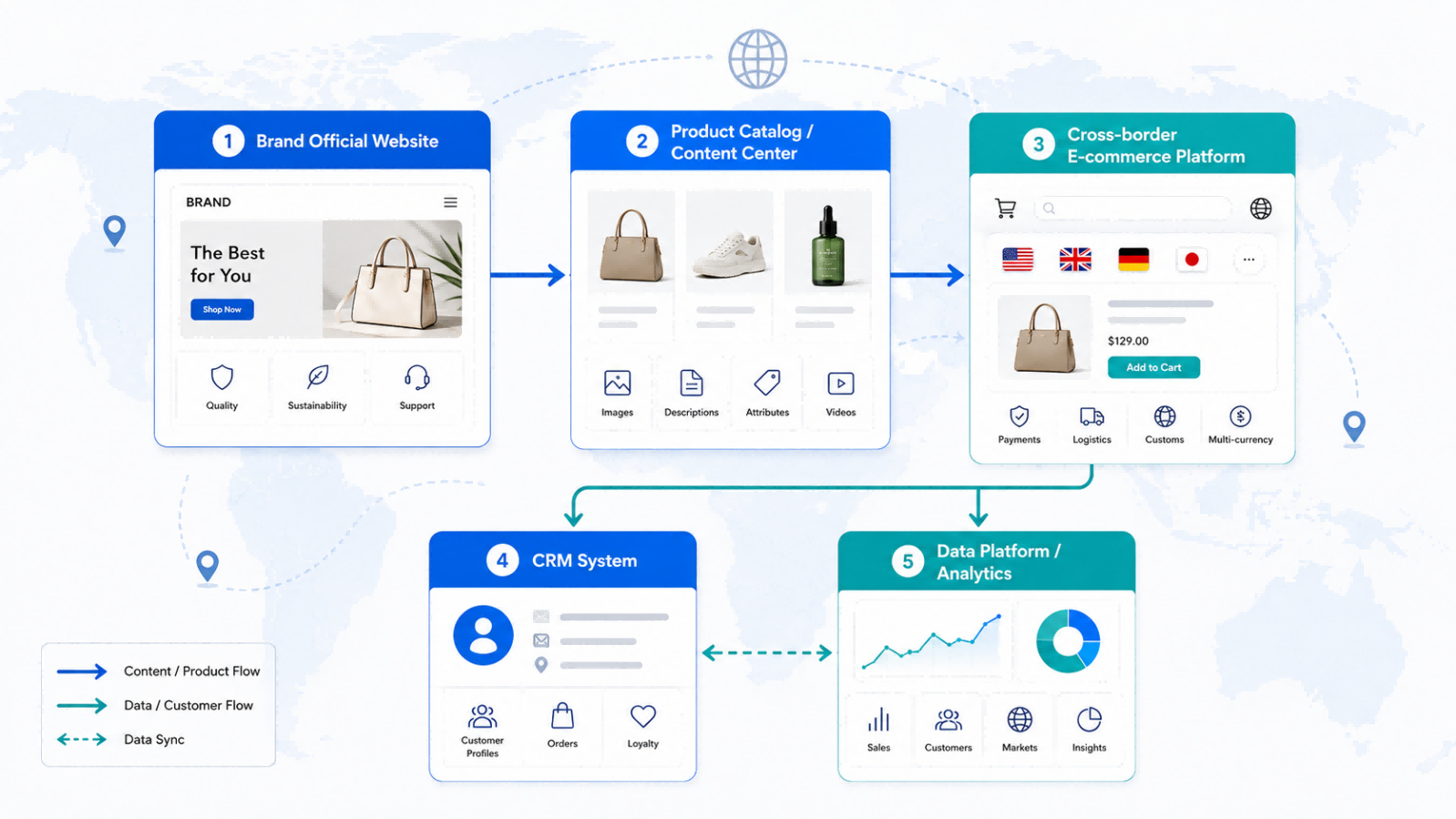
In the past, many companies expanding overseas would first build a brand website, then set up a separate ecommerce system or rely on third-party platforms. The website told the brand story, showcased products, and captured SEO traffic, while the ecommerce system handled checkout, payment, and order management. The division seemed clear, but in real operations it often created fragmentation.
When users enter the website from ads, browse product content, download materials, add items to cart, submit inquiries, or return later, companies need to recognize these behaviors as part of the same journey. If they cannot, it becomes difficult to assess customer interest, purchase intent, and future conversion opportunities. That is why integrating the corporate website and ecommerce platform is a critical step from a “brochure-style website” to a “growth platform” for global brand expansion.
For export-oriented businesses, the corporate website is no longer just a digital storefront. A mature international website needs to support brand building, product education, lead generation, data accumulation, and transaction conversion at the same time.
2. Why websites, ecommerce, and customer data easily become data silos
Before starting website–ecommerce integration, many companies already have a website, ecommerce platform, CRM, advertising platforms, and analytics tools. The challenge is that the website, ecommerce system, CRM, and data platform often still lack real data integration and operational coordination.
Common data silos include:
Content data silos
Website content, product materials, blogs, case studies, and campaign pages are managed separately, making unified maintenance difficult.
Transaction data silos
Ecommerce orders, carts, quotations, member information, and website behavior are disconnected, making it hard to identify the full user journey.
Customer data silos
CRM records sales follow-up, ecommerce systems record transactions, and websites record browsing behavior, but the three do not form a unified customer profile.
Analytics data silos
Marketing teams look at traffic, ecommerce teams look at orders, sales teams look at opportunities, and management struggles to see full-funnel performance.
According to Adobe Experience Manager Sites official materials, AEM Sites helps enterprises create and manage high-performing websites while supporting cross-brand, cross-region, and multilingual expansion. It can also connect with Adobe Commerce, Adobe Analytics, and other products to coordinate content, commerce, and data experiences.
This shows that the focus of a modern global expansion platform is no longer building individual systems in isolation. It is about coordinating content, transactions, and data around the customer journey.
3. What capabilities should website–ecommerce integration provide?
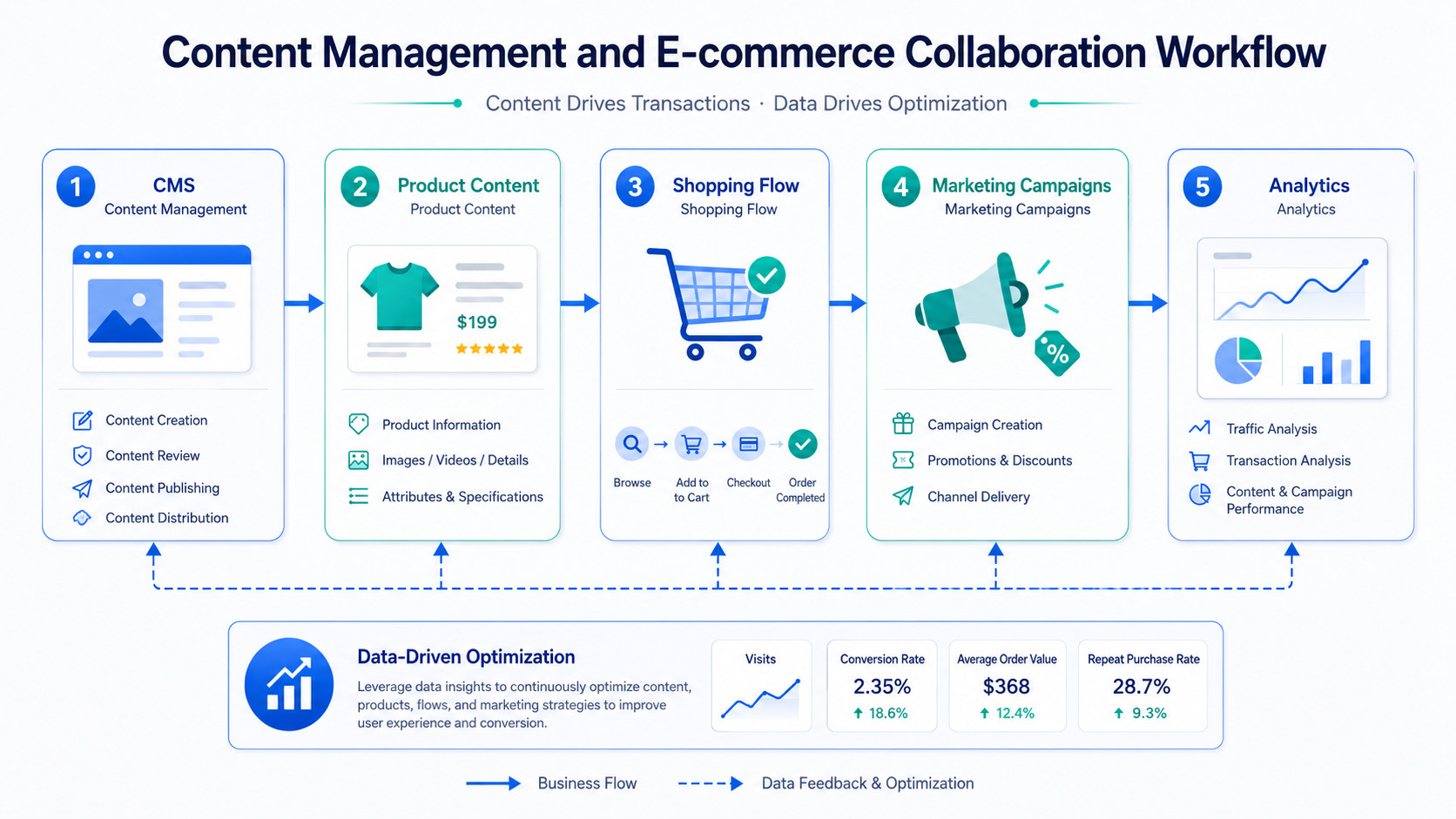
The value of integrating a corporate website with ecommerce is not simply adding a shopping cart to the website. It is about turning content and transactions into one connected growth system.
A mature integrated platform should typically provide the following capabilities:

Unified content and product management
Product introductions, specifications, images, videos, case studies, and industry content should be connected with the product catalog.

Consistent brand experience and purchase path
Website and ecommerce pages should deliver a consistent brand experience so users from SEO, ads, social media, or email can move clearly toward conversion.

Multilingual and multi-market expansion
Support centralized headquarters governance while allowing local teams to operate flexibly across countries and language versions.

Data collection and conversion tracking
Page views, product clicks, downloads, add-to-cart actions, inquiry submissions, and order completion should all be included in one analytics framework.
For enterprises, a truly mature integrated website and ecommerce platform should cover content management, product management, transaction flows, and data analytics—not just front-end page integration.
4. How a unified customer view drives conversion growth
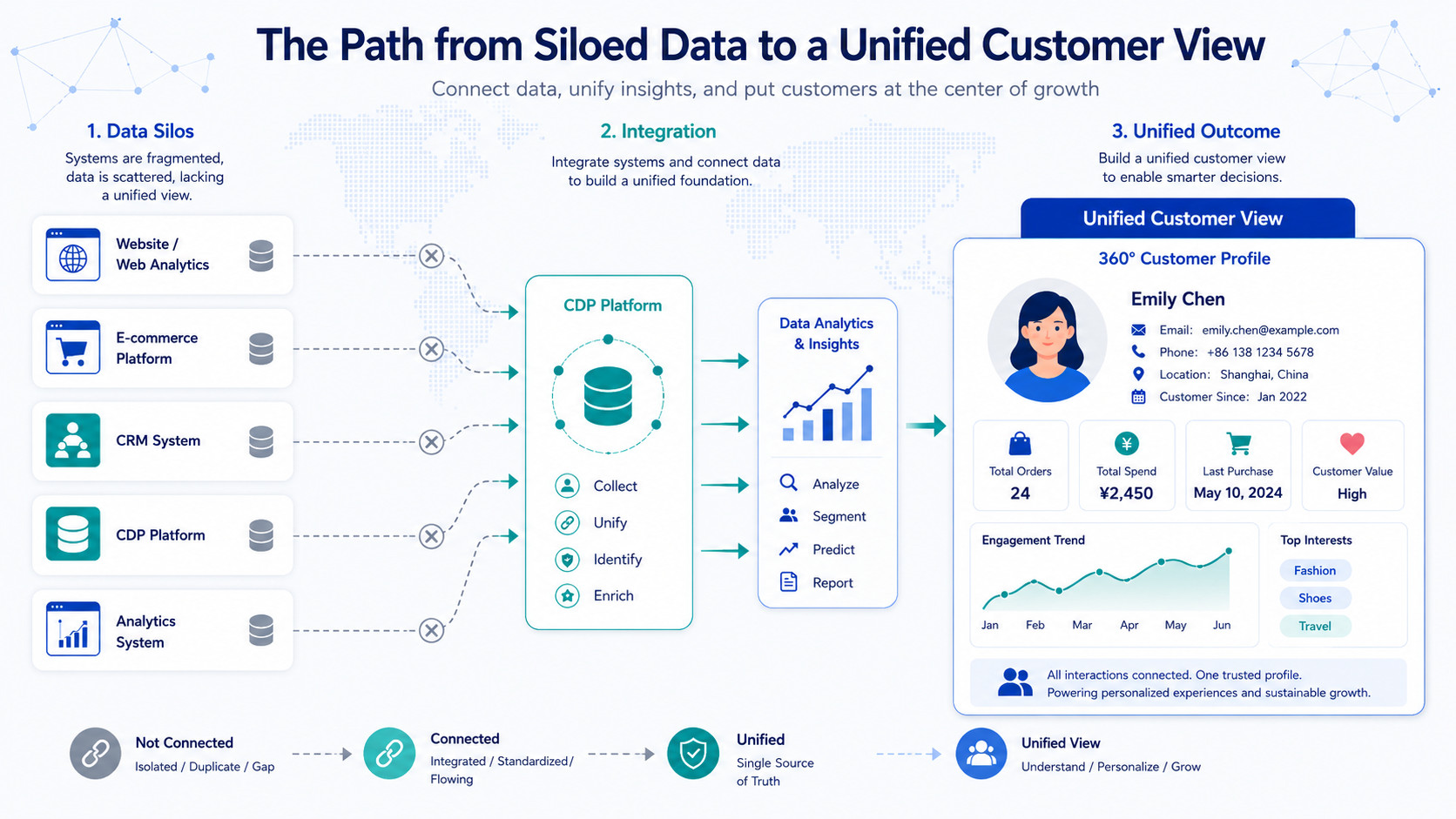
For many global brand projects, the problem is not a lack of traffic. The real issue is the inability to identify customer intent. A user may first reach the website through Google search, visit a product page through a LinkedIn ad the second time, check pricing on an ecommerce page the third time, and only submit an inquiry on the fourth visit. If the system cannot connect these behaviors, the company only sees fragmented data.
One core value of website–ecommerce integration is that it lays the foundation for a unified customer view. Adobe Experience Platform official materials state that it can centralize and standardize customer data from different systems and support real-time customer profiles. Adobe Real-Time CDP also emphasizes integrating known and anonymous data for cross-channel personalized experiences. However, building a unified customer view usually also requires identity resolution, data governance, and cross-channel data integration capabilities.
A unified customer view can create three types of growth value:
More accurate customer segmentation
Identify high-value customers based on content browsing, product interest, inquiry behavior, and purchase history.
More efficient marketing engagement
Send case studies to customers who browsed high-value products but did not inquire, and trigger remarketing for users who abandoned carts.
Clearer sales prioritization
Sales teams can see what content customers viewed, which products they focused on, and whether they returned repeatedly, enabling more precise follow-up.
This is why cross-border ecommerce analytics cannot focus only on order volume. Companies also need to understand the complete path from content engagement to final conversion.
For global brands, the value of integrating the website, ecommerce platform, and customer data platform goes beyond improving order conversion. It also helps reduce customer acquisition costs, increase customer lifetime value (LTV), and strengthen cross-market operational efficiency.
When enterprises can manage content, products, and customer data in a unified way, they can more easily support marketing automation, member operations, and personalized recommendation strategies.
5. Implementation roadmap for an integrated enterprise platform
To implement website–ecommerce integration, enterprises should move in phases instead of trying to rebuild every system at once.
Step 1: Map the customer journey
Clarify the key path from brand discovery, content browsing, and product comparison to inquiry submission and purchase completion.
Step 2: Unify content and product structures
Build a product content model that aligns website content, product information, assets, and marketing pages.
Step 3: Connect the website with the enterprise ecommerce platform
Ensure product details, shopping flows, inquiry forms, member systems, and order processes can work together.
Step 4: Establish data collection standards
Unify event naming, conversion goals, customer identifiers, and channel sources to prepare for analytics and CDP integration.
Step 5: Connect CRM and CDP
Gradually integrate anonymous visits, known customers, sales follow-up, and transaction records to form a unified customer view.
During this process, companies do not need to complete everything in one step, but they must start with an overall architecture design. Otherwise, the website, ecommerce system, and data platform will continue to develop separately, making future integration increasingly expensive.
6. Common pitfalls and optimization recommendations
Many corporate website and ecommerce projects underperform not because the platform lacks capabilities, but because the planning approach is flawed from the beginning.
Common pitfalls include:
Focusing only on page design while ignoring the customer journey
Good-looking pages do not guarantee smooth conversion. The key is whether users can move naturally from content to inquiry or purchase.
Building ecommerce functions while neglecting content capabilities
For global brands, content is often an important part of building trust.
Looking only at orders instead of behavioral data
Many high-value customers visit content pages, case study pages, and product pages multiple times before conversion. These behaviors also matter.
Implementing systems first and adding data later
Without early data structure planning, it is difficult to build a complete analytics loop later.
Therefore, website–ecommerce integration projects should plan content, transactions, customers, and data within the same blueprint from the very beginning.
7. Conclusion
Integrating the corporate website and ecommerce platform is not simply a website redesign, nor is it just launching ecommerce functions. It is a critical transformation for global brands as they move from traffic operations to customer management.
When the website builds trust, the ecommerce system captures transactions, and the data platform creates a unified customer view, companies can truly understand who their customers are, where they come from, what they care about, when they convert, and how to continue engaging them afterward. For enterprises that want to build long-term brand assets overseas, this is increasingly becoming a standard requirement.
If you are planning an enterprise website upgrade, ecommerce platform integration, or unified customer view initiative, you can learn more about our global website and ecommerce integration solutions. You can also visit Contact Us to discuss your business goals, system architecture, and implementation roadmap with our consultants.
Related Reading
- Global Ecommerce Website Solution with Adobe Commerce & AEM
Continue learning how AEM and Adobe Commerce support integrated content and commerce experiences. - Custom Build vs Website Platforms: A Complete Guide for Global Expansion
Compare custom-built websites, ecommerce independent sites, and platform-based solutions for global expansion. - Website Analytics Optimization: Adobe Analytics to CDP for Growth Loop
Explore how websites, ecommerce, and customer data form a conversion growth loop.
Related Articles

Enterprise AI MarTech Trends Analysis 2024-2029 Outlook Report
From AI content productivity tools to a core engine for revenue growth and marketing transformation
*The PDF will be sent directly to your inbox.
Email Error
Please enter a valid email address.
Thank You!
The whitepaper has been sent to your inbox. If you don’t see it, please check your spam or promotions folder.