
Is Magnolia CMS Right for Your Business? Use Cases and Selection Guide
Content Management System (CMS), Magnolia CMS
27 July 2026
- Introduction: CMS selection should not be based on headcount alone
- Assess complexity before company size
- Global website scenarios that are a good fit for Magnolia
- When Magnolia may not be the right choice yet
- The investments most often underestimated
- How to evaluate an implementation partner
- Frequently Asked Questions
- Conclusion
- Further Reading
- Introduction: CMS selection should not be based on headcount alone
- Assess complexity before company size
- Global website scenarios that are a good fit for Magnolia
- When Magnolia may not be the right choice yet
- The investments most often underestimated
- How to evaluate an implementation partner
- Frequently Asked Questions
- Conclusion
- Further Reading
Executive Summary

This article does not present Magnolia CMS as the right platform for every company. Instead, it helps decision-makers determine whether their organisation genuinely needs multisite governance, regional content reuse, complex system integration and long-term content operations. By the end, you should be able to assess whether Magnolia belongs on your shortlist based on business complexity, team collaboration and technical investment.
Content models, permissions, integrations, and long-term maintenance are all part of deciding whether a CMS fits an overseas website. When planning corporate website development and CMS services, LeadsTech evaluates these conditions before recommending a platform and implementation path.
1. Introduction: CMS Selection Should Not Be Based on Headcount Alone
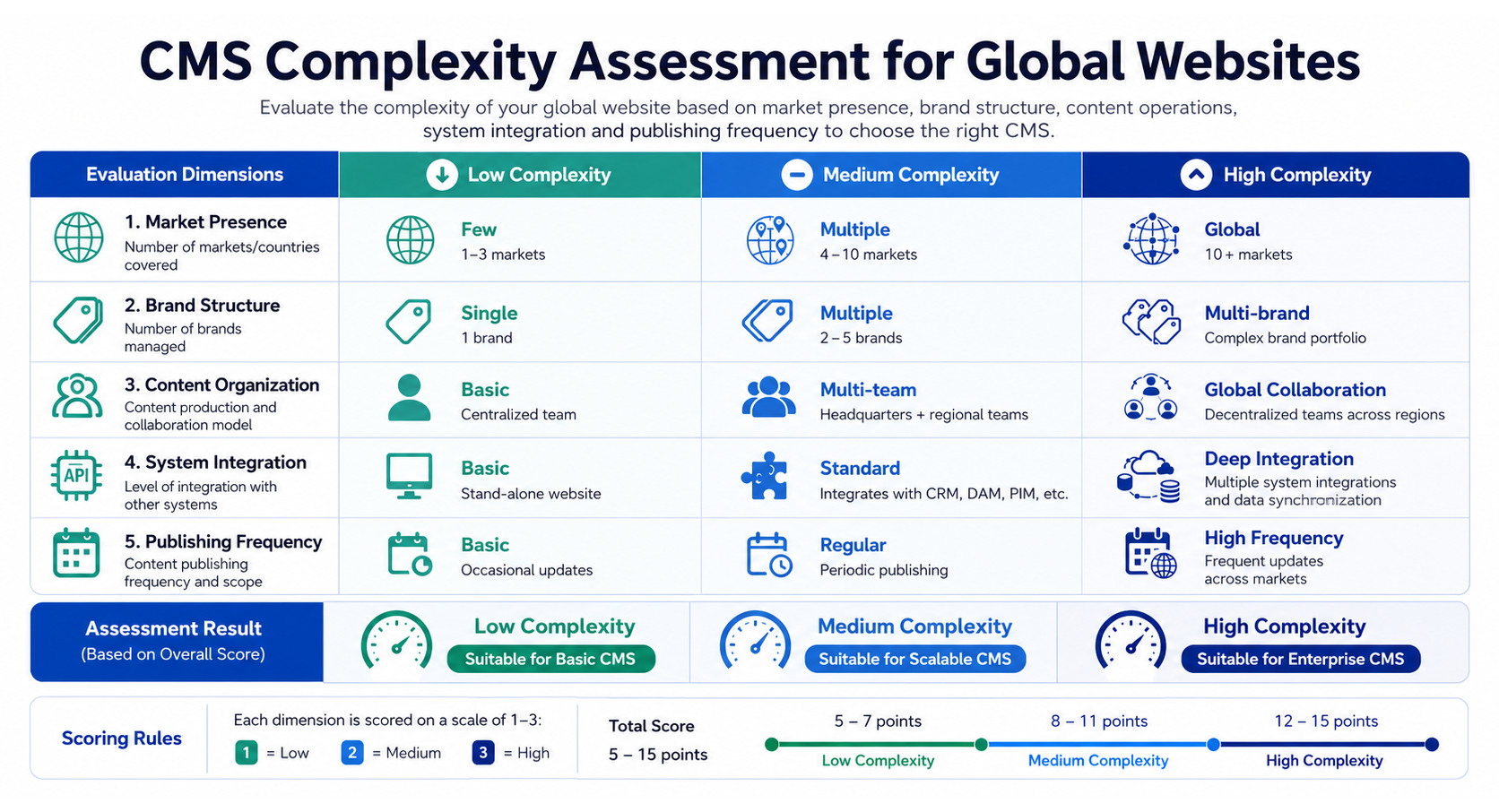
Many companies ask, “How many employees should we have before we need Magnolia?” Headcount, however, is not the most reliable criterion. A smaller company operating several country sites, distributor portals and complex product information may have a greater need for platform-based governance than a large, single-brand organisation.
The value of Magnolia CMS lies primarily in multisite management, content reuse, composable architecture and system connectivity. Its Multisite module can manage multiple sites within one instance while allowing each site to use its own templates, themes, domains and language settings and still inherit shared capabilities.
2. Assess Complexity Before Company Size
When evaluating Magnolia, start with five business signals rather than comparing software prices immediately.
The number of markets is increasing
The company plans to expand from an English-language site into multiple country or regional sites, each requiring different content, domains or campaign schedules.
Brands and product lines have multiple layers
Headquarters wants consistent brand standards while product divisions or regional teams still need the autonomy to publish their own content.
Content updates cannot depend entirely on developers
Marketing teams need components, content pools and workflows to publish pages, case studies, resources and events continuously.
CRM, PIM, DAM or commerce systems are already in place
The website is no longer just a presentation layer; it must retrieve product, customer, asset or transaction data.
The website is not the only channel
Content must also reach portals, mobile experiences, sales tools or other front ends.
When several of these signals appear together, Magnolia CMS is generally more worthy of further assessment than a lightweight website builder. “Three or more” should only be treated as an internal screening guideline, not an official Magnolia selection criterion. Through REST APIs and content delivery capabilities, Magnolia can supply content to different front ends and external systems, making it suitable for architectures with multichannel delivery requirements.
3. Global Website Scenarios That Are a Good Fit for Magnolia
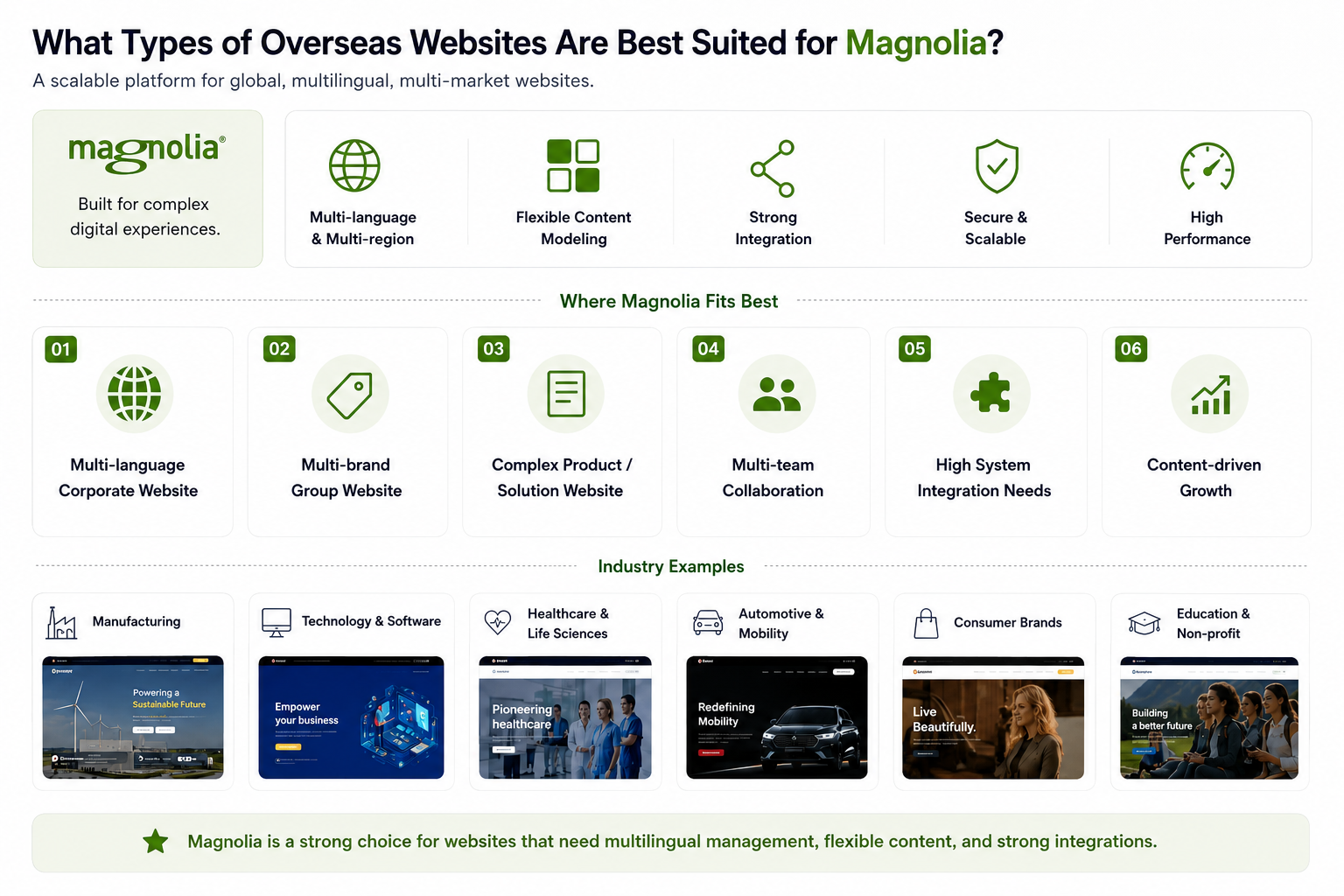

1. Multiple Countries and Brands with Central Governance
Supports a "shared core with local flexibility" model through Multisite site definitions, template and component inheritance.

2. Content Is Closely Connected to Business Systems
Connects product information, digital assets, CRM, membership or commerce data as a content experience layer, not an isolated back end.

3. Front-end Freedom with Visual Editing for Marketing Teams
Supports decoupled front-ends (React/Vue/Next.js) via headless delivery with Visual SPA Editor for visual editing.
4. When Magnolia May Not Be the Right Choice Yet
In practical terms, Magnolia CMS is not suitable for every corporate website project.
First, if a company has only one language version, a limited number of pages, infrequent updates and no clear integration requirements, a lightweight CMS or mature SaaS website builder will often deliver a better return on investment. Choosing an enterprise platform in this situation can turn a simple website into an architecture, environment and operations programme.
Second, companies expecting to operate with no technical team at all should proceed carefully. Magnolia’s modules, site definitions, APIs and deployment mechanisms provide substantial flexibility, but they also require clear content models, front-end and back-end collaboration, and environment management during implementation. Magnolia’s documentation likewise treats modules as a core way to organise project configuration and deployment.
Magnolia CMS solutions are therefore better suited to companies with clearly defined business complexity and long-term operating goals than to single brochure sites focused only on launching quickly.
5. The Investments Most Often Underestimated
Companies often concentrate their budget on page design and front-end development while underestimating the following work:
- Whether the content model can support future expansion of products, case studies and resources;
- How permissions and approval workflows should be divided between headquarters and regional teams;
- Where the boundaries of content reuse across sites should be defined;
- How failures in external system interfaces should be monitored and handled;
- Whether components and configurations can be reused when launching in a new market.
These are not optional platform extras. They are the foundations that determine whether Magnolia CMS can deliver long-term value. In other words, the prerequisite for choosing Magnolia is not simply wanting more features; it is a willingness to plan content operations and technology governance together.
6. How to Evaluate an Implementation Partner
When selecting a Magnolia CMS partner, do not look only at whether the team can build pages. Assess whether it can help the business define the right architectural and operational boundaries.
Evaluate four areas in particular:
Architecture capability
Can the partner distinguish among single-site, multisite, multibrand and multilingual implementation models and explain a realistic expansion path?
Content modelling capability
Can the partner separate products, case studies, resources, people and events from individual pages to create reusable content structures?
Integration capability
Does the partner have experience connecting CRM, PIM, DAM, commerce or identity systems rather than delivering only static pages?
Operations and delivery capability
Can the partner provide environment management, release processes, testing and acceptance, permission training and ongoing optimisation?
A mature Magnolia CMS partner will first challenge ambiguous requirements—for example, which markets truly need independence, which content should be inherited and which data should remain managed by external systems—instead of promising from the outset that every request can be built.
From a project risk perspective, companies should also verify that the Magnolia CMS partner can place configurations, modules and deployment processes under version control, preventing critical rules from depending indefinitely on manual changes in the administration interface.
7. Frequently Asked Questions
What size of company is Magnolia CMS suitable for?
Headcount is not the main criterion. More important factors include the number of markets and sites, brand structure, content team collaboration, system integration and publishing governance. Even a relatively small team may be a good candidate for Magnolia if it operates several country sites connected to PIM, DAM, CRM or commerce systems.
How does Magnolia CMS differ from lightweight SaaS website builders?
Lightweight SaaS tools are generally better for single sites, limited integration and rapid launches. Magnolia places greater emphasis on multisite governance, structured content reuse, composable integration, headless delivery and enterprise workflows. The decision should be based on long-term operating complexity rather than page editing features alone.
What should a company confirm before choosing Magnolia?
Confirm the market expansion plan for the next two to three years, content model, regional permissions, system interfaces, deployment and operational capabilities, and the availability of an internal or external technical team that can maintain Magnolia modules and configurations over time.
8. Conclusion
The key to CMS selection is not deciding whether a platform is “powerful,” but whether the business needs the complexity it provides. Magnolia CMS is a strong fit for companies operating across multiple markets and brands, coordinating several teams, and connecting content to existing business systems. For a simple, single-language website with infrequent updates and no integration requirements, a lightweight tool is usually the more practical choice.
Before evaluating a Magnolia CMS solution, companies should define their expected number of markets over the next two to three years, content governance model, integration roadmap and operational capabilities. Choosing a Magnolia CMS partner that understands these business boundaries will reduce selection risk more effectively than comparing feature lists alone. LeadsTech is listed in Magnolia’s official partner directory as a Solution Partner serving Hong Kong, Taiwan and mainland China.
Explore enterprise website and CMS solutions:
Enterprise Website and CMS Services
Discuss global website architecture and CMS selection with our consulting team:

9. Further Reading
- How Should Enterprises Choose a Platform for an International Website Revamp? The Complete 2026 CMS Selection Guide
Compare CMS platforms further based on company scale, content complexity and long-term operating requirements. - Building a Global B2B Website Is More Than Launching Pages: How a Professional CMS Supports Multilingual, Multicountry Operations
Learn how global content governance, regional collaboration and multilingual website operations work together.
Related Articles

Enterprise AI MarTech Trends Analysis 2024-2029 Outlook Report
From AI content productivity tools to a core engine for revenue growth and marketing transformation
*The PDF will be sent directly to your inbox.
Email Error
Please enter a valid email address.
Thank You!
The whitepaper has been sent to your inbox. If you don’t see it, please check your spam or promotions folder.