
1. Key Takeaways
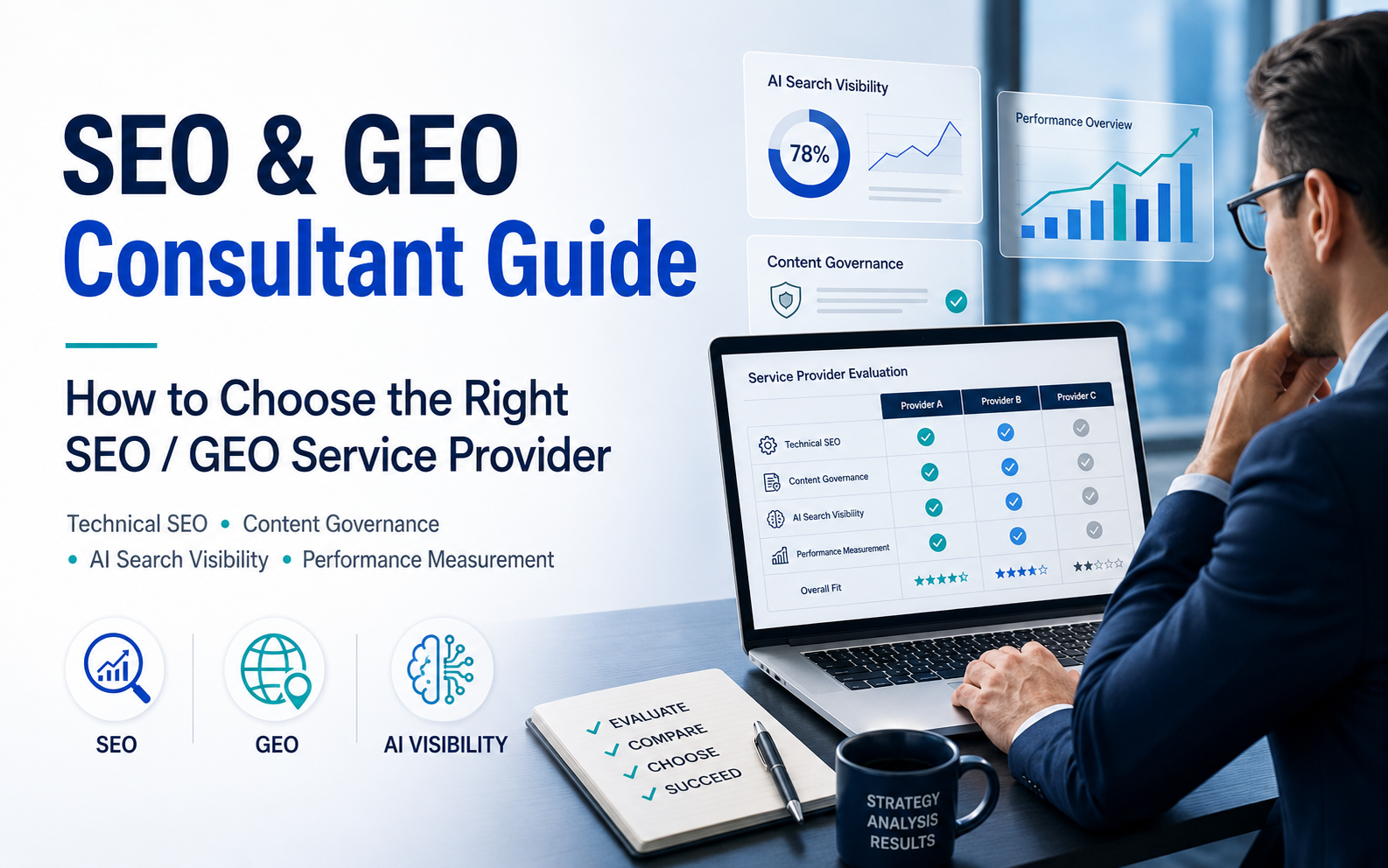
- SEO and GEO consultants should address search visibility, AI comprehension, technical architecture, content quality, and performance measurement—not just keywords.
- Assess providers on technical SEO, content strategy, structured data, analytics, CMS integration, and long-term governance.
- GEO extends SEO to AI-generated answers, brand mentions, and accurate presentation in context.
- A qualified consultant should not guarantee rankings or AI citations, but propose verifiable methods, priorities, and metrics.
- Mid-sized and large enterprises, multilingual sites, and B2B brands benefit most from providers with consulting and integration capabilities.
When assessing providers, compare more than report formats: confirm that the partner can bring technical architecture, content, and AI search visibility into one improvement framework. LeadsTech’s SEO and GEO optimisation service offers one practical reference point for that comparison.
2. Business Challenges SEO and GEO Consultants Solve
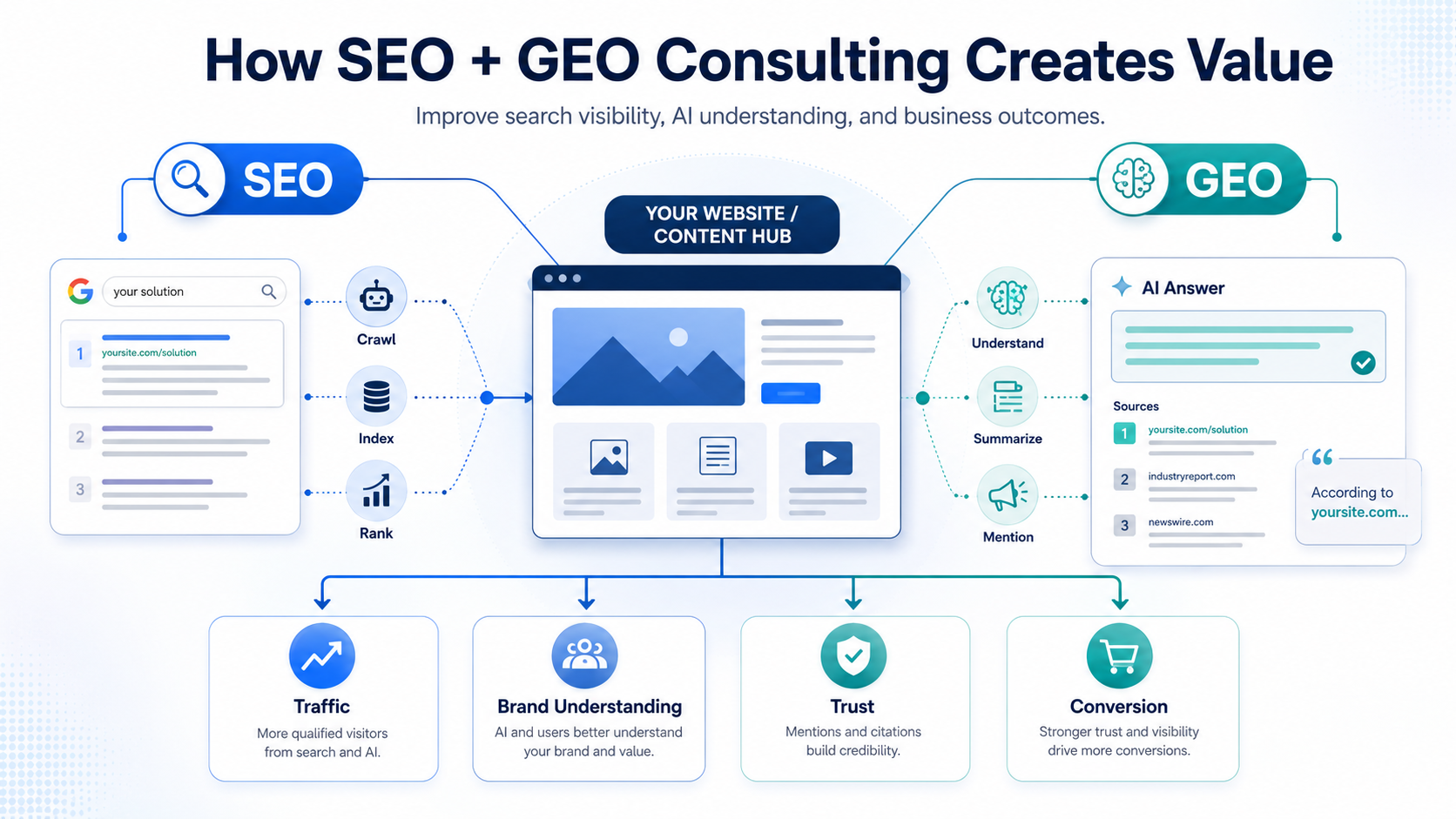
SEO (Search Engine Optimization) aims to improve a website’s ability to be crawled, indexed, and ranked by search engines, helping it attract relevant organic traffic.
GEO (Generative Engine Optimization) focuses on helping generative AI understand the topics, entities, relationships, and contexts within content, increasing the likelihood that AI will accurately mention or cite brand information.
The two do not replace each other. Sound technical architecture, clear website hierarchy, high-quality original content, and trustworthy brand signals remain the shared foundation of both.
SEO and GEO consultants help businesses address questions such as:
- Can search engines crawl and index the website properly?
- Do key pages answer users’ questions clearly?
- Are brand, product, and service descriptions consistent?
- Does the content demonstrate sufficient expertise and credibility?
- Can the website support content governance across multiple languages or markets?
- Can AI search accurately understand the company’s services and expertise?
- Can performance measurement be linked to business outcomes?
The value of an SEO and GEO consultant goes beyond improving rankings. It lies in helping businesses build a content and website foundation that can be discovered, understood, and continuously optimized.
3. Scope of SEO and GEO Consulting Services
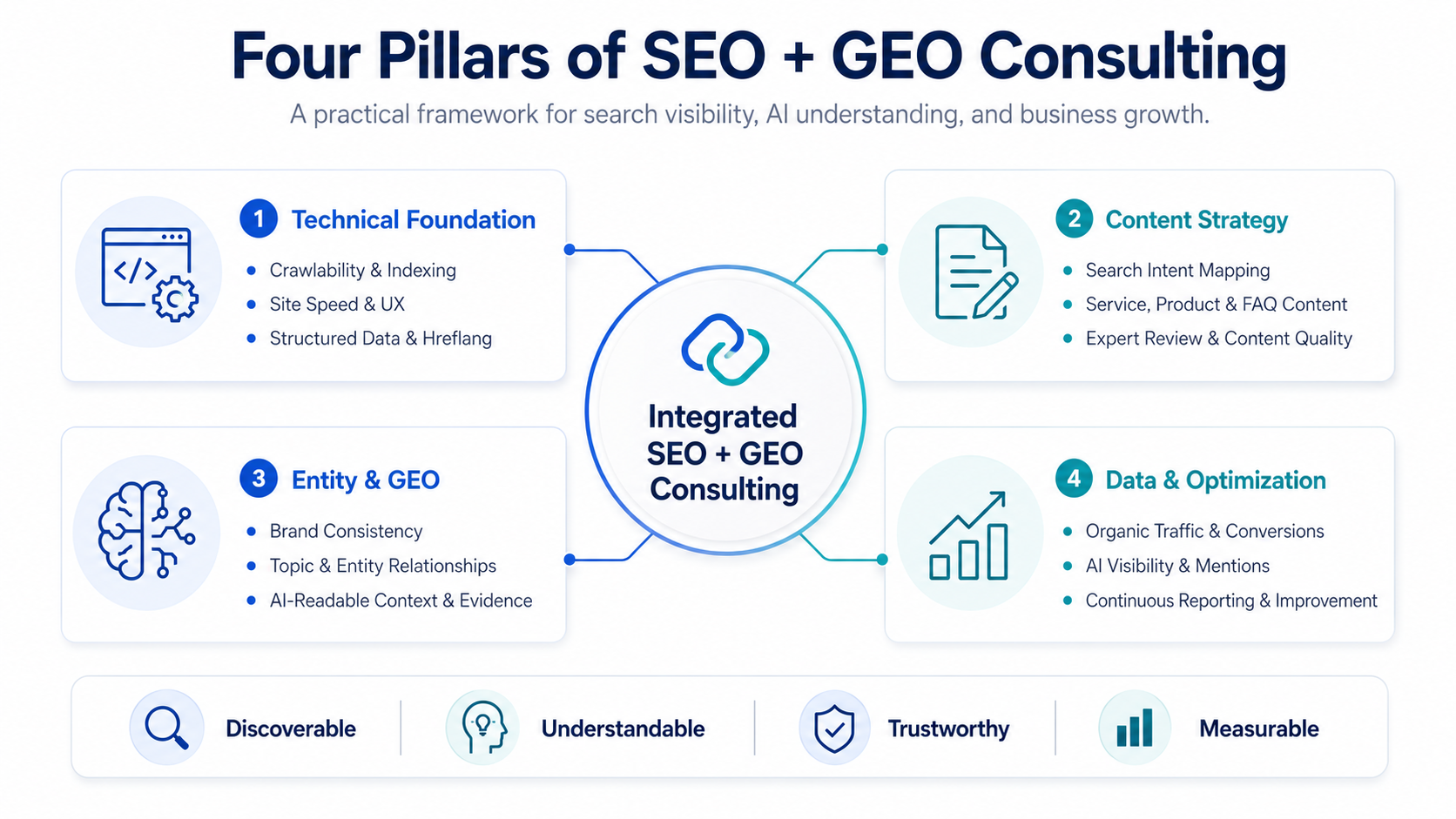
Comprehensive SEO and GEO optimization services typically cover four areas.
Technical SEO and Website Architecture
Consultants should first confirm the website has a healthy technical foundation:
- Review crawling, indexing, canonical tags, sitemaps, robots directives, and hreflang for multilingual sites
- Optimize speed, Core Web Vitals, mobile experience, and semantic markup
- Assess whether the CMS supports metadata, Schema Markup, internal links, and content versions
- Check that important content is in readable HTML, not solely in images or JavaScript
Content and Search Intent
Consultants analyze the questions customers ask at different stages of the decision journey, then plan service pages, product pages, comparison articles, FAQs, and knowledge content accordingly.
Content should not merely target keywords. It should directly answer:
- What is it?
- How does it work?
- Who is it for?
- How does it differ from other solutions?
- What preparations are required?
- What limitations should businesses be aware of?
GEO and Entity Information
Service providers should help businesses standardize brand names, product definitions, service scope, terminology, case studies, and partner information across third-party sources.
GEO requires managing consistency across:
- Corporate website, product pages, and service pages
- Articles, FAQs, and customer case studies
- Partner pages, media coverage, and third-party reviews
- Social media and public company profiles
Structured data can help search engines understand page content but cannot replace valuable body content or guarantee rankings.
Data and Continuous Optimization
Beyond rankings and traffic, consultants should track organic search conversions, non-branded visibility, engagement, content coverage, brand mentions, answer accuracy, citation sources, and AI referral traffic.
Businesses should establish a long-term monitoring framework rather than relying on one-off ranking reports.
4. Why Traditional SEO Is No Longer Enough
Some traditional SEO services focus on keyword volume, backlinks, and producing a fixed number of articles, while neglecting website architecture, content governance, and conversion paths. This model may generate short-term visibility, but it does not necessarily build sustainable content assets.
Common issues include:
Thin, undifferentiated content lacking original insights
Siloed teams produce inconsistent information
AI cannot identify the brand's core proposition
Reporting disconnected from revenue and journey
Low-quality content and unnatural links increase risk
Consultant delivers checklists, not implementation
The value of SEO and GEO consulting lies in establishing an improvement methodology that spans technology, content, and business—not in repackaging GEO as a new label for outsourced content writing.
A truly effective consultant should help the business answer three questions:
- Which content is worth creating?
- Which technical issues should be fixed first?
- Which optimizations can genuinely support the brand, traffic, and conversions?
5. Seven Selection Criteria
1. Do they seek to understand the business first?
The right service provider will first understand the customer profile, sales cycle, product differentiation, target markets, and conversion model before developing a search strategy.
Traffic growth without business context may not generate qualified opportunities. For B2B companies, enterprise software providers, and cross-border businesses, consultants must understand the user’s decision-making process rather than simply pursuing high-volume keywords.
2. Do they have technical SEO capabilities?
Businesses should confirm whether the consultant can analyze JavaScript rendering, indexing issues, website performance, multisite and multilingual environments, and CMS constraints.
If a consultant understands content but cannot drive technical fixes, the scope for improvement will be limited. On enterprise websites, common issues extend beyond copy to URL structures, content models, templates, performance, and system constraints.
3. Do they understand the realistic boundaries of GEO?
Service providers should clearly explain that GEO cannot guarantee an AI citation. Nor should they claim that a single markup implementation, llms.txt file, or other shortcut can guarantee visibility.
Reliable methods still include:

A crawlable and indexable website

Clear, credible content

Consistent brand and product entities

Consistent descriptions across third-party sources

Appropriate structured data

Monitor AI platform brand descriptions
Businesses should carefully assess any service provider that promises “guaranteed citations by ChatGPT” or claims that “adding a particular file will improve AI search visibility.”
4. Can they establish a content governance process?
Businesses need repeatable processes for topic research, content production, expert review, publishing, updating, and retirement.
Content governance should cover:
- Topic and keyword planning
- Review of product and service information
- Validation by subject-matter experts
- Multilingual content synchronization
- Content update frequency and retirement of outdated content
- Review of descriptions on third-party sources
5. Do they provide transparent performance metrics?
Metrics should include organic search visibility, qualified traffic, target-page conversions, non-branded keywords, and AI search visibility.
GEO-related metrics may include:
- Brand mentions and answer accuracy
- Citation sources and coverage of important questions
- Trackable AI referral traffic
- Consistency across third-party sources
Businesses should retain control of their analytics tools, accounts, and raw data.
6. Do they have platform and integration experience?
When a business uses Adobe Experience Manager, Magnolia, WordPress, Adobe Commerce, or another enterprise platform, the consultant must understand content models, workflows, Analytics, CRM, CDP, and marketing automation integrations.
SEO/GEO recommendations often involve:
- CMS template changes and structured data implementation
- Multilingual hreflang implementation and product data synchronization
- Form and conversion tracking, CRM/CDP integration, and performance optimization
7. Can they explain the resources, timeline, and priorities?
Professional consultants prioritize work based on impact and implementation difficulty-fixing indexing issues first, then improving high-value service pages, and finally expanding knowledge content.
Businesses should require the service provider to explain clearly:
- Which tasks the consultant handles vs. which require internal support
- Which tasks require the development team
- Which outcomes are short-term vs. long-term
6. Comparing SEO and GEO Service Provider Types
Different service providers offer different combinations of capabilities. Businesses should select the partner whose capabilities best match their specific challenges.
| Service Provider Type | Core Capabilities | Best-Fit Scenarios | Potential Limitations |
|---|---|---|---|
| Content-focused SEO agency | Keyword research, article production, basic on-page optimization | Websites with simple architecture needing consistent content | May lack technical SEO, CMS, and systems-integration capabilities |
| Technical SEO consultant | Crawling, indexing, performance, architecture, structured data | Website redesigns, traffic drops, large websites, technical issues | Business may need to provide separate content and brand resources |
| Digital marketing agency | SEO, advertising, social media, campaigns, content promotion | Businesses needing multichannel marketing execution | Should confirm GEO and enterprise-level technical capabilities |
| MarTech / systems-integration consultant | CMS, content governance, SEO, GEO, Analytics, CRM/CDP integration | Multimarket, multibrand, B2B, and enterprise content platforms | Higher costs and longer implementation timelines |
If a business needs only foundational articles, a content-focused SEO agency may suffice. For indexing or performance issues, a technical SEO consultant is a better fit. For CMS, CRM, CDP, Analytics, marketing automation, and multilingual content governance, choose a consulting team with MarTech and systems-integration capabilities.
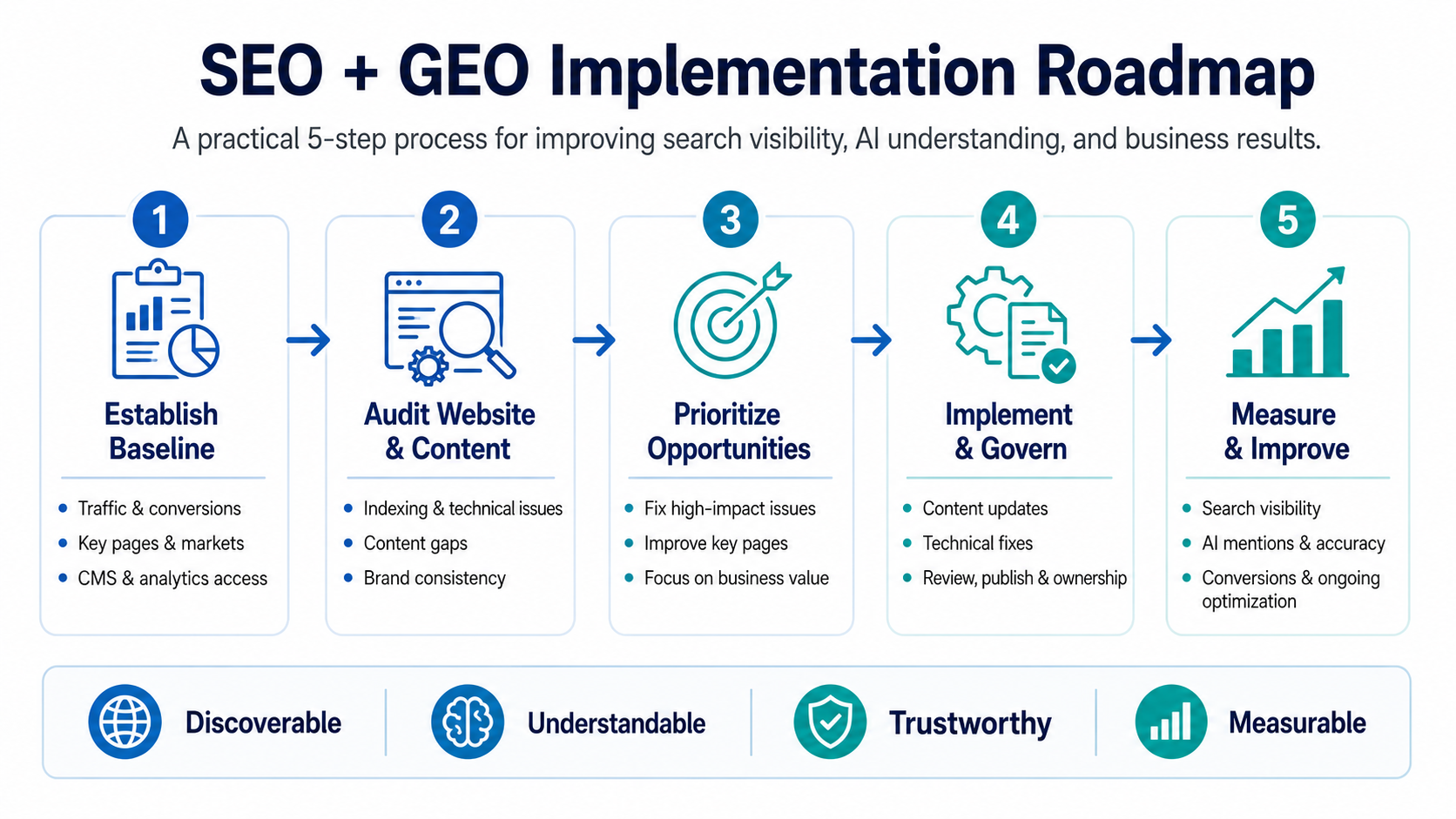
7. Recommended Process for Implementing Enterprise SEO and GEO Services
Step 1: Establish a Baseline
Consolidate information about website traffic, key markets, important pages, conversion goals, CMS architecture, and existing content.
- Current primary sources of organic traffic
- Important product and service pages, and primary conversion paths
- Target markets, languages, and CMS architecture
- Access to GA4, Search Console, and other analytics tools
Step 2: Conduct a Technical and Content Audit
The consultant should identify indexing barriers, duplicate content, topic gaps, inconsistent brand information, and opportunities to improve high-value pages.
The audit should examine:
- Whether search engines can properly access and understand each page
- Whether content answers target customers’ real questions
- Whether product and service descriptions are consistent
- Whether pages have clear CTAs and conversion paths
- Whether AI systems could misinterpret the brand or service capabilities
Step 3: Set Priorities
Begin with product pages, service pages, brand overviews, FAQs, comparison content, and articles with commercial value.
- Technical issues affecting indexing and traffic
- High-traffic pages with low conversion rates
- Pages with high commercial value but thin content
- Pages with inconsistent multilingual content
- Brand or product descriptions AI could easily misinterpret
Step 4: Establish an Implementation Process
Clearly define responsibility for writing, expert review, system changes, tracking, and publication.
- Consultant defines strategy and priorities
- Content team writes or revises content
- Product/sales teams validate facts
- Technical team handles CMS, structured data, performance, and tracking
- SEO/GEO consultant checks production quality; data team tracks performance
Step 5: Review Results Regularly
Review results monthly or quarterly, adjusting content in response to search demand, AI answer changes, product updates, and customer enquiries.
- Organic search impressions and clicks
- Growth in non-branded keywords
- Engagement and conversions on important pages
- Whether AI platforms describe the brand accurately
- Which content needs updating, consolidating, or retiring
8. Which Businesses Benefit Most from an Integrated Consultancy?
The following types of businesses are generally not well served by purchasing a standalone keyword or article package:
Multi-brand, multi-country, or multilingual sites
B2B companies with long sales cycles
Enterprise CMS with complex governance
CRM, CDP, Analytics, or MarTech integration
Website redesign or CMS migration
Teams seeking search, AI, and conversion gains
Large-volume product and knowledge content
Cross-functional marketing, IT, and sales teams
These scenarios require a service provider that can translate strategy into content, technology, and systems initiatives while coordinating different internal stakeholders.
9. Frequently Asked Questions (FAQ)
Should SEO and GEO consulting be handled by the same service provider?
Not necessarily, but one team overseeing both makes it easier to maintain consistency across technical architecture, content strategy, and measurement.
Can GEO optimization guarantee that a business will be cited by ChatGPT or other AI platforms?
No provider can guarantee AI citations. GEO should focus on making content easier to understand, more credible, and more suitable for citation.
How long does it take to see results from SEO and GEO optimization?
It depends on the website's foundations, competition, and execution speed. Technical fixes show faster results; content authority requires sustained effort.
How should businesses compare proposals from different SEO and GEO consultants?
Compare scope, roles, deliverables, tool ownership, and ongoing support—not just article count or monthly fee. Low-cost packages may cost more overall.
Do small and medium-sized businesses need GEO consulting?
It depends on customer search behavior and content complexity. SMBs can start with company profile, core service pages, FAQs, and local business listings.
10. Conclusion
The key to choosing an SEO and GEO consultancy is not to find the provider that makes the most promises, but to determine whether it can understand the business, identify technical and content issues, set sensible priorities, and drive continuous improvement through transparent data.
SEO makes a business discoverable in search; GEO helps AI understand the business accurately. Both should be incorporated into website, content, and data governance.
LeadsTech provides SEO and GEO optimization services integrated with corporate website development, CMS, content strategy, and MarTech systems integration. If your business is assessing search and AI visibility, visit our Contact Us page to discuss your website architecture, content workflows, and implementation priorities:
You can also visit the LeadsTech SEO and GEO optimization services page to learn more:
Further Reading
- SEO and GEO Optimization Services
Learn how LeadsTech helps businesses improve their search and AI visibility through technology, content, and data. - From SEO to GEO: How AEM LLM Optimizer Helps AI Understand Enterprise Content
Discover how businesses can monitor and optimize the performance of their content in generative AI responses. - Content Strategy, Content Creation, Content Entry, and Multilingual Translation Services
Learn how to build consistent, maintainable content operations that can scale across multiple markets. - Corporate Website Development Services
Explore solutions for CMS architecture, content management, systems integration, and long-term website governance.
Related Articles
Enterprise AI MarTech Trends Analysis 2024-2029 Outlook Report
From AI content productivity tools to a core engine for revenue growth and marketing transformation
*The PDF will be sent directly to your inbox.