
How to Make Your Brand Appear in ChatGPT, Gemini, and AI Overviews: A GEO Guide
AI, MarTech
13 September 2026
Buyers increasingly ask ChatGPT, Gemini, or Google AI Overviews which suppliers they should consider. A company can rank in traditional search and still be absent from a generated answer. GEO is not about adding a few AI-oriented phrases. It is about making brand information discoverable, understandable, verifiable, and citable. When assessing GEO readiness, LeadsTech reviews website technology, answer content, entity data, and external evidence together, rather than relying on a single format or short-term tactic. This guide provides a complete framework spanning technology, content, authority, and measurement.
Key Takeaways (TL;DR)
No setting can guarantee that a brand ranks first in ChatGPT, Gemini, or AI Overviews. Enterprises should first ensure that permitted search and AI crawlers can access their content, then build clear entities, direct answers, original evidence, accurate dates, and consistent external information. Google has stated that AI Overviews build on search fundamentals and do not require special schema or dedicated AI files. GEO should be measured with a fixed prompt set that tracks brand mentions, cited sources, website engagement, and qualified opportunities.
Can GEO optimization guarantee that AI will cite a brand?
No. Generated answers vary by query, location, language, time, model, search results, and user context. Even when a site is technically sound and its content is high quality, it cannot be guaranteed to be crawled, indexed, selected, or shown. Any promise to secure the number-one AI position deserves careful scrutiny.
A practical definition of GEO (Generative Engine Optimization) is improving the likelihood that AI search systems can find, correctly understand, verify, and select brand content as a source. GEO shares much of its foundation with SEO, but places greater emphasis on answer completeness, entity relationships, verifiable evidence, and consistency across sources.
How do ChatGPT, Gemini, and AI Overviews discover content?
The platforms do not work in exactly the same way. OpenAI states that public websites can appear in ChatGPT Search. If content is to be included in summaries and snippets, a site should not block OAI-SearchBot, and the host or CDN must allow the relevant traffic. ChatGPT Search may rewrite a question into a set of more precise search queries, and its answers may display citations and source links.
Google explains that AI Overviews and AI Mode build on existing search ranking and quality systems. To appear as a supporting link, a page must be indexed and eligible to show a snippet in Google Search. Google does not require dedicated AI schema, llms.txt, or aggressively fragmented articles. Helpful, reliable, people-first content and technical SEO remain central.
In some cases, Gemini provides public web sources or related links and can use Google Search to help verify information. Enterprises should not assume that a Google ranking automatically guarantees a Gemini citation; platform differences should be part of the testing plan.
What verifiable evidence should an enterprise website establish?
Before an AI system can include a brand in an answer, it needs to understand who the company is, what it provides, where it operates, and which information is trustworthy. A website should present its company name, products, services, locations, contact details, authors, update dates, and policies consistently. Important information should be available as readable text, not hidden only in images, video, or login-gated files.
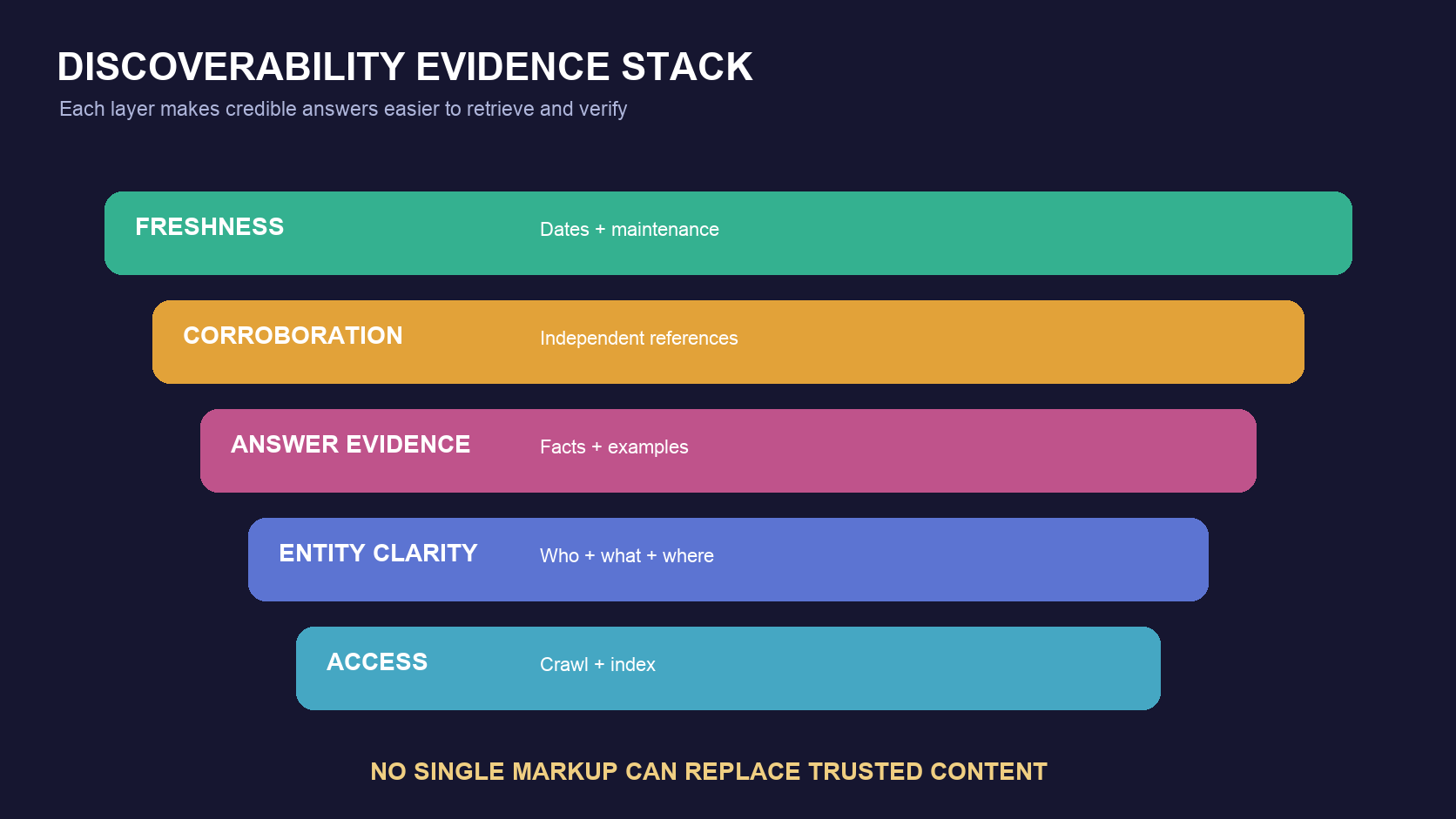
Evidence can be viewed in five layers: technical access, entity clarity, answer content, independent validation, and freshness. Product pages can explain capabilities, but third-party media, industry directories, public customer stories, research, reviews, and expert citations help validate a brand’s claims. The goal is genuine, relevant mentions—not mass-purchased low-quality links or fabricated discussion.
Structured data can still help search engines understand a page and qualify it for traditional rich results, but it must match the visible text. Do not add ratings, prices, FAQs, or company details that are absent from the page, and do not treat schema as a shortcut to AI citation.
How can content be rewritten as answers that are easy to understand and cite?
Start with customer decision questions, not brand slogans. Every important page should clearly answer what it is, who it is for, what it solves, what its limits are, how it compares, and what to do next. Then add methods, examples, sources, and checklists.
- Use descriptive titles: Make each H2 correspond to a natural question or decision.
- Answer before explaining: Put the conclusion in the first two sentences, then add conditions, evidence, and limitations.
- Create original information: Add your own methods, experience, anonymized trends, calculations, or real public cases.
- Define entities clearly: Do not leave product names, company relationships, locations, versions, or dates ambiguous.
- Keep content maintainable: Show update dates and regularly correct features, regulations, pricing models, and broken links.
Content does not need to be written as stiff, AI-only short sentences, and there is no ideal fixed word count. Clear structure helps people and systems understand the material. Breaking an article into repetitive fragments, stuffing keywords, or mass-producing pages with no new information will reduce trust instead.
Scenario: How can a B2B exporter begin GEO?
Imagine an industrial equipment exporter whose brand website can be found on Google. Yet when users ask an AI in English or Chinese how to choose a food-grade packaging equipment supplier, the answer names only competitors. A review finds that the website offers product specifications but no selection criteria, certification guidance, application limits, delivery regions, maintenance approach, or public cases.
The company can begin by building a selection-guide content cluster. Its main page explains evaluation dimensions; product pages explain suitable capacity and limitations; technical pages cover compliance and maintenance; case pages describe verified scenarios; and company, author, and contact pages complete the entity information. In parallel, it should review robots.txt, indexing, canonicals, multilingual hreflang, internal links, and OAI-SearchBot access.
Success tracking should not stop at whether the brand is mentioned. It should also cover whether the answer describes the brand accurately, which page is cited, whether visitors consume high-value content, and whether enquiries enter the CRM as qualified opportunities.
How should GEO visibility and business value be measured?
Start with a fixed prompt set that covers the brand, category, comparisons, questions, regions, and purchase decisions. Repeat the tests monthly under defined platform, language, and location conditions. Record brand mentions, mention position, description accuracy, citations or links, selected sources, and competitors. The same question can produce different results, so evaluate trends rather than drawing conclusions from a single screenshot.
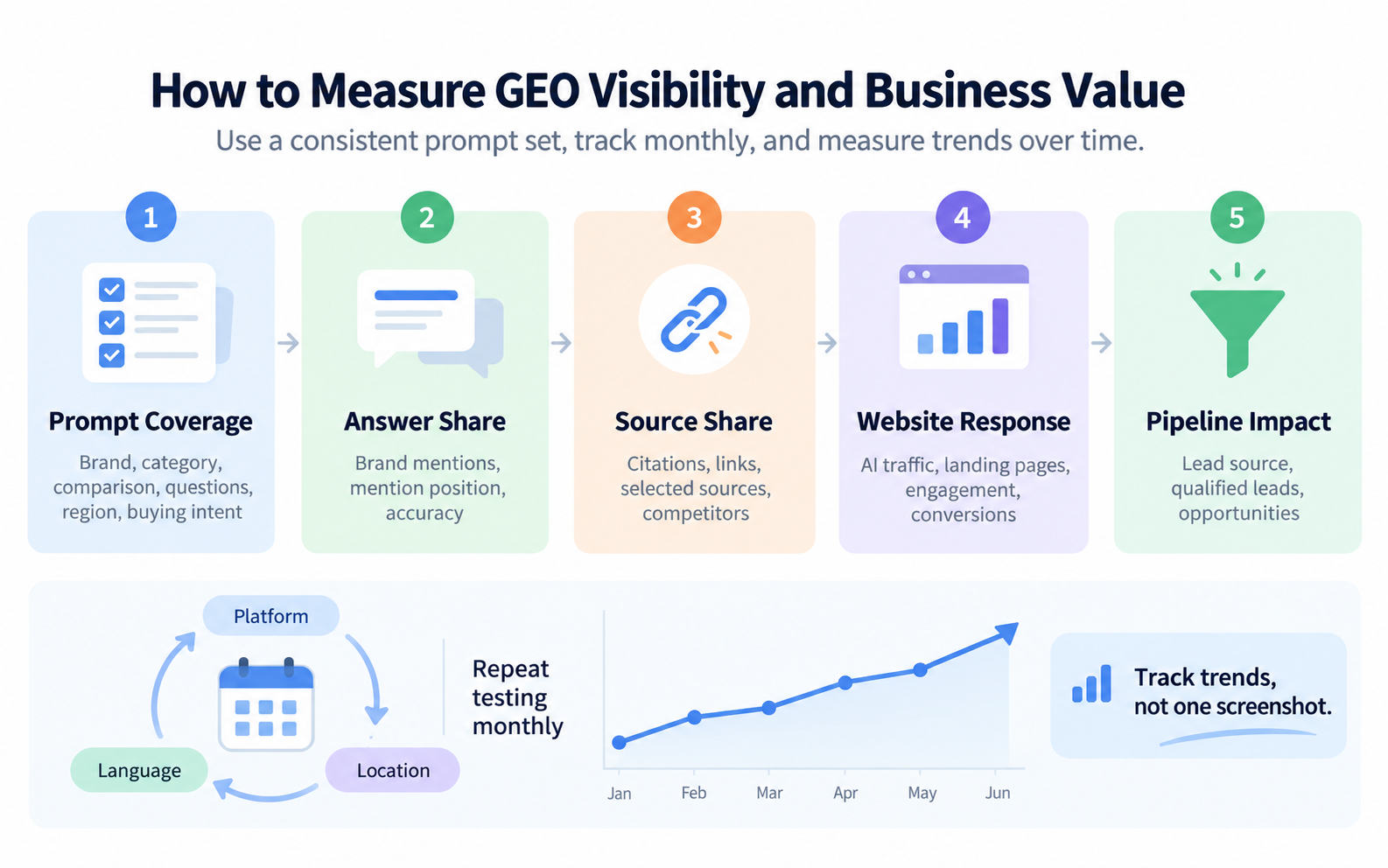
Measurement should have five layers: prompt coverage, answer share, source share, website response, and commercial pipeline. Web analytics can observe AI-referred traffic, landing pages, engagement, and conversion; CRM records lead source, qualification rate, and opportunities. Referral traffic is only the visible portion because many users search for a brand by name after reading an answer.
A 90-Day GEO Optimization Action Plan
Days 1–15
Build a baseline of 30 to 50 high-value questions, platforms, and languages.
Days 1–20
Review Google indexing, snippet eligibility, robots.txt, CDN behavior, OAI-SearchBot, and key-page readability.
Days 10–30
Standardize company, product, author, region, contact, and policy information.
Days 20–50
Optimize five to ten priority pages with direct answers, limits, comparisons, cases, and update dates.
Days 30–65
Create an original content asset, such as a selection framework, research study, calculator, or published methodology.
Days 45–75
Earn genuine industry citations, partner information, and relevant media mentions.
Days 60–90
Re-run the prompt set and review answer accuracy, source changes, website engagement, and opportunities.
Day 90
Discard unsupported content assumptions and extend effective patterns to other topic clusters.
Frequently Asked Questions
Will GEO replace SEO?
No. Google AI features still depend on search indexing and quality systems, and other AI search products also need discoverable public content. Technical SEO and content quality remain GEO foundations.
Do I need llms.txt to appear in AI Overviews?
No. Google has explicitly said that its search and generative AI features do not use llms.txt as a visibility signal; creating one will not improve Google rankings.
Can schema guarantee a ChatGPT citation?
No. Correct schema can help search engines understand content and qualify it for rich results, but no markup can guarantee that ChatGPT or another AI platform will cite a website.
How can I tell whether ChatGPT can crawl my website?
Check robots.txt, CDN/WAF logs, and OpenAI's published OAI-SearchBot and IP information, then confirm that important pages have no noindex directive or login restriction.
How long does GEO optimization take to show results?
There is no fixed timeline. Crawling, indexing, content competition, platform updates, and query type all affect results. Enterprises should assess monthly trends and business indicators rather than promise short-term rankings.
Conclusion
The key to appearing in ChatGPT, Gemini, and AI Overviews is not chasing a mysterious tag. It is building enterprise knowledge that is accessible, understandable, verifiable, and maintainable. The most practical next step is to select a high-value prompt set, fix technical access, and then improve core pages and external evidence. Use the CTA below to discuss measurement baselines, content strategy, and cross-market optimization with our team.


Further Reading
- SEO, GEO, and AI Search Growth Strategy: Increasing Brand Visibility and Opportunities: Connect organic search and AI visibility to growth strategy.
- SEO vs. GEO: A Complete Comparison of Search Engine and Generative Engine Optimization: Understand their shared foundations and measurement differences.
- Multilingual Website SEO/GEO Consulting: Increasing Global Search Visibility: Extend optimization to languages, markets, and international website governance.
Related Articles
Enterprise AI MarTech Trends Analysis 2024-2029 Outlook Report
From AI content productivity tools to a core engine for revenue growth and marketing transformation
*The PDF will be sent directly to your inbox.
Email Error
Please enter a valid email address.
Thank You!
The whitepaper has been sent to your inbox. If you don’t see it, please check your spam or promotions folder.