
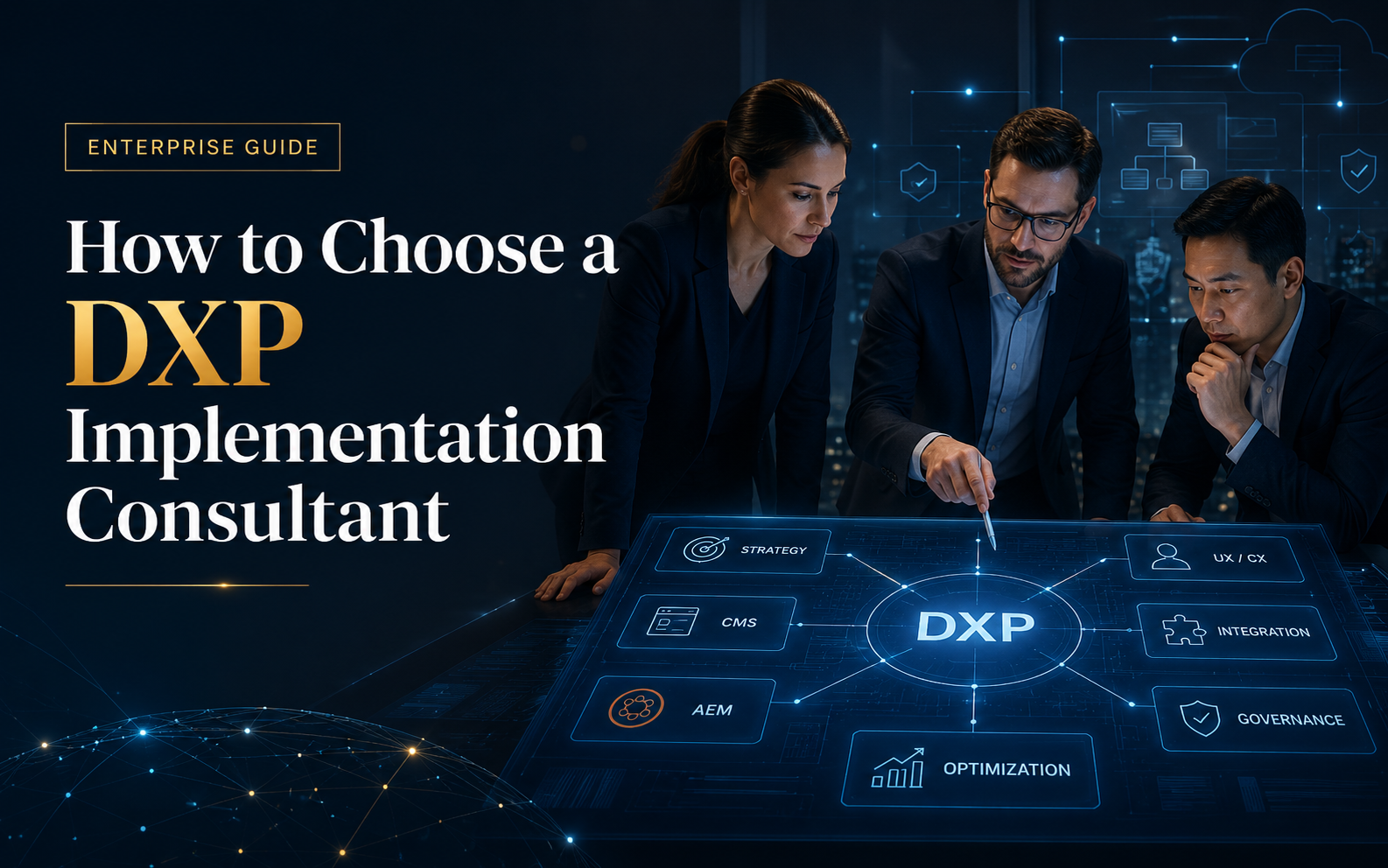
DXP Consulting: How to Choose a Digital Experience Platform Partner
AEM Sites, Content Management System (CMS), Magnolia CMS, Martech
3 July 2026
- Introduction: Why DXP Implementation Success Depends on More Than Just the Platform
- Roles and responsibilities of DXP implementation providers
- DXP Consultants vs General Web Developers vs Platform Technology Providers
- Common DXP and Enterprise CMS Platforms in the Market
- Three common misconceptions when companies select a DXP consultant
- Key criteria for choosing a DXP consultant
- Why DXP Consultants Need Both Industry Experience and Technical Expertise
- How to Assess Whether a DXP Service Provider Has Long-Term Partnership Potential
- What companies should prepare before implementing a DXP
- How LeadsTech Helps Companies Drive DXP, CMS, and MarTech Integration Projects
- Conclusion: Choosing the Right DXP Consultant Lays a Solid Foundation for Digital Experience
- Further Reading
- Introduction: Why DXP Implementation Success Depends on More Than Just the Platform
- Roles and responsibilities of DXP implementation providers
- DXP Consultants vs General Web Developers vs Platform Technology Providers
- Common DXP and Enterprise CMS Platforms in the Market
- Three common misconceptions when companies select a DXP consultant
- Key criteria for choosing a DXP consultant
- Why DXP Consultants Need Both Industry Experience and Technical Expertise
- How to Assess Whether a DXP Service Provider Has Long-Term Partnership Potential
- What companies should prepare before implementing a DXP
- How LeadsTech Helps Companies Drive DXP, CMS, and MarTech Integration Projects
- Conclusion: Choosing the Right DXP Consultant Lays a Solid Foundation for Digital Experience
- Further Reading
1. Introduction: Why DXP Implementation Success Depends on More Than Just the Platform
Quick Answer: When choosing a DXP implementation service provider, companies should evaluate whether they offer platform selection advice, enterprise-level CMS implementation capabilities, content governance, UX/UI and information architecture skills, system integration and data flow design experience, understanding of MarTech architecture, as well as post-launch maintenance and long-term optimization capabilities.
As companies face more digital touchpoints, systems like websites, apps, membership platforms, CRM, CDP, DAM, marketing automation, and content management platforms no longer operate in isolation. What companies need is not just a single website build but a digital experience architecture that supports cross-channel content management, personalized experiences, data integration, and long-term operational optimization.
DXP emerged to help companies integrate content, data, channels, and experience delivery capabilities. However, in practice, the platform itself is just the foundation; what truly impacts implementation success is whether the consultant understands the business, technical architecture, and operational processes. A good DXP consultant not only helps launch the platform but also assists in building a sustainable, scalable, and measurable digital experience architecture.
That said, DXP is not synonymous with any specific brand or platform. The market offers various types of DXP or enterprise-level CMS such as Adobe Experience Manager, Magnolia, Sitecore, Optimizely, Acquia, Contentful, and Drupal. Companies should choose the most suitable platform and implementation path based on content complexity, integration needs, budget, IT architecture, and operational team capabilities.
2. Roles and responsibilities of DXP implementation providers
A DXP implementation service provider is not just a system installer but a partner that helps translate business goals into content models, experience architecture, component libraries, permission workflows, API integrations, data flow design, data tracking, and long-term operational mechanisms.
A mature DXP consulting team typically participates in the full process from initial assessment, requirements clarification, platform selection, system design, third-party integration, to post-launch optimization. This means the provider must understand business strategy, content management, user experience, data flows, system security, and ongoing maintenance.
For companies, choosing a service provider should go beyond price comparison and consider whether the provider can answer the following questions:

Understanding Business Goals
Can brand, marketing, sales, and customer service needs be translated into concrete platform features and implementation plans?

Technical Architecture Planning
Can the provider compare different DXP/CMS platforms based on company needs instead of steering toward a single platform from the start?

Content and Operational Processes
Can it help enterprises establish content governance, permission management, approval workflows, and multi-market operating models?

System integration and data flow design
Can the provider assist companies in planning data flows and API integrations between DXP and CRM, CDP, DAM, Analytics, MA, Commerce, membership systems, or data warehouses?

Long-Term Optimization Capability
Can the provider continuously support performance, SEO, GEO, conversion paths, personalized experiences, and data analytics after website launch, enabling the platform to gradually accumulate measurable operational value?

3. DXP Consultants vs General Web Developers vs Platform Technology Providers
When choosing partners, companies often confuse website developers, platform technology providers, and DXP consultants. While all may be involved in website or platform builds, their roles and applicable scenarios differ.
If a company only needs a simple corporate website, a general website developer may suffice. If the platform is already chosen and the focus is on components, workflows, content migration, and platform deployment, a platform technology provider is appropriate.
However, if the company’s needs involve multiple brands, markets, languages, personalization, data integration, CRM/CDP connections, cross-channel journeys, and long-term operational optimization, it’s necessary to consider implementation service providers with DXP consulting capabilities.
| Type | Core Competencies | Applicable Scenarios |
|---|---|---|
| General Website Developers | Frontend Pages, Website Features, Basic CMS Setup, Visual Implementation | Single official website, limited content volume, low system integration needs |
| Platform Technology Providers | Specific Platform Configuration, Component Development, Content Migration, Workflow Setup | Once a CMS or DXP Is Selected, Focus on Platform Deployment |
| DXP consultants / implementation providers | MarTech architecture, content governance, UX/UI, data flows, system integration, personalization, long-term optimization | Enterprises with Multiple Markets, Systems, and Channels Needing a Holistic Digital Experience Architecture |
4. Common DXP and Enterprise CMS Platforms in the Market
The DXP market does not offer a one-size-fits-all solution. Different platforms vary in content management, personalization, openness, integration flexibility, technical architecture, and licensing costs. Before selecting, companies should understand the positioning of mainstream platforms.
When choosing a DXP, don’t just ask “Which platform is best?” but rather “Which platform best fits the company’s current and next three to five years of operational needs?” For example, if a company values open architecture and flexible integration, platforms like Magnolia or Drupal may be worth considering; if a headless and API-first architecture is needed, composable CMS like Contentful might be suitable.
| Platform | Common Positioning | Suitable Business Types |
|---|---|---|
| Adobe Experience Manager | Enterprise-level content management, DAM, and cross-channel experience delivery | Large Enterprises, Multi-Brand, Multilingual, Adobe Ecosystem Users |
| Magnolia CMS | Flexible DXP/CMS That Can Integrate with Existing Systems | Companies needing open architecture, rapid integration, and multi-market websites |
| Sitecore | Integration of content, personalization, customer experience, and marketing capabilities | Companies that prioritize personalization, customer journeys, and content experience management |
| Optimizely | CMS, experimentation, personalization, and commerce experience | Enterprises Focused on A/B Testing, Conversion Rate Optimization, and Data-Driven Experiences |
| Acquia / Drupal | Open-source CMS, cloud hosting, scalable DXP | Organizations Preferring Open-Source Architecture, Customization Flexibility, and Large Content Sites |
| Contentful | API-first, Headless CMS, Composable DXP | Enterprises Needing Multi-Channel Content Delivery, Frontend-Backend Decoupling, and Development Flexibility |
5. Three Common Misconceptions When Enterprises Choose DXP Consultants
Many companies focus on platform price, development speed, or a single feature list when choosing DXP implementation providers but overlook post-implementation operational costs and scalability.
Misconception 1: Treating a DXP Project as a Traditional Website Redesign
DXP implementation typically involves content management, member data, marketing campaigns, data tracking, third-party system integration, and multilingual management. Planning with only a website development mindset often leads to system integration difficulties or inefficient content maintenance later.
Website redesigns usually focus on page design, front-end development, and launch schedules; DXP projects emphasize content models, component governance, data flow design, permission management, cross-system integration, and long-term optimization.
Misconception 2: Focusing only on whether the provider can use a specific platform
Being able to operate Magnolia, Sitecore, or other CMS does not guarantee successful DXP implementation. A mature DXP consultant must understand content governance, UX/UI, information architecture, API integration, data flows, SEO, performance, security, and maintenance models.
Experienced providers will propose information architecture, content models, component design, permission workflows, data tracking, and maintenance strategies early in the project, rather than just developing features based on a requirements list.
Misconception 3: Underestimating ongoing optimization after launch
DXP is not a one-time project but a long-term foundation for a company’s digital experience. If the service provider only handles the build without ongoing support and optimization capabilities, companies often face technical debt, performance issues, and operational bottlenecks after launch.
A good DXP service provider should help companies continuously monitor platform performance, content maintenance efficiency, SEO results, conversion paths, personalization effectiveness, and system scalability needs, allowing the platform to gradually accumulate business value.
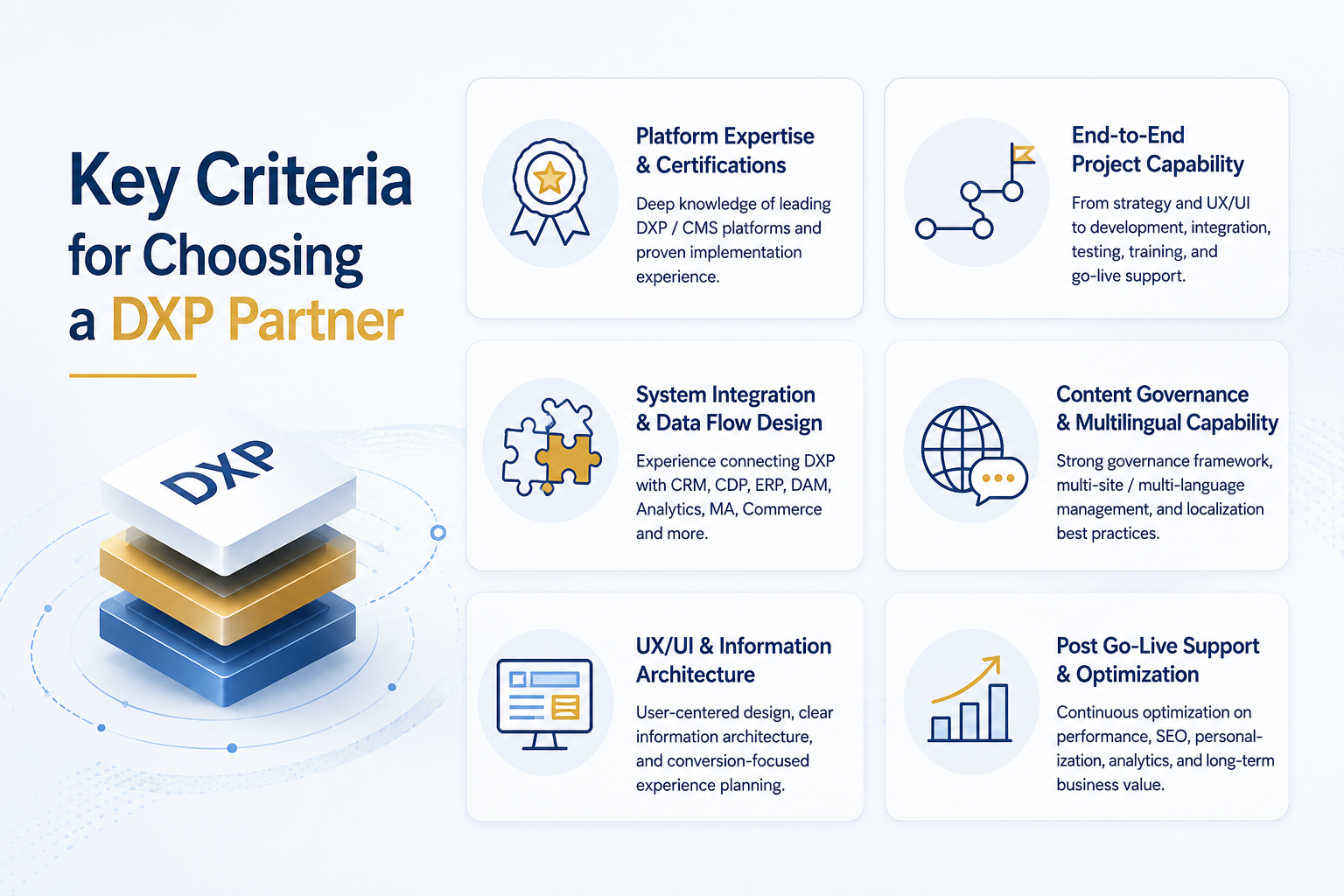
6. Key criteria for choosing a DXP consultant
Enterprises can evaluate DXP consultants from the following perspectives.
Platform expertise and certification capabilities
Can the service provider start from the company’s needs and compare the pros and cons of different DXP/CMS platforms instead of pushing just one? A good consultant should help companies assess differences among AEM, Magnolia, Sitecore, Drupal, Contentful, and others in content governance, integration flexibility, licensing models, and long-term maintenance.
End-to-End Project Capabilities
DXP implementation often includes not only development but also upfront strategy, UX/UI, information architecture, content modeling, content migration, system integration, testing, training, and launch support.
Companies should confirm whether the service provider can deliver end-to-end services rather than just handling a small part. For example, if the provider only manages front-end page development but cannot assist with content modeling, approval workflows, or data tracking, operational gaps are likely to occur later.
Experience in system integration and data flow design
DXP usually requires integration with CRM, CDP, ERP, DAM, MA, Analytics, membership systems, e-commerce platforms, or data warehouses, and involves designing APIs, identity management, data flows, permissions, security, and error handling mechanisms.
If a service provider lacks integration and data flow design experience, projects often face issues with data synchronization, API stability, security permissions, event tracking, and performance.
Content governance and multilingual capabilities
For multinational or multi-brand companies, multilingual support, multiple sites, multi-level permissions, multi-team collaboration, content modeling, and component governance are core DXP implementation requirements.
Service providers should assist companies in planning content models, componentized architecture, approval workflows, permission design, and brand consistency management, allowing different markets to retain local flexibility while maintaining overall corporate governance standards.
UX/UI and information architecture capabilities
DXP projects involve not only backend development but also frontend user experience. Service providers should assist companies in planning information architecture, navigation logic, page templates, content hierarchy, and conversion paths to ensure that user experience supports business goals after platform functionality is completed.
Post-launch maintenance and optimization capabilities
Mature service providers don’t see launch as the end but help companies continuously optimize performance, SEO, GEO, conversion paths, personalized experiences, and data analytics, enabling the platform to gradually accumulate measurable operational value.
7. Why DXP Consultants Need Both Industry Experience and Technical Expertise
The challenge of DXP projects lies in their involvement of people, processes, content, data, and technology simultaneously. Therefore, if a service provider only has technical development skills but lacks industry context, they may fail to design solutions that meet business needs. Conversely, if they only have strategic capabilities without practical implementation experience, projects may stall at the planning stage.
Different industries have varying DXP requirements. Financial and insurance sectors typically emphasize security, permissions, compliance, and approval workflows; retail and e-commerce focus more on personalized recommendations, member data, conversion paths, and transaction experiences; education, government, and public service organizations often prioritize content maintainability, information clarity, multi-device experience, and accessibility.
Hence, when evaluating DXP consultants, companies should ask providers to explain challenges, solutions, and actual outcomes from past cases—not just showcase page designs or feature lists.
8. How to Assess Whether a DXP Service Provider Has Long-Term Partnership Potential
DXP implementation usually impacts a company’s digital operations for the next three to five years, so a service provider’s long-term partnership capability is often more important than short-term development costs.
Companies can evaluate this from the following perspectives:
Whether a clear methodology is in place
Including discovery workshops, requirements interviews, technical assessments, information architecture, content modeling, component planning, development processes, testing standards, launch plans, and knowledge transfer.
Whether knowledge transfer is valued
A good service provider won’t make companies permanently dependent on external teams but will enhance internal team operational capabilities through training, documentation, and workshops.
Whether multi-phase development support is available
DXP projects may start with a corporate website redesign and gradually expand to membership, personalization, marketing automation, data analytics, and AI search optimization. Service providers need the capability to support companies through phased evolution.
Whether cross-regional support capabilities are available
For companies in Greater China or the Asia-Pacific region, cross-language, cross-market, and cross-team project collaboration is crucial. Service providers with cross-regional communication and delivery experience are usually better equipped to help companies manage collaboration challenges in multi-market implementations.
9. What companies should prepare before implementing a DXP
Before searching for a DXP consultant, companies can complete some internal preparations to make the evaluation and implementation process more efficient.
First, clearly define the project goals. Are you aiming to improve website performance, enhance content management efficiency, support multilingual operations, integrate customer data, or build personalized experiences? Different goals will affect platform selection and implementation scope.
Second, inventory existing systems and data sources, including CMS, CRM, CDP, DAM, Analytics, membership systems, e-commerce platforms, and internal databases. This helps service providers accurately assess integration complexity.
Third, organize the current content and process status, such as how many websites exist, how many languages are supported, which teams participate in content publishing, whether there are approval workflows, and if content migration is needed. These details directly impact the DXP project timeline and costs.
Finally, identify internal stakeholders. DXP implementation typically requires collaboration among marketing, IT, content, data, sales, and management. Without clear decision-making and collaboration mechanisms, projects are prone to delays during requirements confirmation, system integration, and acceptance phases.
10. How LeadsTech Helps Companies Drive DXP, CMS, and MarTech Integration Projects
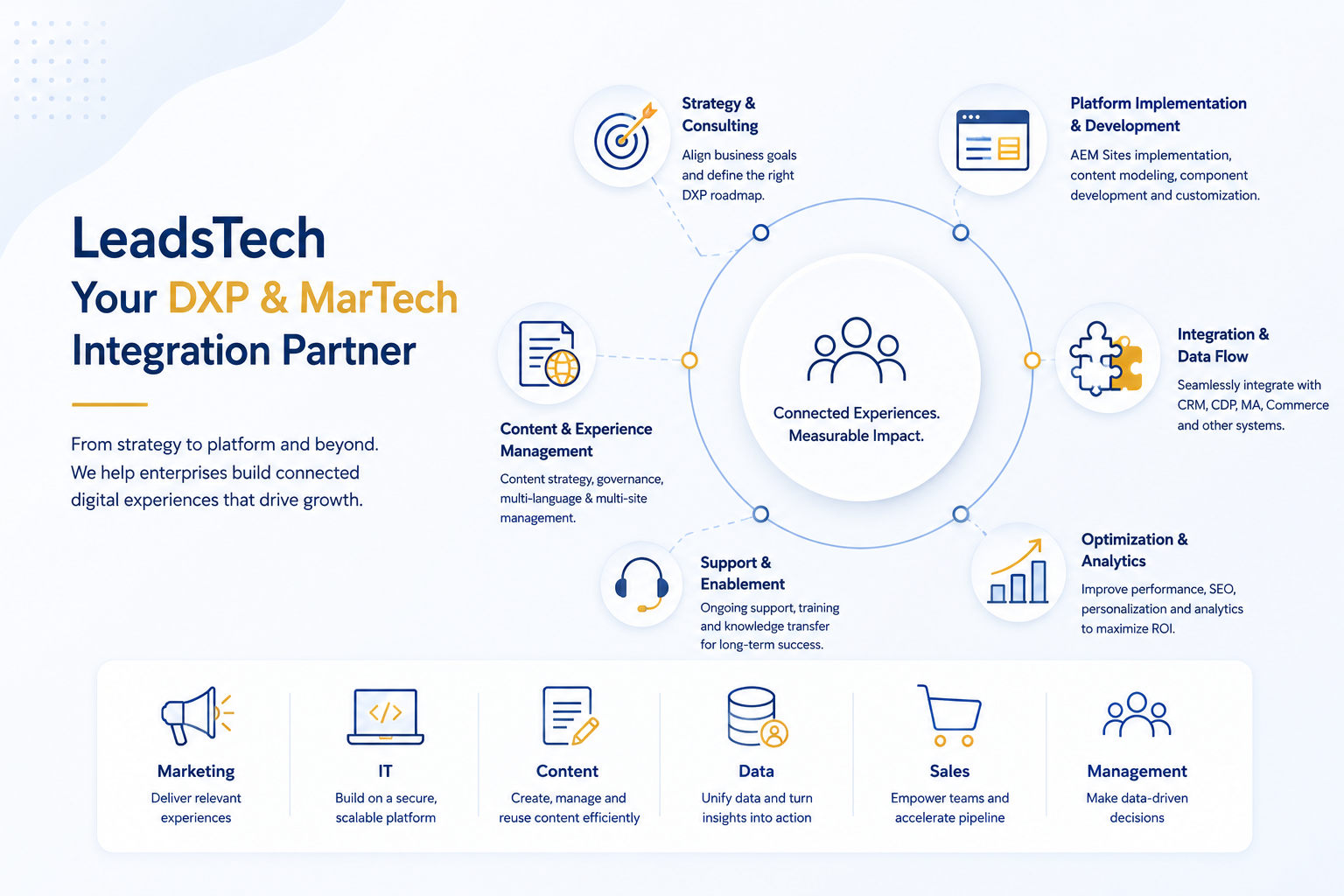
LeadsTech offers enterprise-level digital experience, CMS, CRM, CDP, MA, and MarTech services, assisting companies from strategy planning and platform selection to system deployment, building a sustainable and scalable digital experience foundation.
At the CMS and DXP level, LeadsTech helps evaluate and implement various platforms based on company needs, including Adobe Experience Manager, Magnolia CMS, and other enterprise-level CMS/MarTech solutions. Project scopes cover content modeling, component design, multilingual website architecture, content migration, third-party system integration, performance optimization, maintenance support, and team training.
For companies aiming to use DXP as a long-term digital transformation foundation, these services help reduce implementation risks and accelerate the platform’s transition to an operational and optimizable state.
More importantly, DXP is not a tool for a single department but a digital experience infrastructure used collaboratively by marketing, IT, content, data, sales, and management teams. Choosing a partner with both consulting and implementation capabilities helps reduce siloed risks and build a more consistent and measurable customer experience.
11. Conclusion: Choosing the Right DXP Consultant Lays a Solid Foundation for Digital Experience
Implementing DXP is a decision that affects a company’s long-term digital operational capabilities. While platform selection is important, the real determinant of project success is whether the company chooses the right implementation consultant and service provider.
A suitable DXP consultant should understand business goals, assist in planning technical architecture, design maintainable content workflows, integrate key systems, and provide ongoing support and optimization after launch. This goes beyond delivering a website or platform; it’s about building an experience architecture that supports future digital growth.
If you are evaluating DXP, Magnolia CMS, Adobe Experience Manager, or other enterprise-level CMS implementations, feel free to visit LeadsTech’s product page to learn how we help companies build cross-channel, scalable digital experience platforms:
Also welcome to connect directly via Contact our consulting teamDiscuss your business needs, existing system architecture, and suitable implementation paths.