
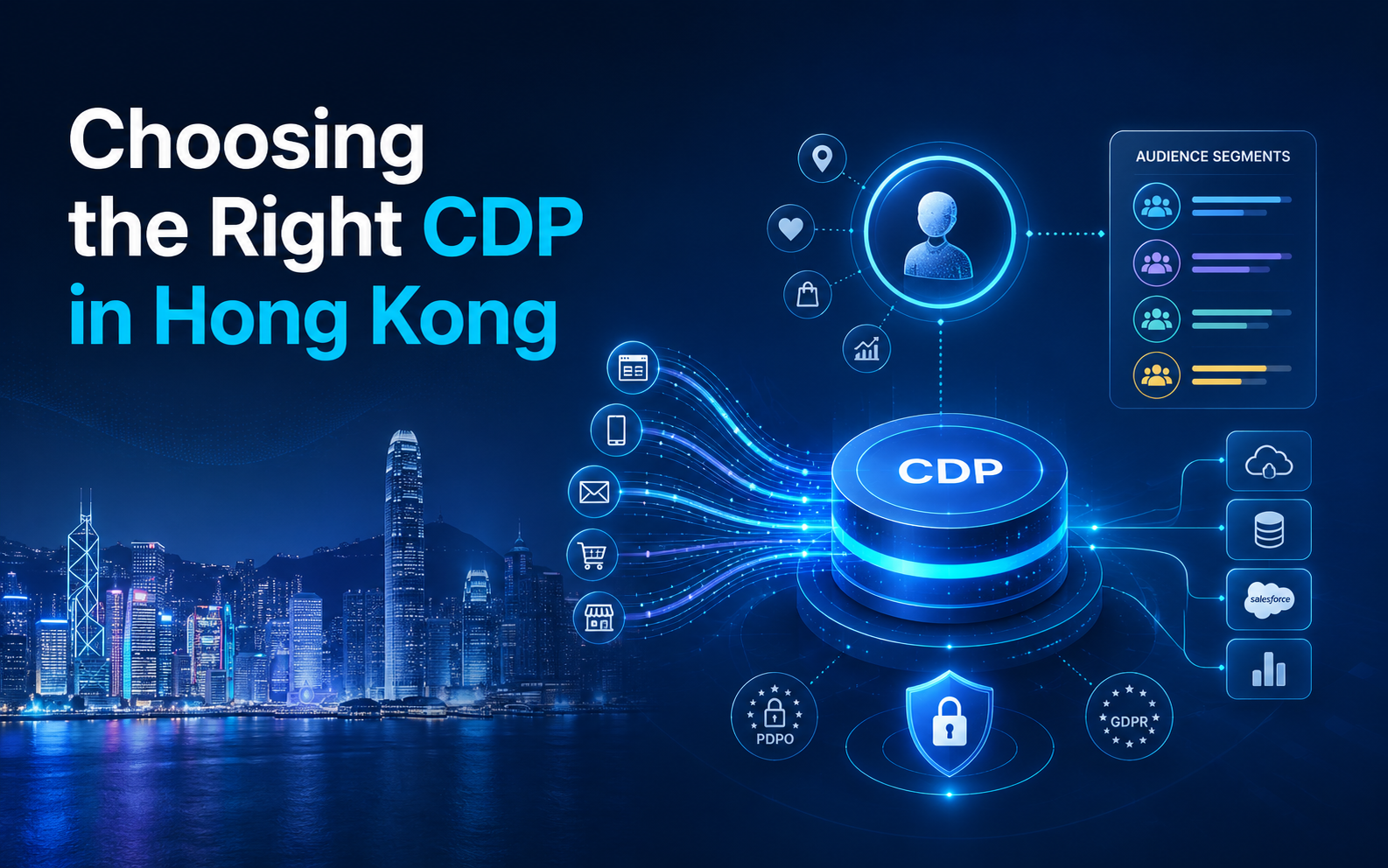
CDP Recommendations | How Hong Kong Enterprises Can Choose the Right Customer Data Platform
Adobe Real-time CDP, CDP, MarTech
28 July 2026
Purpose of This Article and Key Takeaways
This article is designed to help Hong Kong enterprises understand how to choose the right customer data platform (CDP), particularly when addressing needs such as multichannel customer engagement, first-party data management, personalized marketing, and privacy compliance. It explains how to make an informed decision from the perspectives of business objectives, technical architecture, and implementation services.
Quick answer: When choosing a CDP, Hong Kong enterprises should prioritize first-party data integration, identity resolution, real-time segmentation, PDPO privacy compliance, direct marketing consent, MarTech integration capabilities, and local implementation and long-term support services.
After reading this article, you will be able to distinguish more clearly between the positioning of different CDP solutions and establish a selection framework suitable for internal enterprise evaluation.
A CDP creates value only when customer data becomes usable, governed, and sustainable—not simply more centralized. Through its CDP implementation and management service, LeadsTech starts with data sources, identity matching, audience needs, and activation use cases before recommending a platform or implementation path.
1. Introduction: Why Hong Kong Enterprises Are Prioritizing CDPs
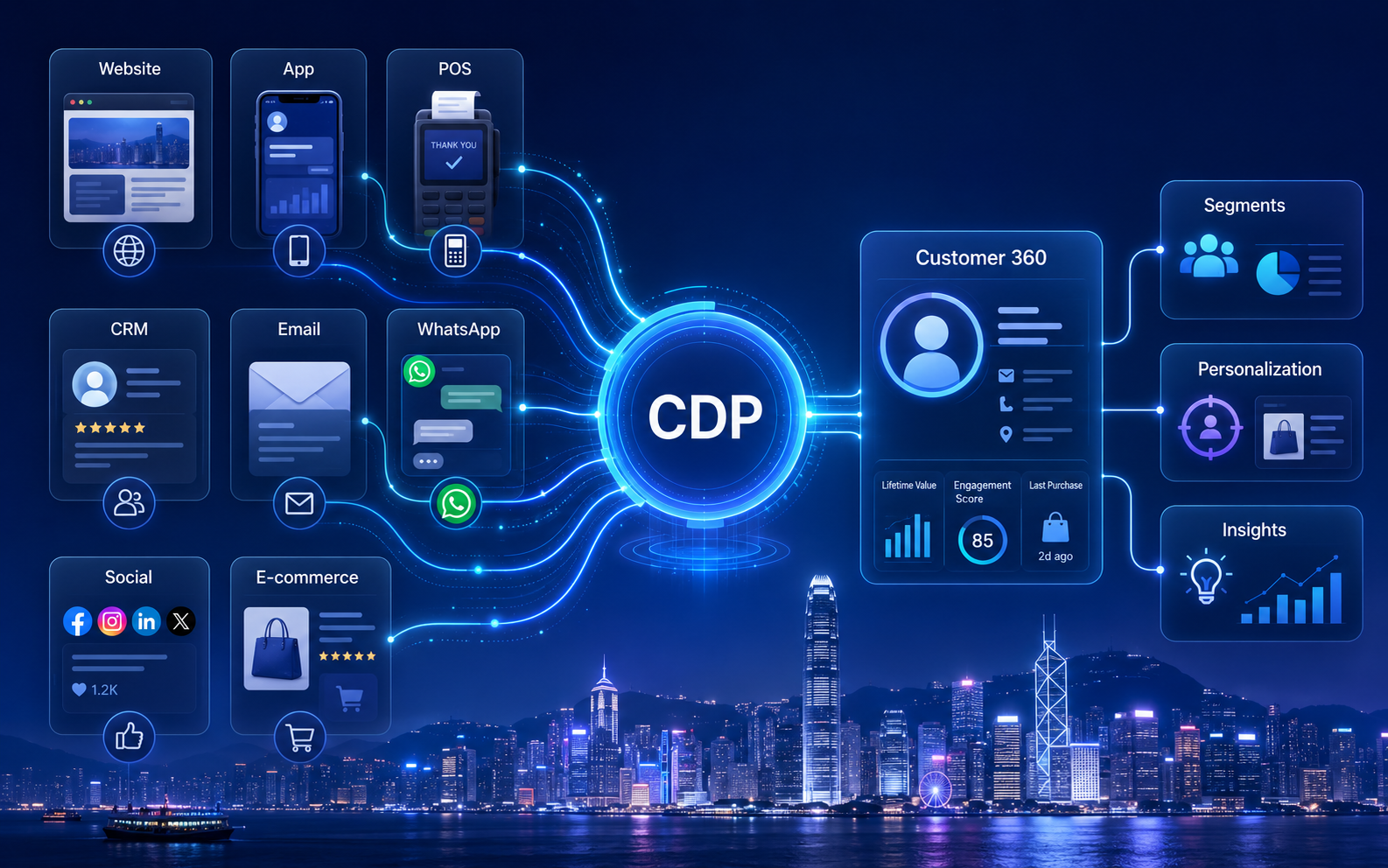
Customer interaction channels are becoming increasingly fragmented for Hong Kong enterprises. Consumers may first browse products on a website, engage through social media, make a purchase at a physical store, and later receive promotional messages through email, an app, or WhatsApp. For businesses in retail, finance, insurance, travel, education, media, and B2B sectors, customer data is often scattered across CRM systems, POS systems, e-commerce platforms, customer service systems, web analytics tools, and advertising platforms.
When data is dispersed across different systems, enterprises struggle to answer several critical questions: Who are their high-value customers? Which customers are at risk of churn? Which channels drive genuine conversions? When and with what content should they engage customers?
This is precisely where a CDP delivers value. A CDP is not simply another marketing tool; it is a critical foundation for building first-party data assets, resolving identities, managing consent, segmenting audiences, activating engagement across channels, and optimizing customer journeys.
For Hong Kong enterprises, CDP selection must also account for local privacy requirements, direct marketing consent, cross-border data processing, Traditional Chinese and English content scenarios, and integration with existing CRM, POS, e-commerce, and MarTech systems.
2. A Quick Comparison of CDPs, CRMs, and DMPs
A CDP (Customer Data Platform) is a platform used to integrate, unify, manage, and activate customer data. Its core function is to consolidate data from different touchpoints into customer profiles that can be used for marketing, analytics, and personalized engagement.
A CDP serves a different purpose from other commonly used systems.
CRM: Primarily Manages Known Customer Data
A CRM is typically used for sales, customer service, and customer relationship management, with a focus on recording customer contact details, transaction histories, opportunity statuses, and service interactions.
A CRM helps enterprises manage known customers and business processes, but it may not fully integrate website behavior, anonymous visitors, advertising interactions, and real-time behavior across channels.
DMP: Focuses on Anonymous Audiences and Advertising
A DMP is commonly used to manage third-party data and advertising audiences and has historically relied heavily on third-party cookies. As third-party cookies decline and privacy regulations become more stringent, enterprises increasingly need to rely on first-party data to build sustainable customer data capabilities.
CDP: Integrates Known and Anonymous Data and Activates It
Subject to data authorization, identity resolution, and consent management rules, a CDP can integrate website behavior, app interactions, member data, transaction records, and marketing responses to build a more complete customer view. It can then send audience segments to email, advertising, website personalization, marketing automation, customer service, or sales workflows.
Put simply, a CRM helps an enterprise manage relationships, while a CDP helps it understand customers and activate data.
3. Questions Hong Kong Enterprises Should Clarify Before Choosing a CDP
Before comparing different CDP platforms, enterprises should not focus solely on feature lists or brand recognition. They should first return to their own requirements, because the most suitable CDP can differ completely from one enterprise to another.
Before implementation, enterprises are advised to clarify the following questions.
What Are the Business Objectives?
Is the goal to increase repeat purchases among members, reduce churn, optimize advertising audiences, strengthen cross-channel personalization, or build a complete Customer 360? Different business objectives will affect data sources, audience segmentation, activation channels, and performance measurement methods.
Which Systems Currently Hold the Data?
Enterprises should determine whether their data is currently scattered across websites, apps, POS systems, CRM platforms, ERP systems, contact centers, EDM platforms, advertising platforms, e-commerce platforms, and offline event records. If there are numerous data sources with different formats and inconsistent field definitions, a data inventory and governance plan will be required before CDP implementation.
Are Real-Time Segmentation and Triggers Required?
If an enterprise needs to send messages based on real-time behavior—for example, triggering remarketing after a customer views a product—it must evaluate not only the CDP's real-time processing capabilities but also whether tracking, consent management, marketing automation, and advertising channels have been integrated.
Does the Internal Team Have Data and Marketing Operations Capabilities?
A CDP does not generate value automatically once it goes live. It still requires data governance, segmentation strategies, customer journey design, marketing content, performance tracking, and continuous optimization. If the enterprise lacks in-house data and MarTech operations capabilities, the implementation provider's consulting and training capabilities will be especially important.
Are There Cross-Regional or Privacy Compliance Requirements?
Hong Kong enterprises that also operate in Mainland China, Taiwan, Southeast Asia, or international markets must pay greater attention to data storage locations, cross-border data processing, consent management, access controls, data retention, and data usage policies. In the Hong Kong market, enterprises must also pay particular attention to the Personal Data (Privacy) Ordinance (PDPO) and requirements related to direct marketing when processing personal data.
4. CDP Evaluation Criteria: Data, Identity, Activation, Compliance, and Integration Capabilities
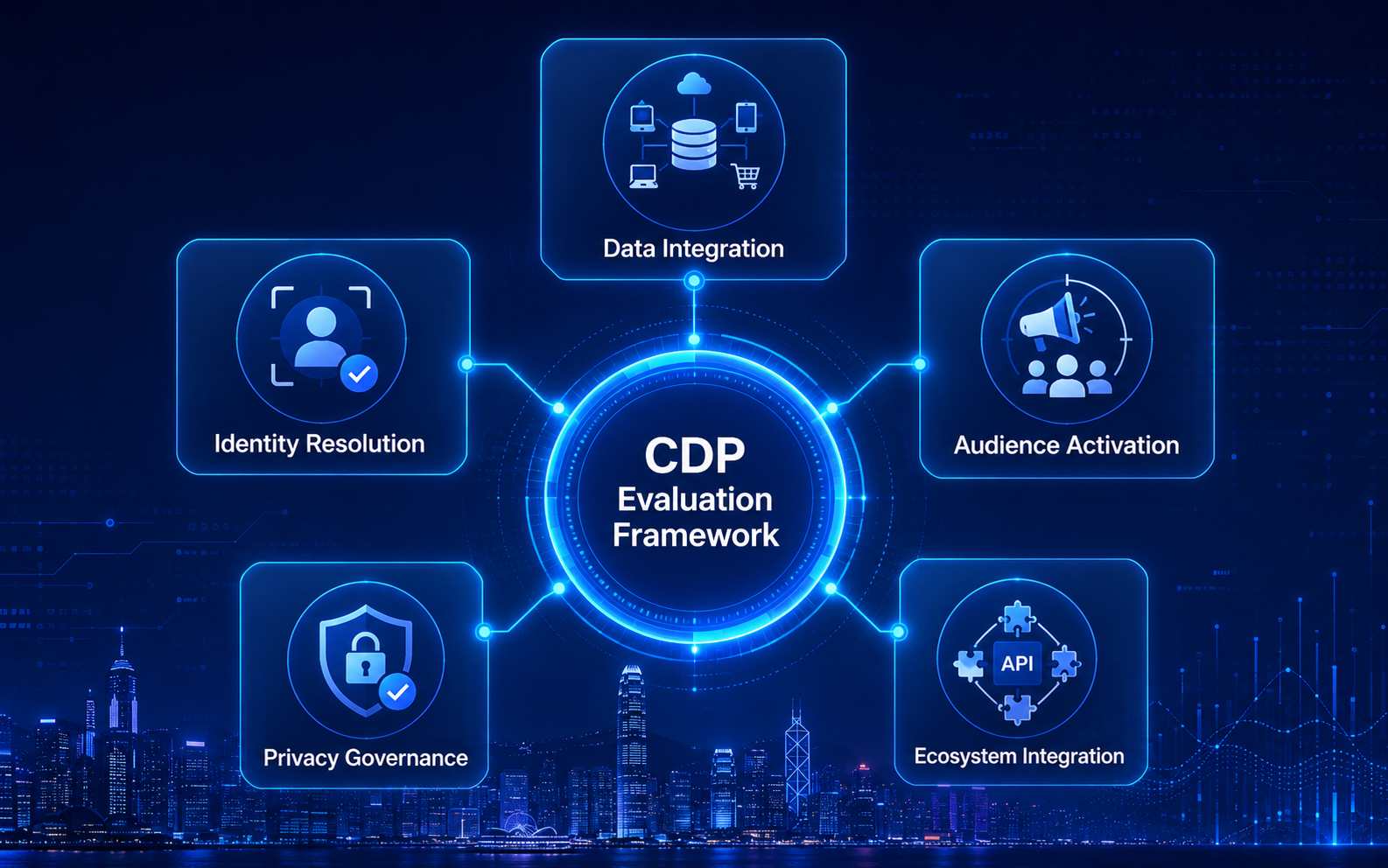
When choosing a CDP, enterprises can evaluate five core capabilities: data integration, identity resolution, audience activation, privacy governance, and ecosystem integration.
4.1 Data Integration Capabilities
A CDP must be able to connect to an enterprise’s existing systems, including its website, app, CRM, POS, e-commerce, customer service, advertising, and marketing automation tools. When data comes from many sources and has complex formats, the platform’s connectors, APIs, and data model flexibility become especially important.
Common data sources for Hong Kong enterprises include in-store POS systems, membership systems, WhatsApp or customer service interactions, e-commerce orders, website behavior, offline event lists, and CRM sales records. A CDP’s ability to integrate this data will directly affect the completeness of the resulting Customer 360.
4.2 Identity Resolution and Customer Profiles
A strong CDP should be able to consolidate customer identifiers from different channels in a compliant manner, including email addresses, phone numbers, member IDs, device IDs, cookie IDs, and transaction records, to progressively build unified customer profiles.
For Hong Kong enterprises, identity resolution is not solely a technical issue. It also involves data consent, the legality of data sources, purposes of use, and cross-system authorization.
4.3 Segmentation and Activation Capabilities
The value of a CDP lies not only in seeing data but also in using it. The platform should support dynamic segmentation and be able to activate audiences across email, advertising, website personalization, app notifications, customer service, and sales workflows.
For example, a retail enterprise can create a high-value member segment based on purchase frequency; a financial services or insurance company can identify customers who may be ready to renew or upgrade based on engagement behavior; and a B2B enterprise can score prospects based on website behavior and CRM status.
4.4 Privacy Compliance and Data Governance
When processing personal data, Hong Kong enterprises must pay close attention to the purpose of data collection, restrictions on use, retention periods, security controls, and mechanisms for data access and correction. If data is used for direct marketing, enterprises must also provide prior notification, obtain consent, and offer an opt-out mechanism.
A CDP should support access management, consent status, data classification, data usage policies, audit logs, and data retention rules to reduce the risks associated with data use.
Enterprises should not treat compliance solely as a legal issue. Consent management, access control, data governance, and audit trails should be designed into the CDP architecture from the outset.
4.5 Scalability and Ecosystem Integration
Enterprises should consider not only their current requirements but also whether they may add AI-powered predictions, personalized recommendations, marketing automation, customer journey analytics, a content management system, or an e-commerce platform in the future.
A scalable CDP architecture helps avoid duplicate investment later. If an enterprise already uses Adobe Experience Cloud, Salesforce, Shopify, Adobe Commerce, AEM, a CRM, or a data warehouse, it should also evaluate the CDP’s compatibility with its existing architecture.
5. CDP Selection Recommendations for Different Business Scenarios
There is no single answer when recommending a CDP. The choice should reflect the enterprise’s maturity and business scenario.
Retail and E-Commerce Enterprises
Retail and e-commerce enterprises should prioritize CDPs with strong real-time behavior tracking, member segmentation, remarketing, and personalized recommendation capabilities. If an enterprise operates an online store, physical stores, and a membership program, it should give priority to a platform that can integrate POS, e-commerce, and website behavior data.
Common use cases include high-value customer segmentation, re-engaging dormant members, abandoned-cart remarketing, repeat-purchase reminders, cross-channel offer delivery, and membership tier management.
Financial Services, Insurance, and Highly Regulated Industries
Financial services, insurance, and highly regulated industries should prioritize data governance, access controls, audit logs, and security architecture. These enterprises typically handle highly sensitive data, so their CDP must not only be powerful but also governable.
In the Hong Kong market, these enterprises must pay particular attention to the purpose of data collection, direct marketing consent, data retention, access controls, and cross-border data processing arrangements.
B2B and Professional Services Enterprises
B2B and professional services enterprises need to focus on account-based marketing, lead nurturing, CRM integration, and long-cycle customer journeys. If an enterprise relies heavily on Salesforce or CRM workflows, it should evaluate the depth of integration between the CDP and its existing CRM. It can also compare Salesforce Data 360 (formerly Data Cloud) and Adobe Real-Time CDP in terms of Customer 360, data activation, and MarTech ecosystem integration.
Media, Education, and Membership-Based Platforms
Media, education, and membership-based platforms should prioritize content preferences, subscription behavior, engagement segmentation, and churn prediction. A CDP can help an enterprise identify highly engaged users and design more precise content and membership engagement strategies.
For example, an educational institution can nurture prospects based on course views, form submissions, and event participation, while a media platform can design personalized content recommendations based on reading preferences, subscription status, and engagement levels.
6. Leading CDP Platforms and Their Best-Fit Scenarios
There is no universally best CDP. The key is whether a platform aligns with the enterprise’s existing systems, ecosystem, data maturity, and business scenarios.
| Platform Type | Best Suited For | Key Strengths |
|---|---|---|
| Adobe Real-Time CDP | Enterprises that already use Adobe Experience Cloud and prioritize real-time personalization and cross-channel experiences | Real-time customer profiles, audience activation, data governance, and integration with AEM / Analytics / AJO / Target |
| Salesforce Data 360 (formerly Data Cloud) | Enterprises that already use Salesforce CRM, Sales Cloud, Service Cloud, or Marketing Cloud | Customer 360, CRM data activation, and AI / automation / analytics integration |
| Other CDPs / Composable CDPs | Enterprises with a mature data warehouse or specific marketing system requirements | Highly flexible architecture that can be configured around existing data platforms and business processes |
When selecting a platform, enterprises should not compare brands alone. They should make their decision by asking the following questions: Where does the core customer data currently reside? Which ecosystem supports the main marketing and sales processes? Is real-time segmentation required? Is cross-channel personalization required? Are there strict data governance and compliance requirements?
7. Which Hong Kong Enterprises Are Best Suited to Adobe Real-Time CDP?
For medium-sized and large enterprises—particularly those already using Adobe Experience Cloud, AEM, Adobe Analytics, Adobe Target, or Adobe Journey Optimizer—Adobe Real-Time CDP is an option that deserves priority evaluation.
Adobe Real-Time CDP’s strengths include integrating known and anonymous data from multiple sources, building real-time customer profiles, activating audiences across channels, managing first-party data, and integrating with the Adobe ecosystem.
For enterprises that need to manage websites, apps, members, advertising, content, and customer journeys simultaneously, it is more than a customer data integration tool; it can also serve as a critical foundation for data-driven experience management.
Scenarios in which Adobe Real-Time CDP should receive priority consideration include:
The Enterprise Already Has Multiple Online and Offline Data Sources
Examples include websites, apps, POS systems, CRM platforms, contact centers, and e-commerce platforms. If an enterprise wants to connect online and offline behavior, Adobe Real-Time CDP can help build more complete customer profiles.
Real-Time Personalized Experiences Are Required
Examples include triggering interactions in real time based on browsing behavior, cart additions, application forms, content preferences, or membership tiers. These scenarios require a CDP, website personalization tools, marketing automation, and consent management to work together.
The Enterprise Already Uses Adobe Solutions
If an enterprise already uses AEM, Adobe Analytics, Adobe Target, Adobe Journey Optimizer, or Adobe Campaign, Adobe Real-Time CDP can more readily create a complete closed-loop experience ecosystem.
Data Governance and Long-Term Scalability Are Priorities
Adobe Real-Time CDP is suitable for enterprises that need to manage customer data consistently across multiple brands, markets, and teams. For Hong Kong and cross-regional enterprises, this helps establish a more consistent framework spanning data governance, audience activation, and marketing operations.
8. Three Common Challenges Hong Kong Enterprises Face When Implementing a CDP
Many enterprises assume that implementing a CDP is simply a matter of purchasing a platform, but data, processes, and organizational readiness are often the true determinants of success.

Challenge 1: Insufficient Data Quality
If CRM data is incomplete, membership fields are inconsistent, or POS and website data cannot be matched, even a powerful platform will struggle to build reliable customer profiles.
Before implementation, enterprises should inventory their data sources, field definitions, data update frequencies, identity resolution rules, and data gaps.

Challenge 2: Lack of Clearly Defined Use Cases
Some enterprises initially attempt to integrate all their data into a CDP without defining the first set of marketing use cases to be implemented. This makes the project extensive while leaving its value unclear.
Enterprises should begin with two to three high-value use cases, such as re-engaging members, abandoned-cart remarketing, high-value customer segmentation, new-customer nurturing, or renewal reminders, and then expand progressively.

Challenge 3: Insufficient Internal Collaboration
A CDP typically involves marketing, IT, data, legal, sales, and customer service teams. Without shared goals and governance mechanisms, the platform can easily become a tool for a single department rather than an enterprise-wide data asset.
Hong Kong enterprises that also handle multilingual content, multiple markets, or cross-regional data processing must establish data governance and internal decision-making mechanisms in advance.
9. How to Plan a CDP Implementation Roadmap
Hong Kong enterprises are advised to implement a CDP in phases to reduce risk and create value quickly.
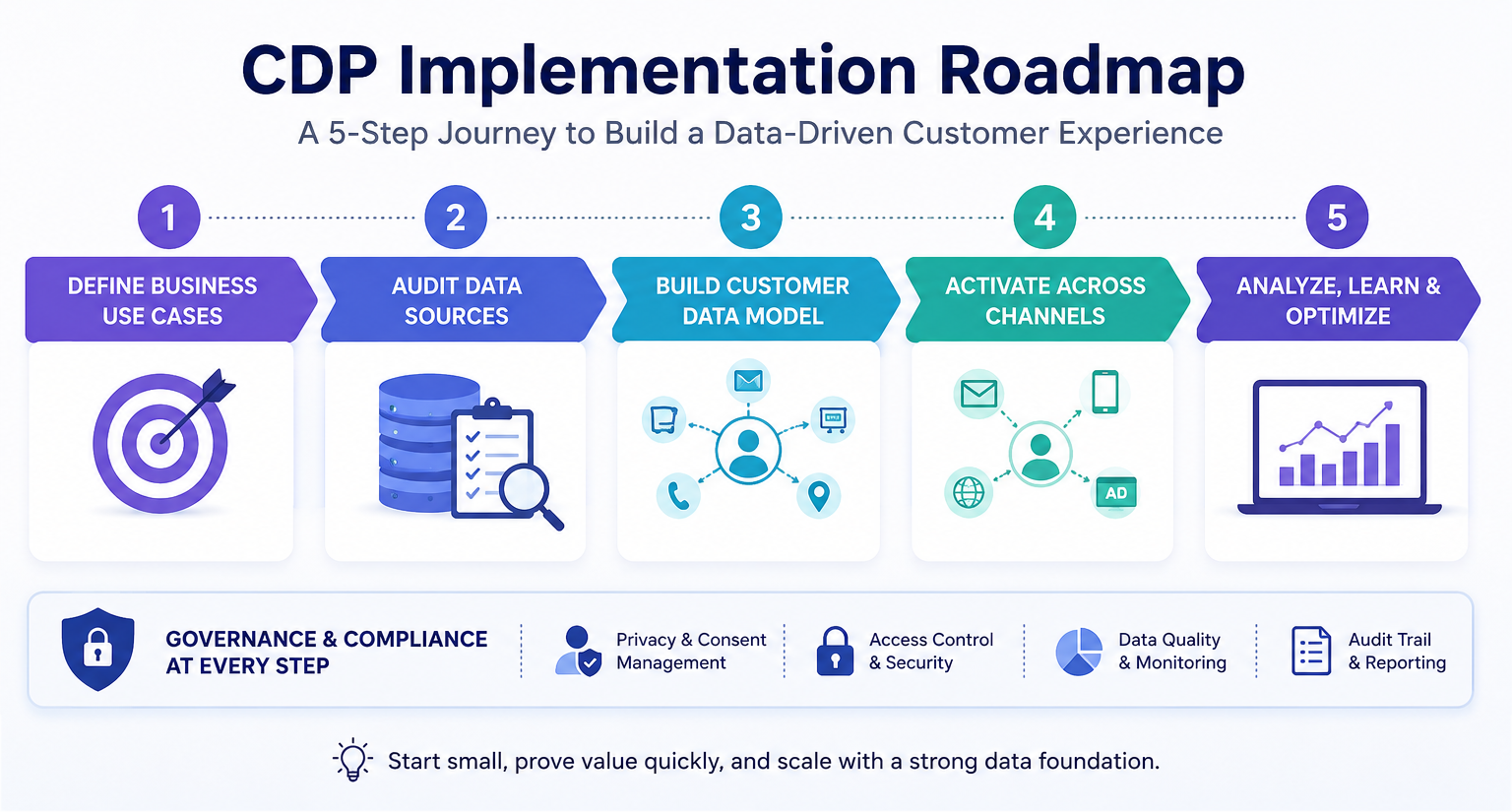
Stage 1: Define Business Use Cases
Select two to three use cases with the greatest business value, such as re-engaging members, abandoned-cart remarketing, high-value customer segmentation, new-customer nurturing, renewal reminders, or churn prediction.
Stage 2: Inventory Data Sources
Determine which data is available, which data is missing, which systems need to be integrated, and whether data use complies with internal policies and PDPO requirements.
Stage 3: Build the Customer Data Model
Define customer attributes, behavioral events, segmentation rules, identity resolution logic, consent status, and data usage rules to ensure the platform can scale in the future.
Stage 4: Activate Marketing Channels
Send audience segments to email, advertising, website personalization, apps, or customer service workflows so that data drives real action. At this stage, enterprises should also confirm that data authorization and communication consent are complete for each channel.
Stage 5: Continuously Analyze and Optimize
Use reporting and performance tracking to evaluate conversion paths, engagement rates, customer lifetime value, marketing return on investment, and audience quality, while continuously refining segmentation strategies and journey design.
10. Conclusion: Choosing the Right CDP Is the First Step Toward Building Long-Term Customer Engagement Capabilities
For Hong Kong enterprises, a CDP is not merely a marketing technology investment; it is the foundation for building long-term customer engagement capabilities. Faced with fragmented channels, the decline of third-party cookies, increasingly stringent privacy compliance requirements, and customer expectations for personalized experiences, enterprises need a platform that can integrate data, understand customers, and activate insights.
When choosing a CDP, enterprises should not ask only, “Which platform is the best?” Instead, they should ask, “Which platform is the best fit for our business objectives, data maturity, compliance requirements, existing CRM / MarTech architecture, and future development?”
If an enterprise requires enterprise-grade architecture, real-time segmentation, cross-channel personalization, and comprehensive data governance, Adobe Real-Time CDP is a solution worthy of in-depth evaluation. If the enterprise’s core operations rely heavily on Salesforce CRM, it can also evaluate the integration potential of Salesforce Data 360 (formerly Data Cloud) with its existing Customer 360 architecture.
LeadsTech provides Adobe Real-Time CDP implementation and integration services covering data source connectivity, audience segmentation design, data governance, system integration, marketing analytics, and team training. If you would like to assess whether your enterprise is ready to implement a CDP, or understand how Adobe Real-Time CDP can integrate with your existing website, CRM, e-commerce, and marketing systems, please visit Contact Us to speak with our consulting team.


11. Further Reading
- What Is a Customer Data Platform (CDP)? An In-Depth Look at Its Value and Applications
- CRM vs. CDP: Differences, Use Cases, and an Enterprise Implementation Selection Guide
- Adobe Real-Time CDP | An Omnichannel, Real-Time Customer Data Platform
- Salesforce Customer 360 | CRM, Marketing, Service, and Customer Data Platform
Related Articles
Enterprise AI MarTech Trends Analysis 2024-2029 Outlook Report
From AI content productivity tools to a core engine for revenue growth and marketing transformation
*The PDF will be sent directly to your inbox.