
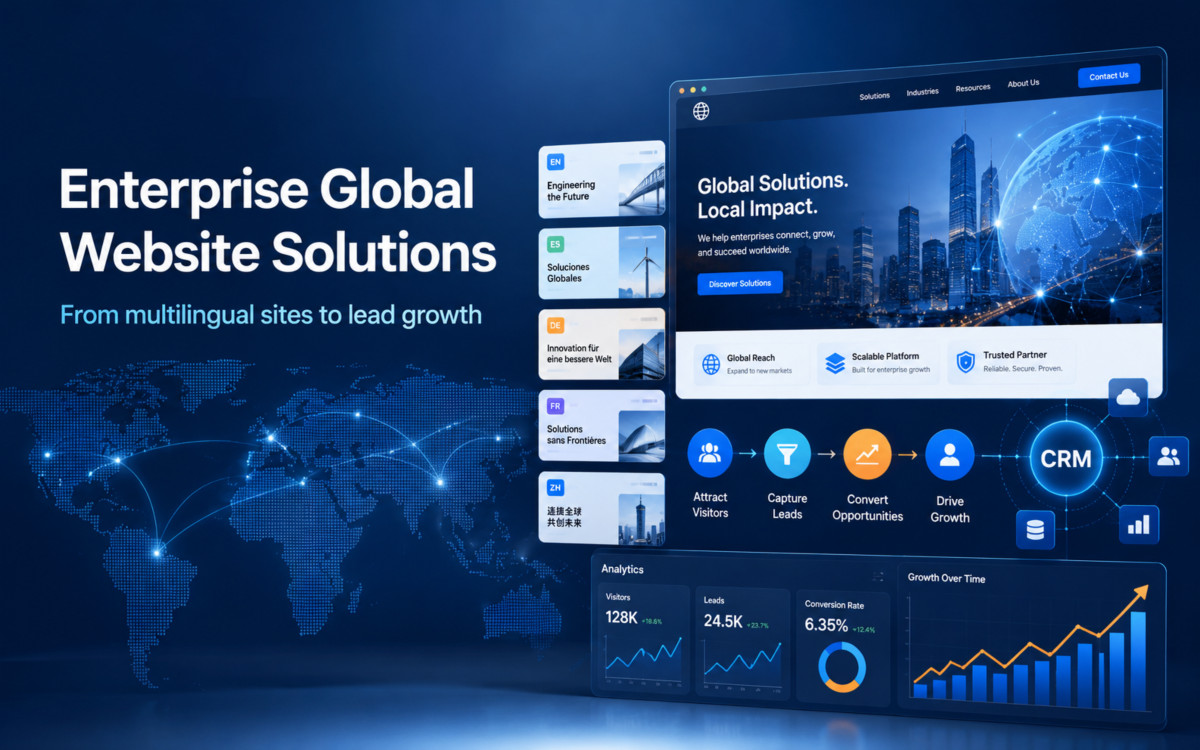
Enterprise Global Website Solutions: From Multilingual Sites to Lead Growth
AEM Sites, Content Management System (CMS), Customer Relationship Management (CRM), Lead Generation
18 June 2026
- What Is an Enterprise Global Website Solution?
- Core Goals of an Enterprise Global Website Solution
- How Multilingual Website Development Supports Overseas Customer Decisions
- From Visit to Inquiry: Building a Global Lead Conversion Path
- How a Website Helps Sales Teams Acquire High-Quality Leads
- Implementation Path: From Site Planning to Continuous Optimization
- Conclusion
- Further Reading
- What Is an Enterprise Global Website Solution?
- Core Goals of an Enterprise Global Website Solution
- How Multilingual Website Development Supports Overseas Customer Decisions
- From Visit to Inquiry: Building a Global Lead Conversion Path
- How a Website Helps Sales Teams Acquire High-Quality Leads
- Implementation Path: From Site Planning to Continuous Optimization
- Conclusion
- Further Reading
Summary
The value of an enterprise global website solution is not merely helping companies launch multilingual websites. It is about turning the website into a growth platform that continuously acquires overseas customers, accumulates market data, and supports sales follow-up. From the perspective of global lead growth, this article explains how companies can use content localization, regional conversion paths, and lead operations mechanisms to make the website a true acquisition hub for global expansion.
1. What Is an Enterprise Global Website Solution?

An enterprise global website solution refers to using multilingual websites, content localization, conversion paths, data analytics, and CRM collaboration to upgrade the website from a brand display platform into a platform for overseas lead acquisition and sales follow-up. Website development should not remain limited to English pages, product introductions, and contact forms. When companies truly enter overseas markets, they often find that customers do not submit an inquiry immediately after viewing the homepage. Instead, they go through multiple stages such as search, comparison, validation, downloading materials, reviewing case studies, and repeat visits.
This is why enterprise global website solutions need to be redefined. A website should not be only a brand display page. It should become a lead growth system that connects multilingual content, overseas SEO, conversion forms, data analytics, CRM assignment, and sales follow-up. LeadsTech’s foreign trade website development service page also emphasizes that modern foreign trade websites need to be secure, stable, scalable, and sustainable, while supporting data integration with platforms such as CRM and ERP.
Compared with an ordinary brochure-style website, a growth-oriented global website must solve three questions at the same time: how overseas customers find you through search and content, how they trust you through case studies, certifications, and localized content, and how they enter the sales process through CTAs, forms, and CRM.
2. Core Goals of an Enterprise Global Website Solution
An enterprise global website solution is not about “creating a few more language versions.” It is about designing website capabilities around the global customer journey. Its core goals can be summarized in three layers.
1. Being Found: Helping Target-Market Customers Discover the Company
- Design content entry points based on different countries and industries
- Turn products, solutions, case studies, and articles into search traffic entry points
- Avoid using one generic English content set for all markets
2. Being Understood: Helping Customers Quickly Assess Fit
- Clearly communicate company capabilities, product advantages, industry experience, and service scope
- Use localized expression to reduce understanding barriers for overseas customers
- Build trust through case studies, certifications, delivery capabilities, and FAQs
3. Being Converted: Helping Customers Move Smoothly to the Next Step
- Set different CTAs based on different customer intents
- Support multiple conversion methods such as inquiries, demo bookings, downloads, and quotation requests
- Sync leads to CRM or marketing systems so sales can follow up in time
A mature website project should plan brand expression, content architecture, CMS selection, SEO structure, conversion paths, data tracking, and CRM-sales collaboration from the beginning, rather than adding conversion capabilities only after launch.
3. How Multilingual Website Development Supports Overseas Customer Decisions
Many companies assume that building a multilingual website simply means translating content, but overseas customers actually need an information structure that fits their local market. For example, on the same product page, European customers may care more about compliance and certifications, North American customers may focus on case studies and service capabilities, while Southeast Asian customers may pay more attention to price, channels, and response speed.
Therefore, global website development should not stop at language switching. It needs a market-oriented content strategy. Existing articles on multilingual website development also point out that multilingual websites should not remain at the translation level; they need localization strategies and CMS capabilities to support global website operations.
Foreign trade multilingual websites should focus on planning the following content:
Market Entry Pages
Display the right products, services, and case studies for different countries or regions.
Industry Solution Pages
Help customers quickly see whether you understand their industry pain points.
Localized Trust Content
Include certifications, customer case studies, partners, service scope, and delivery explanations.
Multilingual Content Governance
Ensure different language versions are not one-time translations, but can be updated, reused, and maintained over the long term.
From this perspective, the key to an enterprise global website solution is not the number of pages, but whether multilingual content can truly support customer decision-making.
4. From Visit to Inquiry: Building a Global Lead Conversion Path
Website traffic itself does not equal business opportunities. Many websites have visits but lack high-quality inquiries, often because they do not have clear conversion paths.
A website designed for overseas lead acquisition should include at least three types of conversion paths.
1. Low-Barrier Conversion
Suitable for early-stage research customers, such as downloading product materials, subscribing to industry content, viewing case study collections, or getting selection guides.
2. Mid-Intent Conversion
Suitable for customers with clear interest, such as requesting samples, booking product demos, submitting requirement forms, or viewing quotation information.
3. High-Intent Conversion
Suitable for customers close to the purchasing stage, such as contacting sales, requesting customized solutions, asking for technical consultation, or submitting project requirements.
To judge whether an enterprise global website solution is effective, companies should not only look at whether the pages are attractive. They should assess whether the website can provide the next action based on customer intent. When the website works together with e-commerce systems, CRM, data analytics, and marketing automation, it has a better chance to improve lead identification, lead assignment, and follow-up conversion efficiency. LeadsTech’s website also states that its services cover enterprise international websites, cross-border e-commerce platforms, CDP, marketing automation, website analytics, and UX/UI design to support global acquisition and business growth.
5. How a Website Helps Sales Teams Acquire High-Quality Leads

A website is not an isolated marketing asset. Ultimately, it should serve sales growth. Especially for B2B companies, the cycle from a customer’s first visit to closing a deal is often long. With compliant tracking, form identification, or CRM integration, sales teams can understand lead sources, visited content, product interests, and return-visit behavior.
Therefore, an enterprise global website solution needs to turn website behavior into sales-usable information through data tracking, form identification, customer scoring, and CRM integration. Companies can focus on building three types of capabilities:

1. Lead Source Identification
• Distinguish sources such as organic search, advertising, social media, trade shows, events, and partners; • Help companies determine which channels bring higher-quality opportunities

2. Behavioral Intent Identification
• Record customer visits to product pages, industry pages, case study pages, and downloads; • Help determine whether customers may be in the awareness, comparison, or decision stage

3. Sales Follow-Up Collaboration
• Connect forms with CRM; • Automatically assign leads to the right regional or product sales team; • Provide customer behavior context before sales follow-up
In this way, the sales team receives more than a simple contact record. They receive a contextual lead. For companies focused on overseas lead acquisition, this affects follow-up efficiency and conversion quality.
6. Implementation Path: From Site Planning to Continuous Optimization
When implementing an enterprise global website solution, companies should proceed in the order of strategy first, architecture second, and optimization afterward.
Step 1: Define Target Markets
First identify priority countries, languages, industries, and customer types instead of pursuing as many languages as possible from the start.
Step 2: Plan the Content Map
Build page structures around the customer decision journey, including brand pages, product pages, industry pages, case studies, resource centers, and contact entry points.
Step 3: Choose the Right CMS
If the company will later expand multilingual, multi-region, and multi-team content operations, it needs to consider an enterprise-grade CMS. LeadsTech’s service page shows that it provides foreign trade website development services based on platforms such as Adobe, Magnolia, and WordPress to support website needs of different complexity levels.
Step 4: Design Conversion Mechanisms
Plan forms, CTAs, downloads, bookings, quotations, and sales assignment mechanisms before launch.
Step 5: Build Data Tracking and Continuous Optimization Mechanisms
Use data analytics to continuously evaluate the performance of different markets, content, and pages, and optimize low-conversion pages and high-potential content every month.
Many global website development projects fail not because the design is poor, but because there is no continuous operation mechanism after launch. To become a growth asset, the website must be iterated over the long term.
7. Conclusion
Competition in enterprise global websites has evolved from “whether a company has a website” to “whether the website can continuously generate high-quality overseas leads.” For B2B companies, an effective website should combine brand expression, multilingual content, localized trust building, conversion path design, data analytics, and sales collaboration.
A mature enterprise global website solution should help companies move from multilingual website development toward global lead growth: helping overseas customers find you, understand you, trust you, and smoothly enter the sales process. For companies upgrading their websites, expanding overseas markets, or building a global digital acquisition system, the website is no longer a cost center. It is long-term growth infrastructure.
If you are planning a foreign trade multilingual website, overseas website upgrade, or global lead growth system, we invite you to learn more about our enterprise global website and digital growth services, or visit Contact Us to discuss your target markets, content architecture, and implementation path with our consulting team.
Further Reading
- 5 Localization Strategies for Global Websites and the Complete Guide to CMS Selection: Suitable for understanding how multilingual websites can evolve from translation into localized operations.
- Global Website Development Is More Than a Site: How CMS Powers Growth: Suitable for further understanding how CMS supports long-term multi-country and multilingual website operations.
- How to Choose a B2B Website Agency: 5 Key Criteria for Global Success: Suitable for evaluating whether a website development partner has the capabilities required for long-term global expansion projects.
Related Articles

Enterprise AI MarTech Trends Analysis 2024-2029 Outlook Report
From AI content productivity tools to a core engine for revenue growth and marketing transformation
*The PDF will be sent directly to your inbox.
Email Error
Please enter a valid email address.
Thank You!
The whitepaper has been sent to your inbox. If you don’t see it, please check your spam or promotions folder.