
Adobe Analytics vs. CJA: Which Platform Is Right?
Adobe Analytics, Adobe Customer Journey Analytics, Adobe Experience Cloud, MarTech, Website Analytics
30 July 2026
- Key Takeaways
- What Adobe Analytics and CJA Are Designed to Do
- Adobe Analytics vs CJA: Key Differences
- When Is Adobe Analytics the Right Fit?
- When Should You Evaluate CJA?
- How Do CJA, AEP, and Real-Time CDP Work Together?
- What Should Organizations Confirm Before Implementation?
- Frequently Asked Questions
- Conclusion
- Further Reading
- Key Takeaways
- What Adobe Analytics and CJA Are Designed to Do
- Adobe Analytics vs CJA: Key Differences
- When Is Adobe Analytics the Right Fit?
- When Should You Evaluate CJA?
- How Do CJA, AEP, and Real-Time CDP Work Together?
- What Should Organizations Confirm Before Implementation?
- Frequently Asked Questions
- Conclusion
- Further Reading
1. Key Takeaways
- Adobe Analytics helps organizations understand user behavior across websites, apps, and other digital channels. It is well suited for measuring traffic, content engagement, campaign performance, and conversions.
- CJA is built on Adobe Experience Platform and can use a broader range of data sources and the XDM data model to analyze cross-channel customer journeys.
- CJA is not simply an upgraded version of Adobe Analytics, and not every organization needs it. The decision depends on the available data sources, identity resolution requirements, business questions, and data governance maturity.
- If your analytics needs center on website and app performance, Adobe Analytics can usually meet most of them.
- If your organization needs to combine CRM, customer service, POS, loyalty program, offline transaction, and other data to analyze journeys at the customer level, consider CJA and the broader AEP architecture.
- In practice, LeadsTech starts with the data sources, analytics use cases, and implementation path before recommending whether Adobe Analytics or CJA is the better fit and whether Adobe solution partner services are needed.
2. What Adobe Analytics and CJA Are Designed to Do
Adobe Analytics is an enterprise-grade digital analytics platform for understanding user behavior across websites, apps, and other digital channels. Teams can track page views, events, campaigns, content interactions, form submissions, product views, and conversion flows, then build custom reports in Analysis Workspace.
For many organizations, Adobe Analytics is the foundation of their digital analytics program. It can answer questions such as:
- How do users navigate the website?
- Which content drives engagement and conversion?
- Which campaigns bring in high-value traffic?
- Which pages or flows cause drop-off?
- How does behavior differ across markets, products, or devices?
Customer Journey Analytics (CJA) is built on Adobe Experience Platform. It brings data from multiple sources into Analysis Workspace through XDM schemas, connections, and data views, allowing teams to analyze how customers interact with the brand across channels and touchpoints.
In simple terms, Adobe Analytics shows how people use your websites, apps, and digital channels. CJA shows how the same customer interacts with your brand across multiple touchpoints.
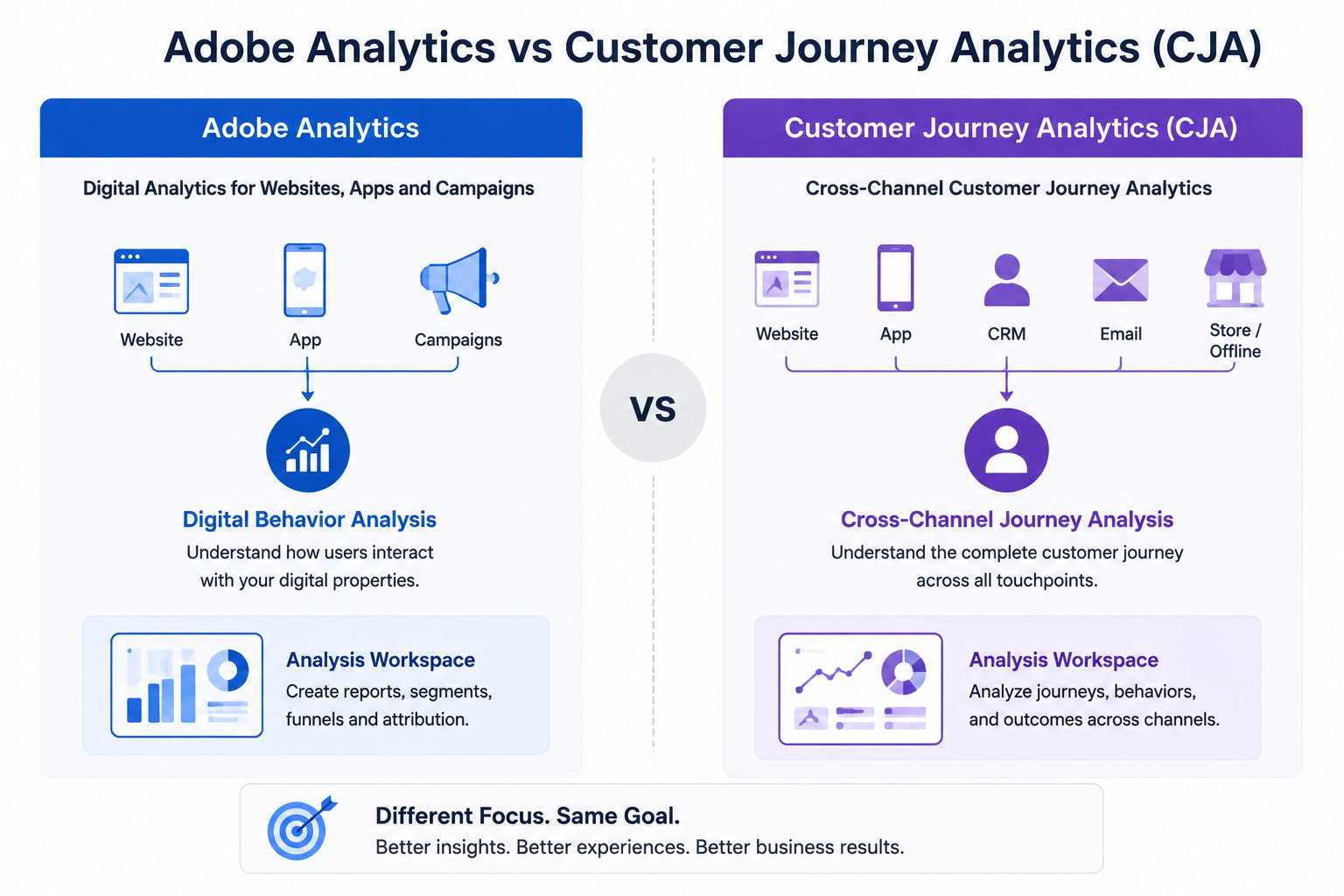
Choosing between Adobe Analytics and Customer Journey Analytics is not simply a feature comparison. The first question is whether the business needs clearer website and marketing performance data or a broader view of cross-channel customer journeys. LeadsTech starts with data sources, analytical depth, governance, and team adoption before comparing Adobe Analytics with Customer Journey Analytics.
3. Adobe Analytics vs CJA: Key Differences
| Comparison Area | Adobe Analytics | Customer Journey Analytics (CJA) |
|---|---|---|
| Core use | Website, app, campaign, and digital channel analytics | Cross-channel and cross-system customer journey analytics |
| Data foundation | Primarily digital behavior data organized in report suites | AEP datasets, XDM schemas, connections, and data views |
| Analytics perspective | Pages, events, campaigns, content, and conversions | Customers, identities, touchpoints, and cross-channel journeys |
| Best-fit questions | Which content, campaigns, or flows drive conversions? | Which combinations of touchpoints influence the customer journey and conversion? |
| Implementation prerequisites | Tracking plan, data layer, Adobe Experience Platform Tags or Web SDK, and report suites | AEP data integration, XDM schemas, identity resolution, connections, and data views |
| Best suited for | Organizations that need digital channel behavior analytics | Organizations that need multisource data integration and journey analytics |
Do not choose between the two by comparing feature lists alone. Start with the business questions your team needs to answer. If your priorities are website traffic, content performance, campaign measurement, and conversion analysis, Adobe Analytics can usually meet those needs.
Consider CJA when you need to combine web and app data with CRM, customer service, loyalty, POS, e-commerce, and other offline data to understand how interactions across touchpoints affect customer decisions.
4. When Is Adobe Analytics the Right Fit?
Adobe Analytics is a strong fit when your analytics program centers on website, app, and digital channel behavior. If your immediate goals are to improve the website experience, content performance, campaign results, and conversion flows, Adobe Analytics is usually the more direct choice.
Common use cases include:

Analyze website visitor sources, content engagement, and conversion paths

Track campaign performance and traffic quality across channels

Analyze app usage and digital service interactions

Build reports for marketing, content, product, and management teams

Compare behavioral differences across markets, languages, products, or devices

Use Analysis Workspace for segmentation, funnel, drop-off, and attribution analysis
If most of your data comes from websites and apps and your questions still focus on digital channel performance, Adobe Analytics can usually meet your requirements.
5. When Should You Evaluate CJA?
CJA is designed for organizations that need to analyze data across channels and systems. Consider CJA when you need to go beyond website and app performance and understand how the same customer interacts with your business across multiple touchpoints.
Common use cases include:
- Combining website, app, CRM, customer service, in-store, loyalty program, and e-commerce data
- Analyzing the combined impact of online and offline touchpoints on conversion
- Analyzing behavior at the customer level rather than by individual website visit
- Bringing interaction data from different systems into a unified analytical view
- Giving management, marketing, customer service, e-commerce, and data teams a shared view of the customer journey
The value of CJA depends on data quality across sources, a reliable identity resolution strategy, well-designed XDM schemas, effective AEP data governance, and the organization’s analytical maturity. If the data is not integrated, customer identities cannot be resolved reliably, or field definitions vary across systems, strengthen the data foundation before adopting CJA.
6. How Do CJA, AEP, and Real-Time CDP Work Together?
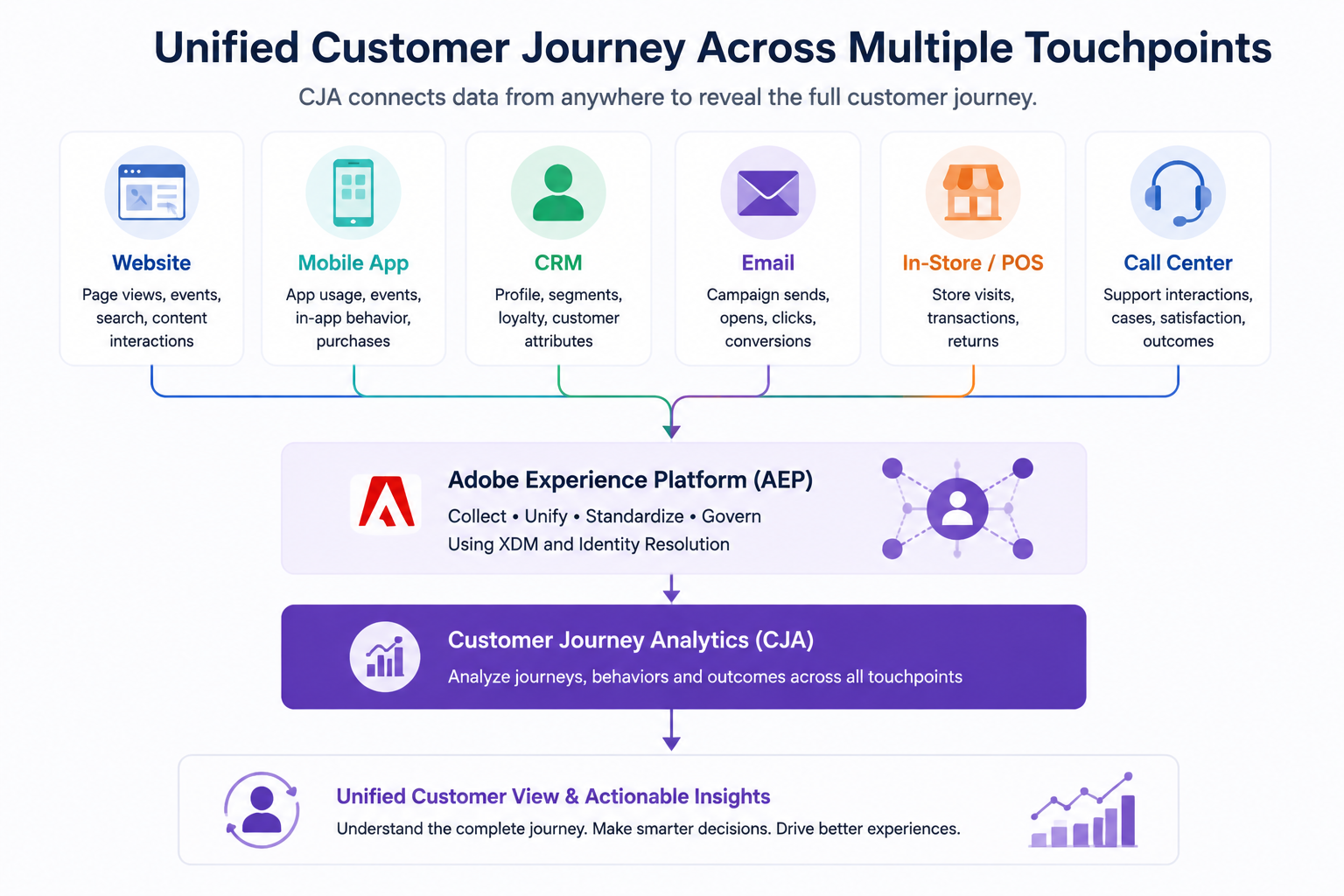
When organizations plan an Adobe data architecture, CJA, AEP, and Real-Time CDP often appear in the same conversation. Each plays a different role, and the products are not interchangeable.
Adobe Experience Platform (AEP)
Provides the data foundation for collecting, standardizing, governing, and managing data from multiple sources.
Customer Journey Analytics (CJA)
Provides the analytics layer for examining cross-channel customer journeys using data stored in AEP.
Real-Time CDP
Unifies first-party customer data, creates audiences, and activates those audiences across channels for personalized marketing.
Adobe Analytics
Measures behavior across websites, apps, and other digital channels.
Adobe Analytics is not a CDP, and CJA is not a data collection or audience activation tool. First determine whether your organization needs digital channel analytics, cross-channel journey analysis, audience activation, or personalized marketing. Then select the combination of products that supports those needs.
7. What Should Organizations Confirm Before Implementation?
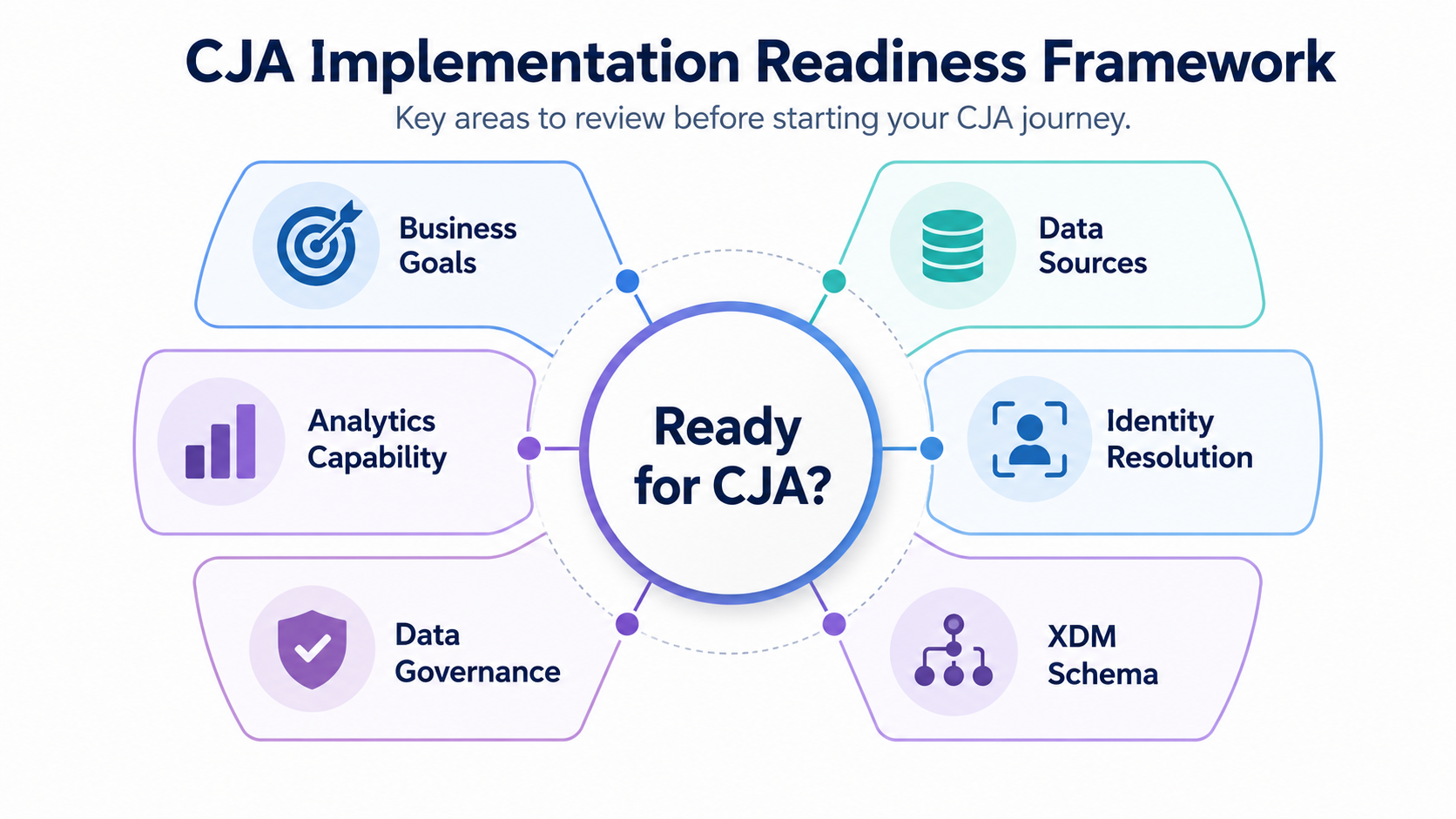
Before implementing Adobe Analytics or CJA, define your analytics goals and assess your data readiness rather than starting with product features.
Review the following areas before technical planning:
- Are the KPIs clearly defined? What business questions should the analytics program answer?
- Have all data sources been identified? Will the analysis include data from websites, apps, CRM systems, customer service platforms, POS systems, e-commerce platforms, or other sources?
- Can identities be resolved reliably? Can interactions across touchpoints be linked to the same customer?
- Are the XDM schemas well designed? Can data from different sources be standardized consistently?
- Is data governance in place? Are naming conventions, permissions, reporting standards, and change management processes clearly defined?
- Does the team have the necessary analytics skills? Is someone responsible for using Analysis Workspace, interpreting the results, and turning insights into recommendations?
- Is marketing activation required? If the goal includes audience activation and personalization, does the organization also need Real-Time CDP?
If your organization does not yet have a tracking plan, a consistent data layer, clear governance standards, and an established reporting process, strengthen the data foundation or begin with Adobe Analytics before evaluating CJA.
8. Frequently Asked Questions
What is the difference between Adobe Analytics and CJA?
Adobe Analytics focuses on behavior across websites, apps, and other digital channels. CJA is built on Adobe Experience Platform and combines a broader range of data sources to support cross-channel customer journey analysis.
Can CJA replace Adobe Analytics?
Not necessarily. CJA is not a direct replacement for Adobe Analytics. An organization may use Adobe Analytics for website and app measurement while using CJA to analyze journeys across systems and channels.
When is CJA a good fit for an enterprise?
CJA is a good fit when an organization needs to combine website and app data with CRM, customer service, e-commerce, in-store, loyalty, or other offline data and analyze the customer journey across those touchpoints.
Is CJA the same as a CDP?
No. CJA focuses on analytics, while Real-Time CDP focuses on customer data integration, audience creation, and marketing activation. They can be used together, but they play different roles.
What should enterprises prepare before implementing Adobe Analytics or CJA?
Before technical planning, review the business goals, data sources, tracking requirements, KPIs, identity resolution strategy, XDM schemas, system architecture, data governance standards, and the team’s analytics capabilities.
9. Conclusion
Adobe Analytics and CJA are not direct substitutes. They address different analytics needs. Adobe Analytics focuses on website, app, and digital channel performance, while CJA combines data from multiple systems to analyze customer journeys across online and offline touchpoints.
Success depends not just on selecting the right product, but also on defining clear KPIs, connecting reliable data sources, resolving customer identities, establishing governance standards, and continuously improving the analytics program.
LeadsTech provides Adobe Experience Cloud consulting, implementation, and integration services. We help organizations plan and implement Adobe Analytics, Customer Journey Analytics, and related MarTech architectures. Contact our team to discuss the right analytics approach for your business:

Explore our Adobe Analytics and Customer Journey Analytics services:

Recommended Articles

Enterprise AI MarTech Trends Analysis 2024-2029 Outlook Report
From AI content productivity tools to a core engine for revenue growth and marketing transformation
*The PDF will be sent directly to your inbox.
Email Error
Please enter a valid email address.
Thank You!
The whitepaper has been sent to your inbox. If you don’t see it, please check your spam or promotions folder.