
How to Analyze and Optimize a Website: An Essential Guide to SEO, GEO, and Conversion Growth
MarTech, Website Analytics
5 August 2026
A website may attract traffic without generating enough inquiries—and SEO may not be the only issue. Businesses need to evaluate search and AI visibility, page experience, content persuasiveness, and conversion tracking together. This article provides a data-driven analysis framework to help teams identify bottlenecks, prioritize improvements, and connect website optimization to measurable business outcomes.
1. Key Takeaways
Website analysis should not focus solely on total traffic. Visibility, experience, and conversion should be treated as one connected customer journey. SEO and GEO share the same technical and content foundation that enables search systems to understand a website, but GEO places greater emphasis on clear, verifiable, and citable answers. Businesses should first establish a data baseline, correct tracking issues, and improve high-impact pages, then validate results through organic clicks, AI referral traffic, qualified leads, and conversion rates. Tool scores can support diagnosis, but meaningful optimization outcomes must ultimately align with business objectives. In this type of diagnosis, LeadsTech typically evaluates search visibility, page experience, and the conversion path against the same business question. this is also the starting point for SEO and GEO optimization services.
2. Where Should Website Analysis and Optimization Begin?
The first step is not an immediate redesign, but defining the business actions the website should drive, such as submitting an inquiry, booking a demo, downloading specifications, or completing a purchase. Next, organize data into three layers: whether the website can be found, whether the on-site experience is frictionless, and whether visitors complete the next step. This framework prevents SEO, content, design, and IT teams from optimizing isolated metrics independently.
Before beginning the analysis, establish consistent comparison criteria, including the date range, primary markets, devices, traffic sources, and conversion definitions. New and returning visitors—as well as branded and non-branded search users—often behave very differently. Combining all of them in one report can allow averages to conceal the real problems.
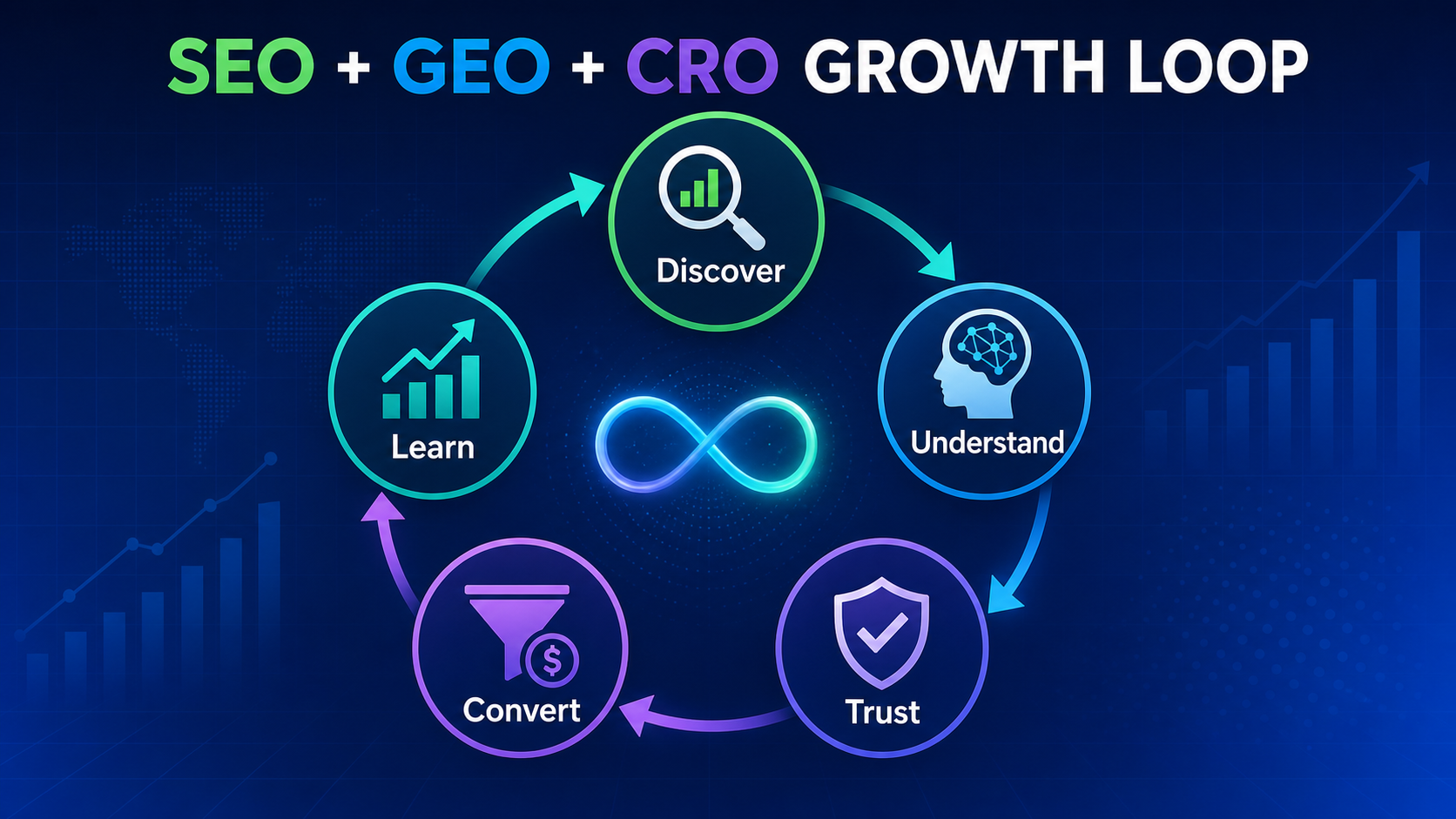
Website optimization framework: moving from visibility and user experience to conversion
Consider an industrial equipment exporter whose monthly organic traffic is increasing while inquiries remain flat. If the team simply publishes more articles, it may overlook slow-loading product pages, an overly long form, or a GA4 setup that does not define successful submissions as key events. The team should review search landing pages, device-specific drop-off, form completion rates, and lead quality in sequence before deciding whether to prioritize content, performance, or form improvements. If the problem is concentrated on mobile product pages, speed and the form should be fixed first rather than immediately rewriting every blog post.
3. How Do You Analyze SEO and GEO Visibility?
SEO (Search Engine Optimization) helps search engines crawl, understand, and present web pages, while GEO (Generative Engine Optimization) increases the likelihood that content will be accurately understood, mentioned, and cited in AI-generated answers. One does not replace the other: an indexable technical foundation, clear topical structure, and credible content all affect both traditional and generative search. No single markup can guarantee that AI systems will select a website, so businesses must continue to focus on content quality, technical readability, and brand credibility.
For SEO analysis, start with Google Search Console to review indexing, impressions, click-through rates, and pages that rank well but receive few clicks. Then determine whether titles align with search intent, each core service has a dedicated page, and internal links establish clear topical relationships. For GEO analysis, build a set of natural-language questions related to customer decisions and test them regularly in major AI search tools. Track whether the brand is mentioned, whether the answers are accurate, which pages are cited, and which topics feature competitors more frequently.
Adobe LLM Optimizer can operationalize this work. The platform helps businesses understand brand and content visibility and citations in generative search, compare competitors’ AI search share of voice, and identify inaccurate descriptions that may affect brand trust. It also recommends improvements related to structured data, crawler access, headings, FAQs, on-site content, and third-party content opportunities, enabling teams to move beyond asking, “Does our brand appear?” to determining, “Which improvement should we prioritize?” If a business also uses Adobe Analytics or Adobe Customer Journey Analytics, it can connect AI referral traffic to engagement, conversions, and downstream business outcomes. However, the business must first define its brands, topics, prompts, competitors, and conversion criteria; otherwise, the dashboard will merely accumulate data that is difficult to act on.
Regardless of the tools used, content should answer questions directly, explain applicable conditions and limitations, and provide verifiable information. Clear H2 headings, full entity names, and consistent product descriptions also help reduce ambiguity. Businesses should track non-branded organic clicks, coverage of priority topics, AI mentions and cited pages, AI referral traffic, qualified inquiries, and their conversion rates so that visibility is not mistaken for revenue.
4. How Do You Identify Website Experience and Conversion Bottlenecks?
Once traffic reaches the website, use real-user data to review Core Web Vitals. As a reference for a “good” experience at the 75th percentile, LCP should be no more than 2.5 seconds, INP no more than 200 milliseconds, and CLS no more than 0.1. Scores are diagnostic signals, however, and should still be evaluated alongside device type, page type, and conversion outcomes. A fast homepage does not guarantee that ad landing pages or product detail pages perform equally well, so reports should be segmented by at least page type and device.
Next, build a funnel from the landing page through successful submission. Track CTA impressions and clicks, form starts, field errors, successful submissions, and CRM receipt status. If many visitors see the form but do not start it, the value proposition may be unclear. If they start but abandon it, review the number of fields, mobile usability, and error messages. If the website generates many submissions but sales considers the leads low quality, revisit traffic sources, keyword intent, and qualification questions.
Website conversion rate can be calculated as “sessions or users that completed a goal ÷ qualified traffic,” but the same definition must be used consistently. In addition to overall conversion rate, compare performance across markets, devices, landing pages, and traffic sources, and verify the lead-to-opportunity conversion rate. This approach helps determine whether the issue lies in the website’s persuasiveness, interaction friction, or traffic that does not match the target audience—instead of relying on averages from other industries.
5. Seven-Step Website Optimization Implementation Checklist
- Define primary conversions and qualified-lead criteria, and confirm that marketing and sales use the same definitions.
- Validate GA4, Tag Manager, CRM, and form events to eliminate duplicate or missing counts.
- Audit organic search landing pages to identify high-impression, low-click pages and high-traffic, low-conversion pages.
- Review indexing, heading hierarchy, internal links, structured data, and whether content is verifiable.
- Evaluate Core Web Vitals, accessibility, CTA visibility, and form usability by device.
- Test only one primary hypothesis at a time, documenting the baseline, change, time period, and result.
- Conduct quarterly reviews using qualified inquiry volume, lead-to-opportunity conversion rate, cost per lead, and response time.
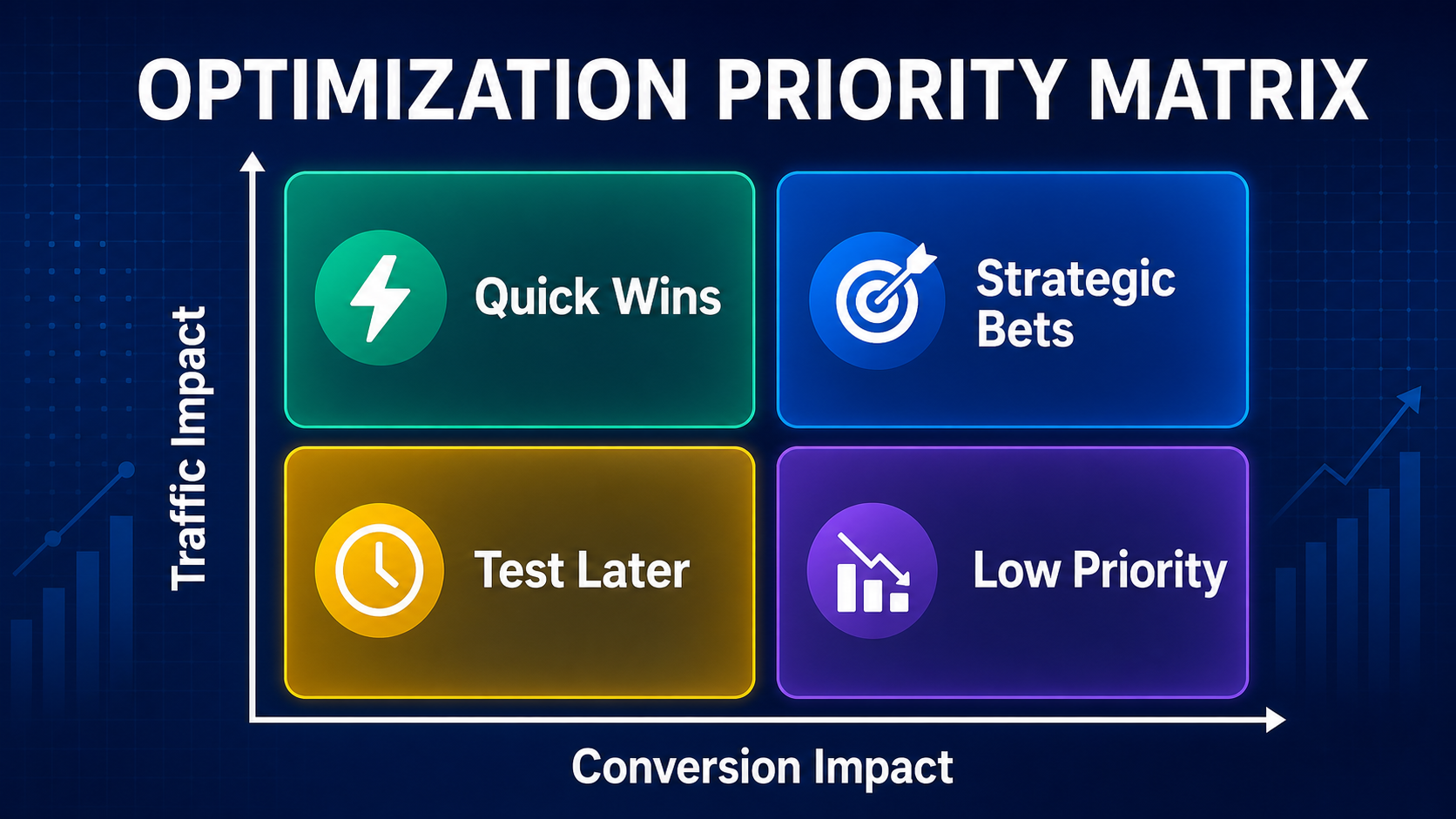
Priorities can be scored using “expected business impact × strength of evidence ÷ implementation cost,” with an owner, completion date, and validation metric assigned to every task. This enables teams to address broken tracking, high-traffic pages, AI content gaps, or obvious form barriers before investing in a major redesign. After implementing improvements, compare equal-length periods before and after the change and exclude major campaigns or seasonal factors to assess results reasonably.
6. Frequently Asked Questions (FAQ)
How often should website analysis be performed?
Businesses can review traffic, indexing, speed, and conversion anomalies monthly, followed by a cross-functional review each quarter. A new analysis should be performed immediately after a website redesign, a tracking configuration change, or a sudden decline in major traffic sources.
Do SEO and GEO require two separate sets of content?
Usually not. Both depend on a clear structure, reliable information, and understandable page content. GEO adds the requirement that answers be easy for generative AI to summarize, cite, and verify. Businesses should manage both under one content strategy rather than creating two duplicate sets of articles.
What types of businesses are a good fit for Adobe LLM Optimizer?
It is best suited to businesses that need to continuously monitor AI visibility across multiple brands, products, regions, or competitors. Smaller websites can first establish a baseline through manual prompt testing, AI referral traffic, and Search Console before deciding whether an enterprise platform is necessary.
Why are inquiries not increasing even though website traffic is growing?
Common causes include mismatched traffic intent, an unclear product value proposition, poor page speed or mobile experience, form friction, and tracking errors. Review the journey segment by segment—traffic source, landing page, CTA, form, and qualified lead—to identify where the actual drop-off occurs.
7. Conclusion
Effective website analysis and optimization create a closed loop connecting search visibility, AI readability, user experience, and sales outcomes. Businesses can begin by establishing baselines for three to five priority pages, then work through the seven-step checklist one item at a time. For integrated diagnostics, tracking, and prioritization, LeadsTech can help develop a tailored plan through its related services.


8. Further Reading
- Website Analytics Strategy: From Data to Growth Actions: Build an analytics framework that turns data insights into optimization actions.
- SEO vs. GEO: A Complete Comparison of Search Engine and Generative AI Optimization: Understand their roles, differences, and how to integrate them.
- How Can an Export Website Increase Inquiries and Conversions? A B2B Lead Generation Solution: Improve the website inquiry process and lead quality.
Recommended Articles

Enterprise AI MarTech Trends Analysis 2024-2029 Outlook Report
From AI content productivity tools to a core engine for revenue growth and marketing transformation
*The PDF will be sent directly to your inbox.
Email Error
Please enter a valid email address.
Thank You!
The whitepaper has been sent to your inbox. If you don’t see it, please check your spam or promotions folder.