
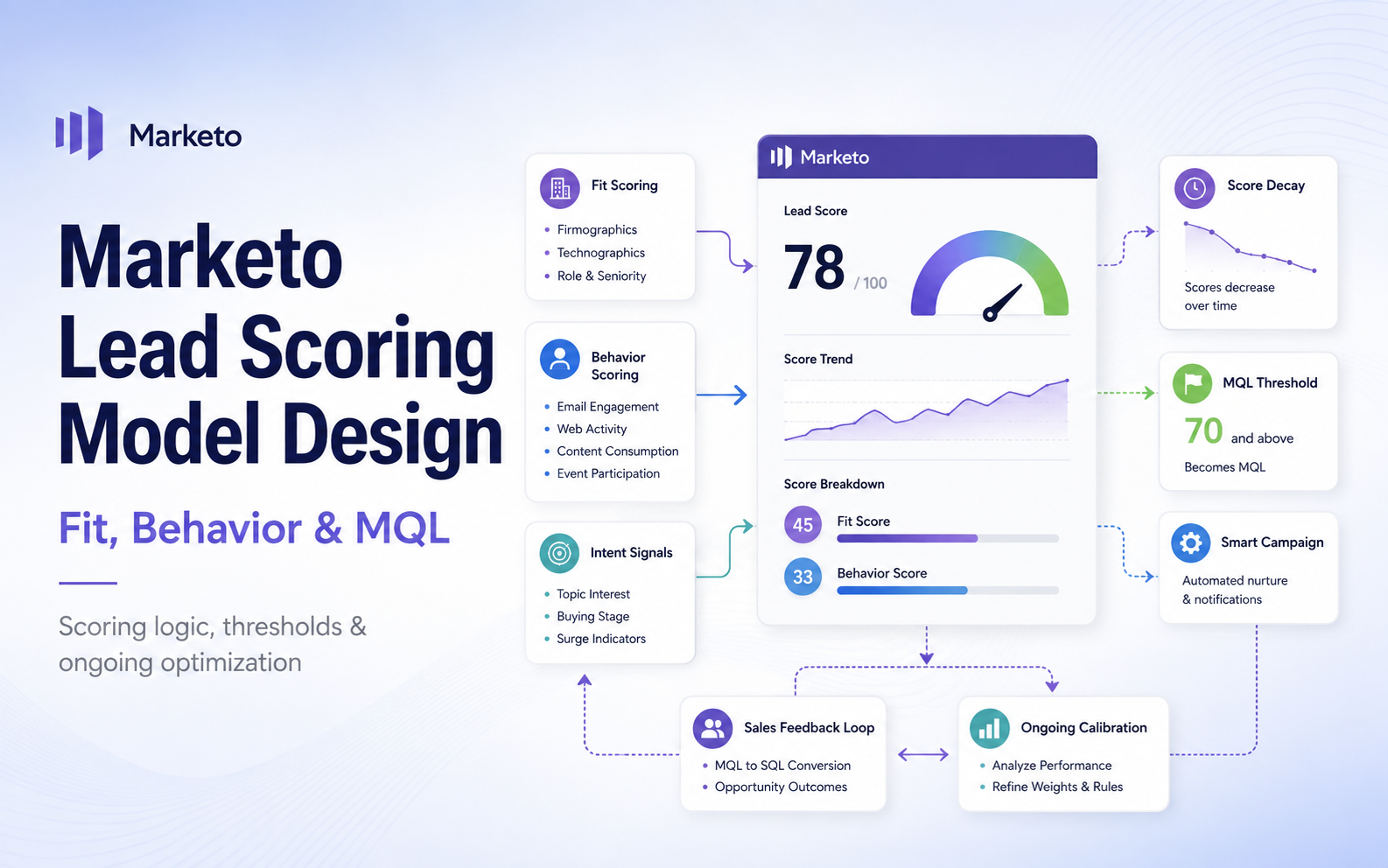
Marketo Lead Scoring Model Design | Fit, Behavior, MQL
Marketing Automation, Marketo, MarTech
6 September 2026
Lead scoring is not about turning every click into points. It is about translating ideal customer traits, buying intent, engagement recency, and sales-ready conditions into a consistent operating model. When LeadsTech designs a scoring model, we first use historical opportunities and sales feedback to validate which signals actually indicate a follow-up-worthy opportunity. Then we define the score values and handoff thresholds. A strong model helps Marketing focus nurture efforts and helps Sales prioritize follow-up. A weak model simply creates a large number of high-scoring MQLs with little opportunity value.
1. Key Takeaways (TL;DR)
- Marketing and Sales should jointly define the ideal customer profile, key behaviors, exclusion rules, and sales handoff commitments.
- Separate Demographic/Firmographic Fit from Behavioral Engagement, then use thresholds or a matrix to determine MQL status.
- High-intent actions should carry more weight than low-commitment engagement. Add negative scoring, frequency caps, and score decay so old activity does not remain overvalued.
- Manage Smart Campaigns, score tokens, qualification rules, and routing centrally in Marketo, then keep recalibrating the model against opportunity outcomes.
2. What Problem Does Lead Scoring Solve?
Enterprise databases usually contain a mix of students, job seekers, partners, early-stage researchers, and buyers actively comparing solutions. If Sales receives leads based only on form submissions or a total score, many of those names will be poor fits or not yet ready for outreach. A scoring model should answer two separate questions: does this person or company fit the target market, and does recent behavior show enough interest and intent? Handoff only makes sense when both are true.
3. Five Building Blocks of a Lead Scoring Model
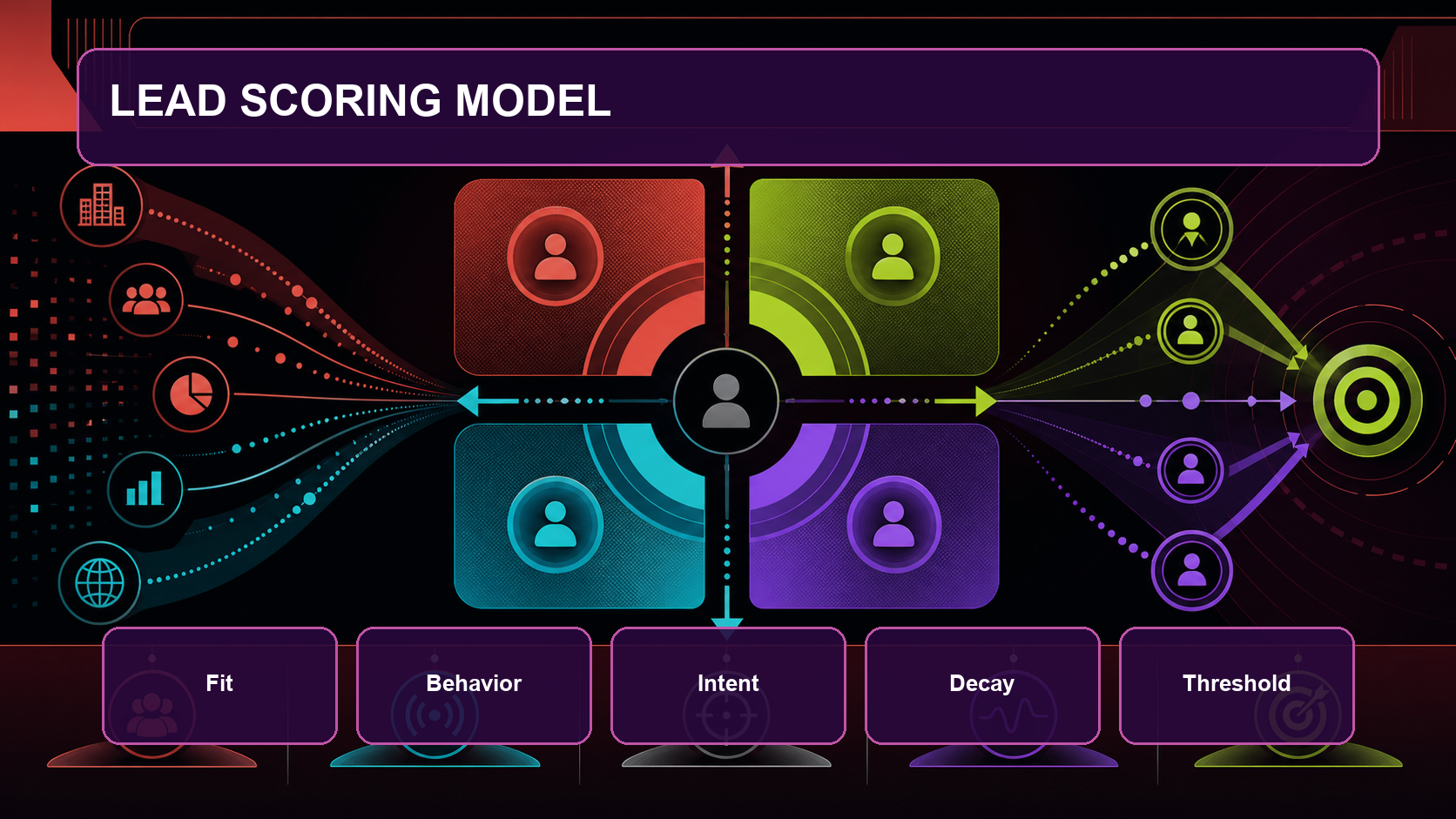
1. Fit: Is this account worth sales attention?
Fit may include industry, company size, revenue, region, job function, seniority, customer type, or product-fit criteria. Each score should map to the ideal customer profile, not simply reward a field because it is filled in. Students, competitors, unsupported regions, personal email addresses, or unsupported company sizes can be handled with negative scores or exclusion flags. If data confidence is low, mark the value as unknown instead of assuming a high score.
2. Behavior: How deep is the engagement?
Behavior reflects observable activity such as content downloads, webinar attendance, product page views, email clicks, event conversations, or return visits. Weight actions by buying-signal strength. Request Demo or Contact Sales can move a lead close to the handoff threshold, pricing and product-comparison pages are mid-to-high intent, and a single email open should not carry much weight. You also need to decide whether the same behavior can score repeatedly and set frequency caps based on business meaning.
3. Intent: What is the context and timing?
The same click can mean different things in different contexts. Multiple solution-page visits in a short period, several decision roles from the same account, or a product-demo attendee reviewing pricing usually signals stronger buying intent than scattered content consumption. You can build an intent layer with time windows, page types, program status, or account-level signals, but start with rules that can be explained and validated.
4. Negative Scoring and Decay
Unsubscribes, invalid email addresses, career-page visits, competitors, long inactivity, or Sales Disqualified outcomes can all reduce score. Score decay lets old activity lose influence over time, so a campaign from a year ago does not keep a lead permanently in a high-score band. Negative scoring is not punishment. It reflects that the lead should not be prioritized right now. Permanently ineligible cases should use a qualification flag rather than relying on scores to fall slowly.
5. Threshold: When does a lead become an MQL?
A single total-score threshold is easiest to build, but it can send low-fit, high-engagement leads into the MQL queue. A more reliable approach is to set minimum Fit and Behavior thresholds, such as Fit ≥ 30 and Behavior ≥ 50, and add required conditions such as consent, region, valid contact data, and not being an existing customer. If markets or product cycles differ significantly, start with a shared framework and adjust weights and thresholds by segment.
4. Why Separate Fit and Behavior?
Separating the two dimensions helps Marketing choose the right next action. High Fit and low Behavior should enter nurture. Low Fit and high Behavior may be routed to self-service or held back from Sales. High Fit and high Behavior should be prioritized for Sales. Low Fit and low Behavior should receive less frequent communication. Even if you keep a single total score, it is still useful to store Fit Score, Behavior Score, and Qualification Reason separately so routing and analysis can be explained.
5. How to Build It in Marketo Engage
Create a dedicated operational program to manage demographic scoring, behavior scoring, decay, thresholds, and resets. Do not scatter Change Score flow steps across every campaign. Use Smart Campaigns to detect behavior or data changes, and store weights centrally in Score-type My Tokens. When a shared process is needed, a parent campaign can pass in tokens and run the central scoring flow. Each campaign should have a clear Smart List, Qualification Rule, Flow, and naming convention, and you should test it with sample leads in the Activity Log.
When demographic data changes, avoid repeatedly adding points for the same attribute. For behavior, decide whether an action can score every time, once per day, once per program, or once over the entire customer lifecycle. Add separate operational Smart Campaigns to manage the MQL timestamp, original threshold, latest Qualification Reason, Lifecycle Stage, owner, and alerts so the same lead is not handed off repeatedly after small score increases.
6. MQL Thresholds and Sales Handoff
An MQL should not be defined by a score alone. The handoff package should include the trigger reason, recent key activities, related content or products, a Fit summary, consent status, recommended follow-up, and the required response time. Sales must be able to send back Accepted, Working, Disqualified, or Recycle status with a reason. Marketing can then manage overdue follow-up, rejected leads, and re-nurture by SLA. Without feedback fields, the model has no way to learn where it is wrong.
Example Scenario: B2B SaaS Scoring Model
Assume the target customer is an IT or Digital leader at an Asia-Pacific company with more than 200 employees. Director or above receives +15, target industry +10, and company size +10. Request Demo receives +50, Pricing Page +15, Webinar Attended +12, and a general content download +5. Ninety days without engagement receives -10, and job seekers receive -50. The MQL criteria are Fit ≥ 25, Behavior ≥ 40, supported region, and valid contact data. After a four-week test, if most demo leads become opportunities but webinar leads are often rejected, adjust the threshold or nurture path instead of simply increasing all scores.
7. Validation and Ongoing Calibration
Build a Scoring Feedback Loop
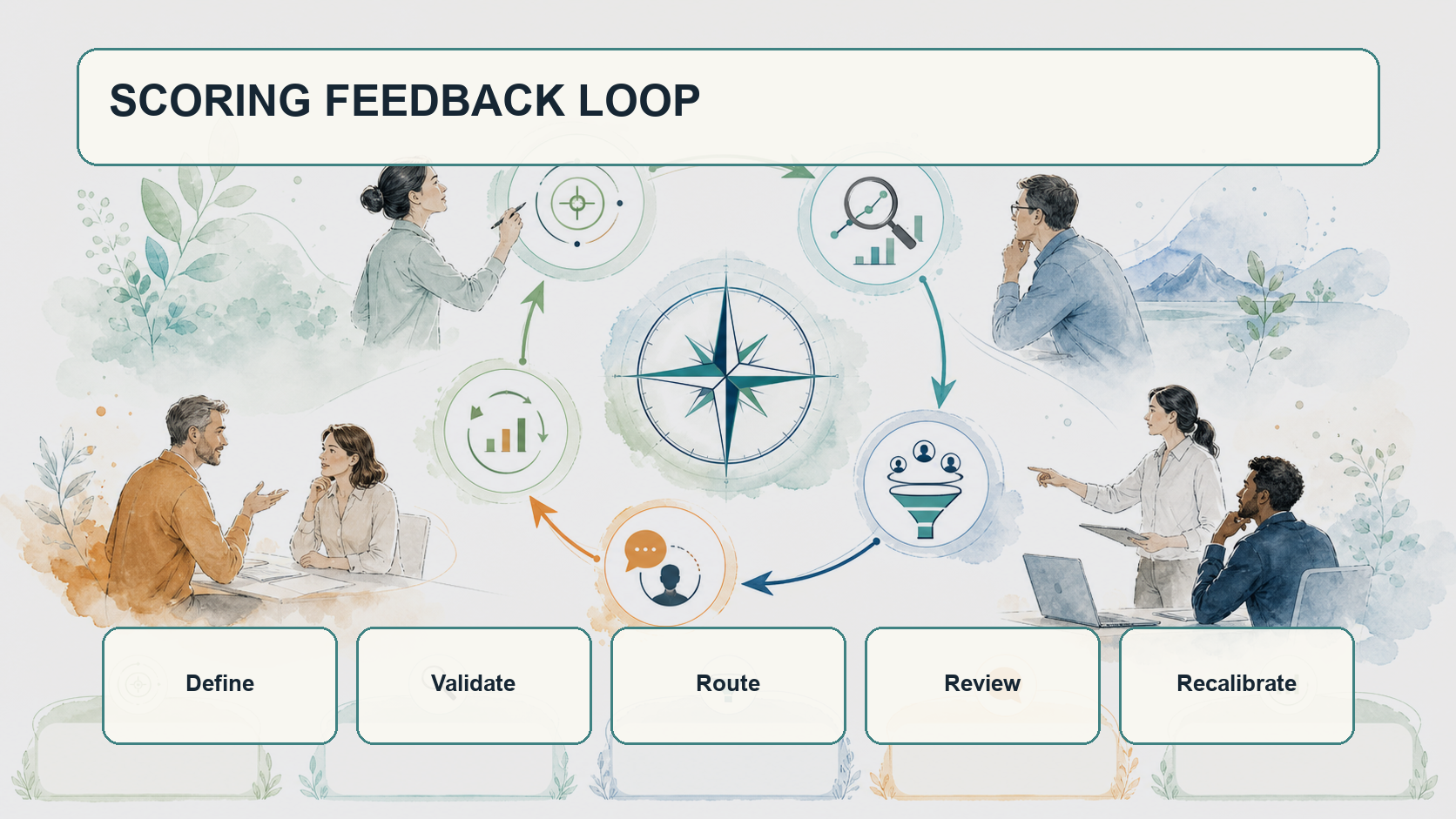
Before launch, back-test three to six months of historical data. Are MQL-to-SQL and SQL-to-Opportunity rates meaningfully higher in high-score groups? Does one rule create bias across segments? After launch, review MQL volume, acceptance rate, rejection reasons, first-response time, and score distribution monthly. Each quarter, feed Closed Won and Closed Lost outcomes back into the model. Change only a small number of rules at a time and document the version and effective date so the impact is traceable.
8. Marketo Lead Scoring Checklist
- Have Marketing and Sales jointly confirmed the ICP, key behaviors, exclusion rules, and MQL definition?
- Does each Fit, Behavior, Intent, negative scoring, and decay rule have a clear business rationale?
- Are high-frequency behaviors capped, and are weak signals prevented from receiving too much weight?
- Are scoring campaigns and tokens centrally managed, testable, auditable, and reversible?
- Does MQL qualification check thresholds, consent, region, valid contact data, and lifecycle stage?
- Does Sales receive the Qualification Reason and have a way to return acceptance, rejection, and reasons?
- Are acceptance rate, opportunity conversion, follow-up time, score distribution, and segment bias tracked?
- Is there a monthly monitoring process, quarterly calibration, version history, and model owner?
9. FAQ
Should Lead Score Use a 0-100 Scale?
Not necessarily. The scale itself has little value. What matters is relative weighting, thresholds, and whether outcomes can be validated. Choose a scale that is easy to understand and maintain.
Should Email Opens Add Score?
They can be treated as weak signals or ignored. Opens are affected by privacy controls and preloading, so they should not be weighted above clicks, forms, demos, or high-intent page visits.
Is One Total Score Enough?
A small model can start with one total score, but you should still preserve Fit, Behavior, and Qualification Reason. Otherwise, teams cannot explain why a lead scored highly or design differentiated nurture paths.
How Often Should the Model Be Recalibrated?
Review it monthly during the initial launch period and formally recalibrate it each quarter. Major changes in market, product, routing, or sales strategy should trigger a separate review.
If Sales Disagrees with MQLs, Should We Raise the Threshold?
Start by analyzing rejection reasons. If the issue is fit, missing data, slow follow-up, or misaligned definitions, raising the total score may hide the real problem.
10. Conclusion
An effective Marketo lead scoring model gives Marketing and Sales a shared language for what is worth pursuing. When you separate fit, behavior, intent, timing, and exclusion rules, then build them centrally and calibrate them against opportunity outcomes, score becomes a decision tool rather than a polished but hard-to-explain number. It also helps teams build trust over time. To assess your model or operationalize Marketo, use the CTAs below to learn more about LeadsTech’s Adobe Marketo Engage solutions and marketing automation services.


Further Reading
- A Complete Guide to B2B Marketing Automation: Put scoring back into the full nurture and conversion process.
- Marketing Automation vs. CRM: Differences and Integration: Clarify ownership for scoring, routing, and sales follow-up.
- What Is Marketing Automation?: Extend the discussion into automation, nurture, and activation workflows.
- How to Choose a Marketing Automation Platform: Understand platform selection and operating-model evaluation.
Related Articles
Enterprise AI MarTech Trends Analysis 2024-2029 Outlook Report
From AI content productivity tools to a core engine for revenue growth and marketing transformation
*The PDF will be sent directly to your inbox.
Email Error
Please enter a valid email address.
Thank You!
The whitepaper has been sent to your inbox. If you don’t see it, please check your spam or promotions folder.