
B2B Export Intent Data: Website Signals to Sales Follow-Up
B2B Marketing, CDP, Lead Generation, Marketing Automation, MarTech
18 August 2026
Executive Summary
B2B export prospecting should go beyond trade shows, B2B marketplaces, and cold outreach. Intent data refers to behavioral or account-level signals that indicate the topics prospects are researching, the depth of their engagement, and their stage in the buying journey. This article explains how to combine website behavior, analytics, a CDP, marketing automation, and CRM data to build a trackable overseas customer acquisition pipeline and prioritize prospects that are more likely to be evaluating a purchase.
1. Trade Shows and B2B Marketplaces Still Matter, but They Cannot Tell You “Who Is Actively Buying”
When businesses discuss channels for export prospecting, common answers include trade shows, B2B marketplaces, search advertising, social media, and cold outreach. These channels can generate visibility or leads, but the source channel alone is usually not enough to determine which prospects are merely browsing and which have entered the supplier evaluation stage.
Trade shows help businesses build face-to-face relationships, while B2B marketplaces capture active inquiries within their platforms. However, the downstream value still depends on lead identification, data capture, and consistent follow-up. To improve B2B overseas customer acquisition efficiency, businesses can add an “intent identification” layer: Turn behaviors such as product page visits, technical resource downloads, repeat case study views, and clicks on request-for-quote entry points into follow-up signals by combining them with ideal customer profiles and sales feedback. Teams can then focus their time on prospects that are closer to the purchase evaluation stage.
2. Where Intent Data Comes From: Start with First-Party Website Behavior
Businesses should first make systematic use of website behavior, form submissions, and CRM data that they have a lawful basis to collect, then assess external intent data or contact lists according to business needs. First-party data is usually easier to connect with actual pages, content, and sales outcomes, but businesses must still comply with privacy notices, consent management practices, and applicable data protection requirements.
Start by tracking four types of signals:
Product interest signals
Repeated views of the same product, specification page, industry solution page, or technical resource.
Decision-stage signals
Clicks on request-for-quote links, catalog downloads, or views of delivery capabilities, certifications, and after-sales information.
Account fit signals
When visitors can be lawfully identified or their form and account data can be enriched, determine whether their country, industry, company size, and other attributes match the ideal customer profile.
Repeat engagement signals
When an individual can be lawfully identified or matched to an account, track whether the same contact or company visits repeatedly, reads different content, or attends online events over a given period.
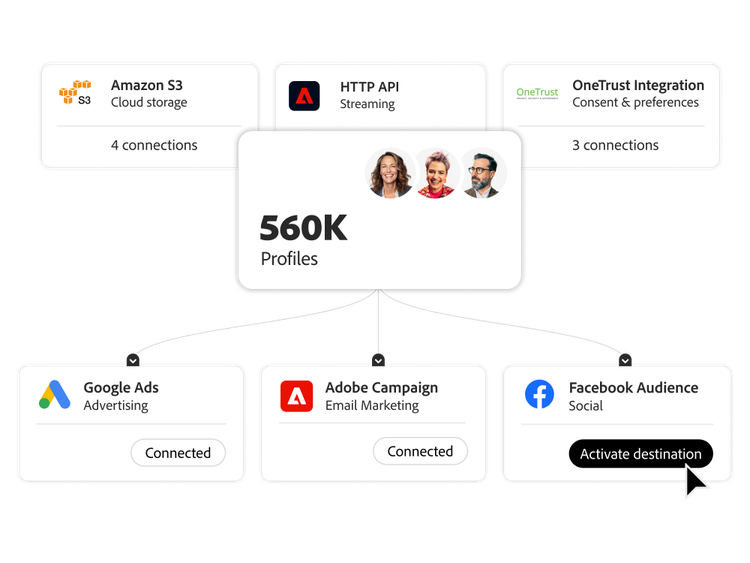
Adobe Real-Time CDP can unify known and anonymous data from multiple enterprise sources, create person or account profiles, define audiences, and activate them across target channels. Effective implementation still requires data model configuration, identity rules, merge policies, governance policies, and destination connections. Businesses can begin by connecting foundational data from their websites, forms, content downloads, and CRM, then progressively validate intent rules against business outcomes.
3. From Website Behavior to Sales Priorities: Build a Three-Tier Lead Routing Model
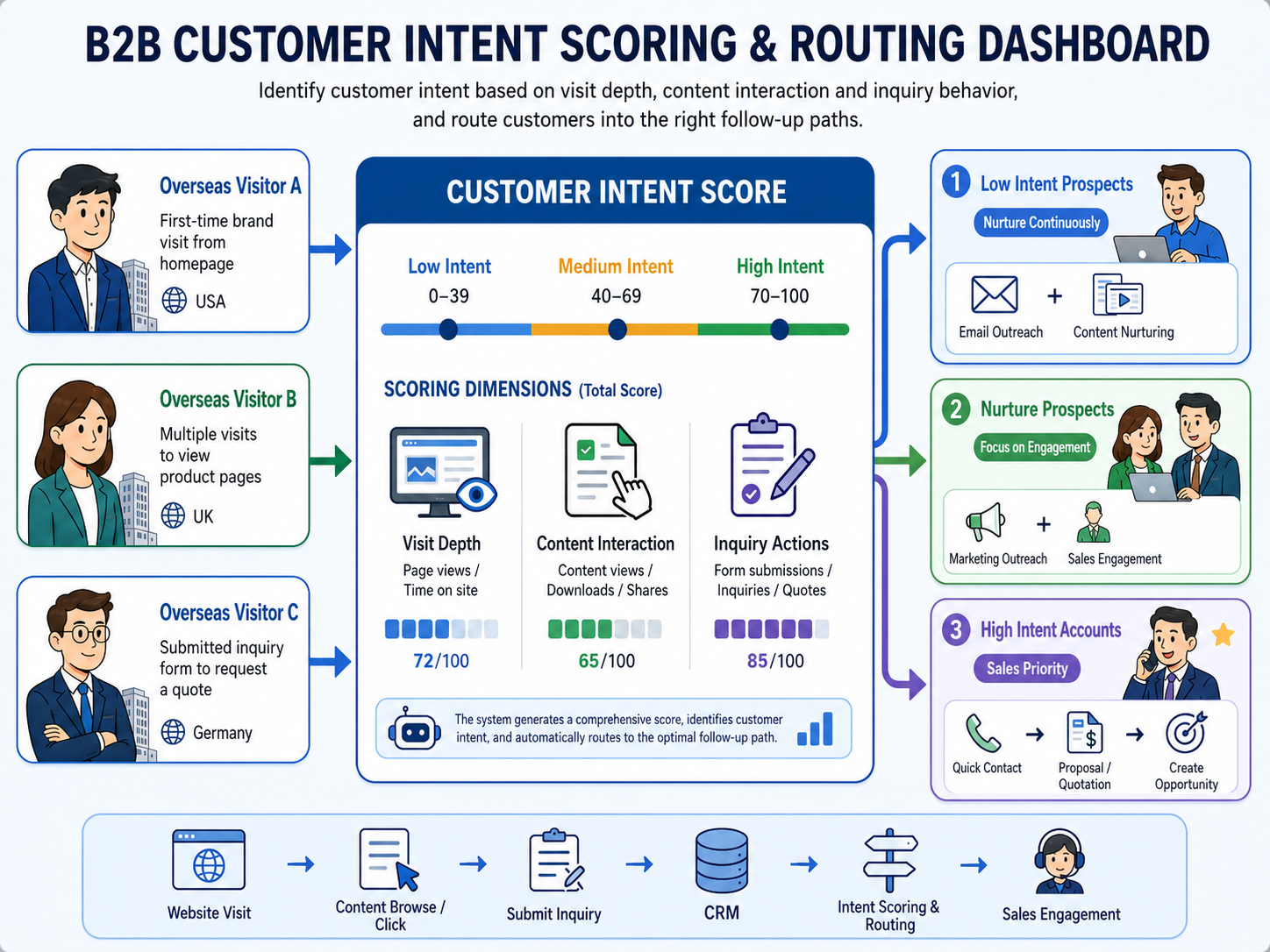
The purpose of intent data is not to label every visitor as “likely to convert.” It is to help teams decide what to do next. Based on behavioral intensity, ideal customer fit, and explicit inquiry signals, businesses can route prospects into three groups: sales-priority, nurture, and monitor. Specific thresholds should be continuously calibrated using historical conversion data and sales feedback.
High-intent prospects: Prioritize for sales follow-up
Examples include visiting a pricing or request-for-quote page, repeatedly viewing a specific product, submitting a project inquiry form, or downloading a critical technical document. Sales should respond within the agreed service level and begin the conversation with context about the content the prospect has already viewed.
Nurture-ready prospects: Continue delivering relevant content
Examples include repeatedly reading industry solution pages, subscribing to resources, or visiting case study pages without expressing a clear purchase need. Email, retargeting, or content recommendations can progressively provide relevant case studies, selection guides, and service information.
Research-stage prospects: Retain the data and minimize disruption
These visitors have only completed a single shallow browsing session and have not yet shown clear interest. Businesses can monitor subsequent behavior rather than rushing to send a sales email.
This routing model prevents sales resources from being distributed evenly across every prospect. It also helps marketing teams understand which content actually moves prospects to the next stage, rather than evaluating performance by traffic volume alone.
4. How CDPs and Marketing Automation Turn Signals into Action
In a data-driven export prospecting system, the corporate website serves both as a content and conversion channel and as an important source of first-party intent signals. Analytics tools reveal paths and drop-off points; a CDP unifies, governs, and segments data; and marketing automation or journey orchestration tools trigger content, alerts, or channel interactions according to business rules and consent status.
A practical closed-loop system can be built in the following sequence:
- The website records product views, CTA clicks, form submissions, and content downloads.
- The analytics system identifies high-traffic pages, repeat-visit paths, and critical drop-off steps.
- The CDP combines website behavior with CRM, event, or historical customer data to create actionable audiences.
- The automation system delivers case studies, resources, event invitations, or sales alerts based on each prospect’s stage.
- Sales teams write actual follow-up outcomes back to the CRM, using the results to refine intent scoring rules.
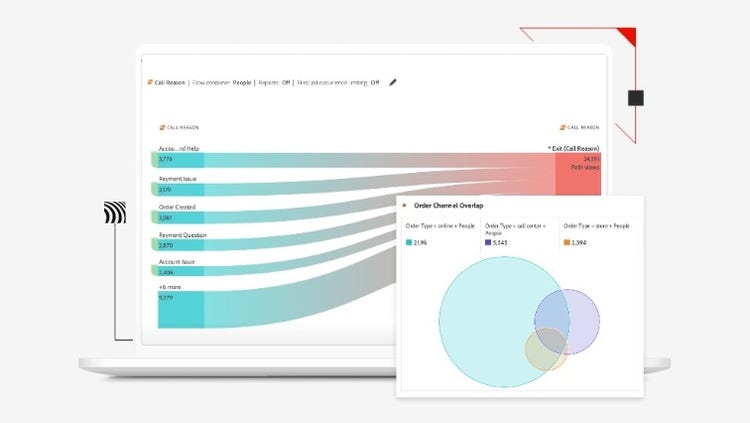
Adobe Customer Journey Analytics can use multiple datasets from Adobe Experience Platform for dimensional breakdowns, segmentation, querying, and visual analysis in Analysis Workspace. Adobe Journey Optimizer uses Experience Platform profiles, audiences, events, and channel configurations to support real-time triggered journeys and scheduled cross-channel marketing campaigns.
The key to this approach is not buying every tool at once, but ensuring that each signal leads to a specific action. This is the turning point that moves export marketing and prospecting from a disconnected model—where marketing generates traffic and sales chases inquiries—to coordinated operations.
5. Getting Started in 30 Days: How Small Teams Can Validate the Model Cost-Effectively
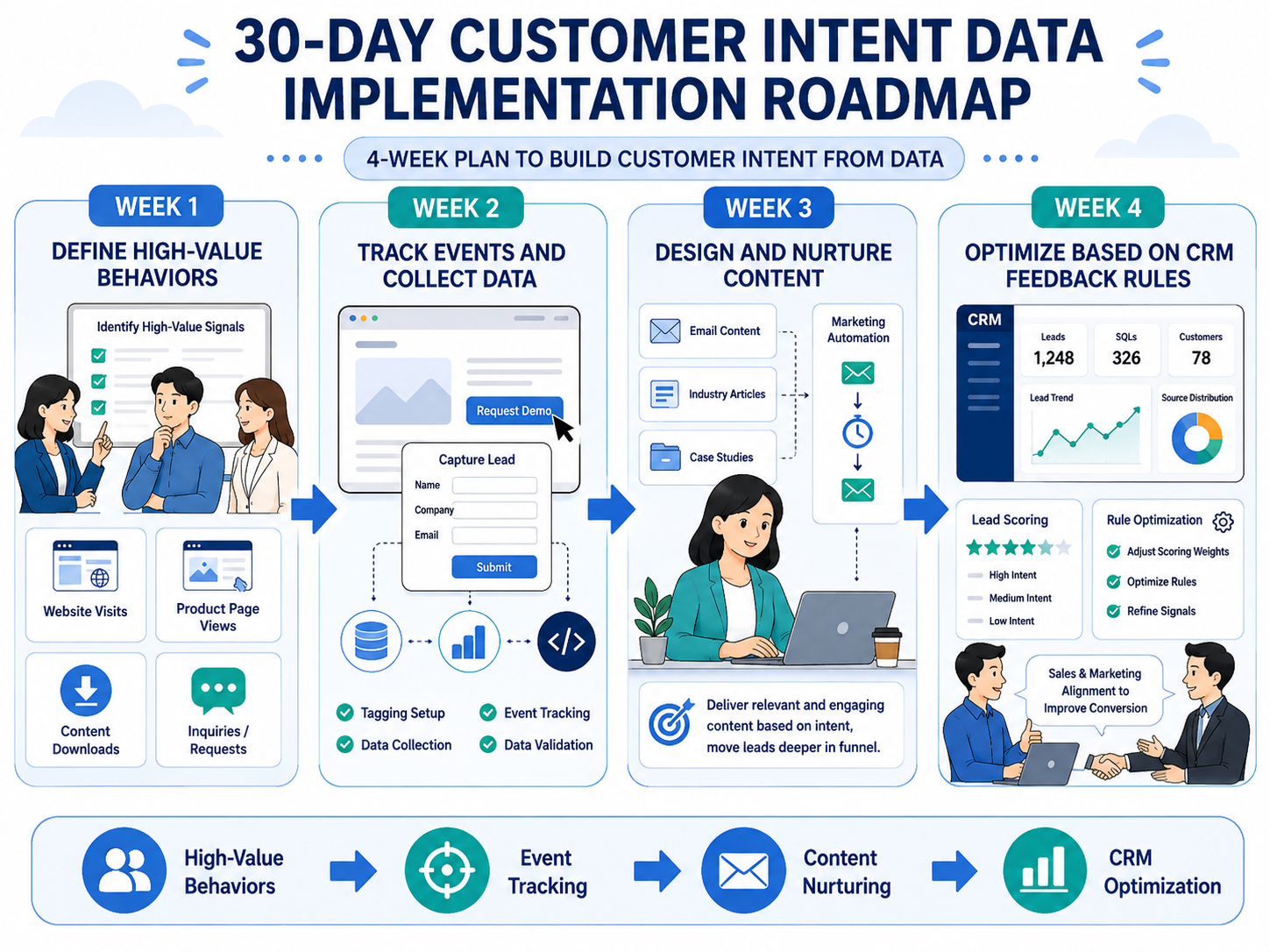
Businesses do not need to implement a large enterprise platform from the outset. Instead, they can use a 30-day pilot to validate a minimum viable closed loop—from tracking high-value behaviors and nurturing prospects with content to feeding results back into the CRM. The actual timeline should be adjusted based on traffic volume, sales cycle length, and data readiness.
Week 1: Define high-value actions
Select a small number of behaviors that are closely associated with the buying stage, such as viewing product specifications, downloading critical resources, or submitting a request for quotation. Avoid treating a single page view as definitive evidence of high intent.
Week 2: Complete tracking and form fields
Confirm that these behaviors can be recorded, and ensure forms collect at least the prospect’s country, company, type of need, and product interests.
Week 3: Prepare matching content
Prepare case studies, product selection resources, and FAQs for different products or industries, so prospects do not receive the same generic introduction after submitting their information.
Week 4: Review results with sales
Review which leads were considered qualified, which prospects did not respond, and which pages generated higher-quality prospects.
After completing this initial cycle, businesses can decide whether to expand into a CDP, automated nurturing, account segmentation, or CRM integration. Calibrating the rules with real business outcomes before building a complex technology architecture is the more reliable approach.
6. How LeadsTech Helps Businesses Build an Intent Data Pipeline
LeadsTech helps businesses start with their international corporate websites, content, and conversion paths, then progressively connect website and customer journey analytics, a CDP, marketing automation, and CRM systems. Its international corporate website development services support enterprise multilingual websites and long-term operations, while its website and customer journey analytics services cover Google Analytics, Adobe analytics capabilities, personalization, and marketing automation planning.
For businesses that already have customer data across multiple channels, LeadsTech also provides CDP implementation and managed services, supporting the planning, deployment, and integration of platforms such as Adobe Real-Time CDP.
A more effective implementation sequence is usually to define target customers and high-value behaviors first, complete the website and analytics data foundation next, and then introduce a CDP, marketing automation, and sales collaboration mechanisms according to business maturity. This helps prevent businesses from deploying systems without practical use cases.
7. Conclusion
Trade shows and B2B marketplaces can remain part of the customer acquisition mix, but businesses should not depend on a single channel. A more sustainable path is to use data collected lawfully and compliantly to convert interactions from every channel into intent signals that can be evaluated, routed, and continuously calibrated.
Once the website, analytics, CDP, marketing automation, and CRM form a closed feedback loop, B2B overseas customer acquisition can rely less on individual experience alone. By combining behavior, ideal customer fit, and sales outcomes, businesses can make better-informed assessments of each prospect’s stage in the buying process.
 Explore our website and customer journey analytics services
Further Reading
- Recommended Analytics Tools for Global Websites: How Adobe Analytics Drives Global Business Decisions Learn how to identify higher-value growth opportunities from traffic sources, content paths, and customer behavior.
- A Closer Look at Adobe RTCDP: The Value and Benefits of a Real-Time Customer Data Platform Learn how businesses can unify customer data across channels and build activatable audiences.
- From Global Website Development for Chinese Businesses to CDPs and Marketing Automation Learn how corporate websites, customer data, and automated journeys work together to support overseas customer acquisition.
Related Articles
Enterprise AI MarTech Trends Analysis 2024-2029 Outlook Report
From AI content productivity tools to a core engine for revenue growth and marketing transformation
*The PDF will be sent directly to your inbox.
Email Error
Please enter a valid email address.
Thank You!
The whitepaper has been sent to your inbox. If you don’t see it, please check your spam or promotions folder.