
Salesforce Marketing Cloud vs Adobe Journey Optimizer: Enterprise Selection Guide
Adobe Journey Optimizer, CDP, Customer Relationship Management (CRM), Marketing Automation, MarTech, Salesforce
30 August 2026
- Key Takeaways
- How Do the Two Platforms Differ in Their Core Positioning?
- Which Five Decision Areas Should Enterprises Compare?
- How Does the Existing Technology Ecosystem Affect the Choice?
- How Do the Data Foundation and Real-Time Journeys Differ?
- How Can Enterprises Complete Platform Selection in Five Steps?
- How Should Enterprises Estimate Total Cost of Ownership and Implementation Risk?
- Enterprise Platform Selection Checklist
- Frequently Asked Questions (FAQ)
- Conclusion
- Further Reading
- Key Takeaways
- How Do the Two Platforms Differ in Their Core Positioning?
- Which Five Decision Areas Should Enterprises Compare?
- How Does the Existing Technology Ecosystem Affect the Choice?
- How Do the Data Foundation and Real-Time Journeys Differ?
- How Can Enterprises Complete Platform Selection in Five Steps?
- How Should Enterprises Estimate Total Cost of Ownership and Implementation Risk?
- Enterprise Platform Selection Checklist
- Frequently Asked Questions (FAQ)
- Conclusion
- Further Reading
When comparing Salesforce Marketing Cloud and Adobe Journey Optimizer, enterprises can easily get caught up in feature-by-feature comparisons while overlooking their data foundation, existing systems, and day-to-day operational capabilities. When LeadsTech helps enterprises assess their marketing technology architecture, we first examine existing data sources, channel responsibilities, and high-value journeys within the same operational context, then determine which platform can better support future growth objectives. This article provides an actionable selection methodology based on enterprise use cases, technology ecosystems, journey requirements, costs, and governance.
1. Key Takeaways
- Salesforce Marketing Cloud Engagement is well suited to enterprises that prioritize mature email and mobile messaging operations and already make extensive use of the Salesforce ecosystem.
- Adobe Journey Optimizer is natively built on Adobe Experience Platform and is better suited to experience strategies centered on real-time customer data, cross-channel journeys, and centralized decisioning.
- Platform selection should not be based solely on the number of features. Enterprises should also compare data readiness, integration costs, team skills, governance, and their operating model for the next three years.
- The most reliable approach is to define two or three high-value use cases first, then conduct a proof of concept using the same data and performance metrics.
2. How Do the Two Platforms Differ in Their Core Positioning?
Salesforce Marketing Cloud Engagement is a mature cross-channel marketing execution platform. Enterprises can orchestrate journeys through Journey Builder and use capabilities such as Email Studio, Mobile Studio, and Content Builder to manage messaging, content, and automation. Its advantages typically extend beyond any single feature. When used with Sales Cloud, Service Cloud, and other Salesforce applications, it can connect marketing interactions to sales and customer service processes.
Adobe Journey Optimizer (AJO) is natively built on Adobe Experience Platform. It brings real-time customer profiles, audiences, content, decisioning, and journey orchestration together on a single data architecture. It can handle journeys triggered by individual events and also supports scheduled or batch campaigns. For enterprises already using Adobe Experience Cloud and seeking to combine website, app, transactional, and offline behavior into real-time experiences, this integration of data and journeys can be particularly attractive.
Both platforms support personalization and multichannel engagement, but they start from different foundations. Salesforce Marketing Cloud more commonly extends from mature channel execution and the CRM ecosystem, while AJO more commonly starts with the real-time data and experience orchestration capabilities of Adobe Experience Platform. The selection question, therefore, is not “Which platform is more powerful?” but “Which architecture better fits the enterprise’s current state and next-stage objectives?”
3. Which Five Decision Areas Should Enterprises Compare?
First, the existing technology ecosystem.
Which CRM, customer data platform, analytics tool, content management system, and ecommerce platform does the enterprise already use? The cost of changing core data flows often exceeds the value of adding a new feature.
Second, the data foundation.
Enterprises need to determine which system is responsible for identity resolution, consent status, event data, audience refresh frequency, and data quality. If data remains fragmented and field definitions are inconsistent, even the most advanced journey tool will only amplify the problems.
Third, journey timeliness.
Welcome journeys, cart abandonment reminders, inventory notifications, and high-value customer interactions have different requirements for event latency. Enterprises should first define acceptable data and messaging latency rather than broadly requiring everything to be “real time.”
Fourth, the operating model.
Who builds audiences, approves content, tests journeys, handles failed messages, and monitors frequency? Without clearly defined responsibilities, greater platform flexibility can create greater governance risk.
Fifth, total cost of ownership.
In addition to licensing, enterprises must account for contacts or engageable profiles, message volume, channel add-ons, data processing, integrations, sandboxes, consulting services, training, and ongoing optimization.
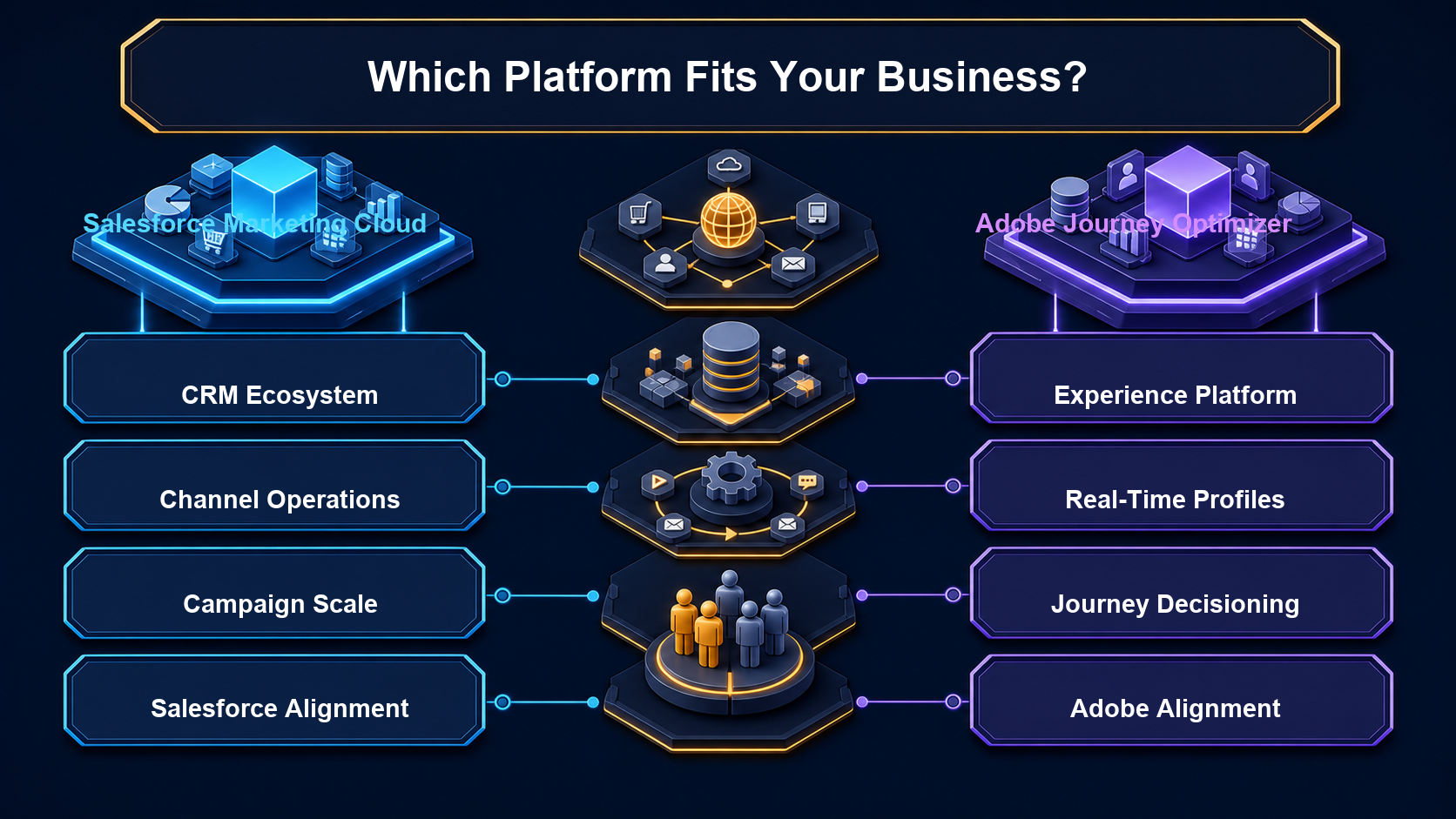
Figure: Comparing the fit of the two platforms across technology ecosystems, data foundations, journey orchestration, and operating models.
4. How Does the Existing Technology Ecosystem Affect the Choice?
Suppose a multiregional retail enterprise already uses Salesforce to manage memberships, sales, and service cases, while its marketing team has accumulated years of experience with Journey Builder and email operations. If its primary goals are to improve member segmentation, repeat-purchase reminders, and post-service follow-up, continuing with Salesforce Marketing Cloud will usually reduce the costs of data mapping, rebuilding permissions, and team transition.
Another enterprise may already use Adobe Analytics, Adobe Experience Manager, and Adobe Experience Platform, and want website, app, and in-store events to update customer profiles quickly before unified decisioning selects the content and channel. In this situation, AJO’s native data architecture may align more closely with its objectives.
However, using products from the same ecosystem does not mean an enterprise must choose the same vendor. It still needs to determine whether existing integrations are stable, whether the data is truly usable, and whether the new platform can reduce rather than increase system duplication. The most important evaluation documents are not product feature lists, but current-state data flow diagrams, defined responsibilities, and future journey inventories.
5. How Do the Data Foundation and Real-Time Journeys Differ?
AJO uses the real-time customer profiles, audiences, and event data in Adobe Experience Platform to support journeys and campaigns. To take advantage of this architecture, enterprises must first address schemas, identity namespaces, data governance, and consent management. When data readiness is insufficient, much of the implementation effort occurs before the platform goes live.
Salesforce Marketing Cloud Engagement can use Data Extensions, CRM-synchronized data, APIs, or other sources as journey entry points, with Journey Builder managing one-time, transactional, or multistep journeys. Enterprises must carefully design the Contact Key, data retention, subscription status, and cross-Business Unit governance. Otherwise, duplicate contacts, inconsistent opt-outs, or uncontrolled costs can easily arise.
“Real time,” therefore, is not a single product button. It is an end-to-end chain that spans data collection, identity resolution, audience evaluation, content decisioning, and channel delivery. A proof of concept should document latency, error rates, and the number of manual interventions at every stage.
6. How Can Enterprises Complete Platform Selection in Five Steps?
Define Business Objectives
Select two or three measurable use cases, such as increasing cart abandonment journey completion rates, reducing campaign launch time, or improving cross-channel consent consistency.
Inventory Existing Systems
Map the data flows among the CRM, CDP, website, app, data warehouse, content systems, and messaging channels, and identify owners and refresh frequency.
Assess Data Readiness
Sample identity fields, event timestamps, consent status, audience rules, and historical data to ensure both platforms are evaluated against the same test baseline.
Conduct a Proof of Concept
Use the same use case to compare build time, data latency, content approval, error handling, reporting visibility, and required skills.
Design Governance and Scalability
Establish rules for naming, versioning, permissions, frequency control, testing, deactivation, and cost monitoring before defining the scope of a phased rollout.
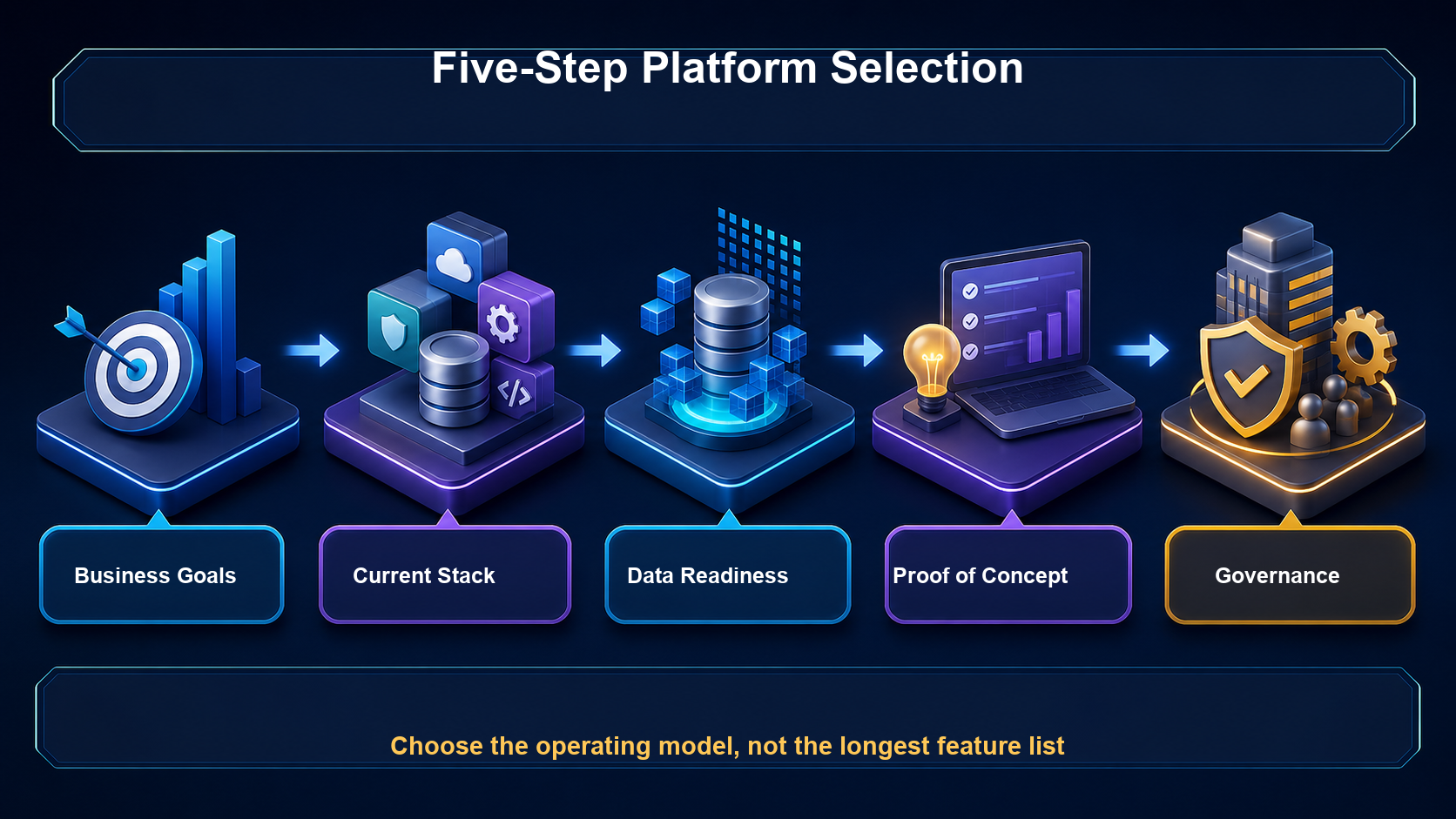
Figure: Complete platform selection step by step, from business objectives, existing technology, and data readiness to proof of concept and governance.
7. How Should Enterprises Estimate Total Cost of Ownership and Implementation Risk?
Licensing is only one part of the cost. Actual Salesforce Marketing Cloud Engagement entitlements vary by edition and add-on, while contact, message, and channel usage may also affect the budget. AJO costs must be evaluated together with engageable profiles, data processing, channels, and related Adobe Experience Platform capabilities. Enterprises should ask vendors to provide quotes based on the same three-year use cases, data volumes, and message volumes to avoid comparing different assumptions.
We recommend dividing the budget into five categories: platform licensing; data and integration; implementation and migration; content and operations; and governance and optimization. Risk assessments should cover identity mismatches, inconsistent consent data, duplicate journey triggers, channel delivery limitations, team skill gaps, and vendor dependency. Each risk should have an owner, monitoring metrics, and a recovery plan.
8. Enterprise Platform Selection Checklist
- Have two or three high-value journeys and their success metrics been defined?
- Who owns the existing CRM, CDP, analytics, and content platforms?
- Can identity, consent, and contact preferences be updated consistently across channels?
- Does the proof of concept use the same data, audiences, and message volumes?
- Can the marketing team independently build, test, and monitor journeys?
- Can IT support APIs, data latency, permissions, and troubleshooting?
- Does the quote include additional channels, sandboxes, integrations, training, and maintenance?
- Are frequency control, versioning, deactivation, and approval rules in place?
- Will data volumes and market expansion remain within a manageable cost range three years from now?
9. Frequently Asked Questions (FAQ)
Which is better, Salesforce Marketing Cloud or Adobe Journey Optimizer?
There is no single answer for every enterprise. Teams that make extensive use of Salesforce CRM and prioritize mature channel operations can generally realize value from Marketing Cloud Engagement more easily. For enterprises centered on Adobe Experience Platform and real-time experiences, AJO may be a better fit.
Do both platforms require a customer data platform?
Not necessarily, but both require reliable customer data. AJO is natively built on Adobe Experience Platform, while Salesforce Marketing Cloud Engagement can connect to CRM, Data 360, or other data sources. The need for a standalone CDP depends on identity unification, real-time audience, and governance requirements.
Can enterprises compare only email features and pricing?
That is not recommended. Email is only one part of the journey. Enterprises must also compare data flows, identity, consent, other channels, testing, analytics, team skills, and long-term maintenance costs.
How long should a proof of concept take?
The duration should be determined by the complexity of the use case rather than a predetermined number of weeks. The scope should include one high-value journey, a realistic but controlled data sample, two or three channels or decision points, and clear technical and business acceptance criteria.
What is the biggest risk when switching platforms?
The greatest risk is usually not the interface or features, but incomplete migration of identity, consent, historical data, journey logic, and operational knowledge. Enterprises should establish data mapping, parallel testing, and recovery plans first.
10. Conclusion
Choosing between Salesforce Marketing Cloud and Adobe Journey Optimizer is fundamentally a choice between operating models and data architectures. Confirm high-value journeys, the existing ecosystem, data readiness, and three-year total cost of ownership first, then compare the platforms through a controlled proof of concept. This approach is more reliable than scoring individual features. To assess your architecture, integrations, and implementation roadmap, contact LeadsTech and explore the relevant Salesforce Marketing Cloud or Adobe Journey Optimizer solutions.


11. Further Reading
- Marketing Automation Customer Journey Design Guide: Learn how to design automated journeys based on business objectives, triggers, and channels.
- How to Use Adobe Journey Optimizer to Enhance Customer Journey Management: Explore the key principles of journey orchestration in AJO.
- Marketing Automation vs CRM: Differences and Integration: Clarify the roles of marketing automation and CRM and how they work together.
Related Articles
Enterprise AI MarTech Trends Analysis 2024-2029 Outlook Report
From AI content productivity tools to a core engine for revenue growth and marketing transformation
*The PDF will be sent directly to your inbox.
Email Error
Please enter a valid email address.
Thank You!
The whitepaper has been sent to your inbox. If you don’t see it, please check your spam or promotions folder.