
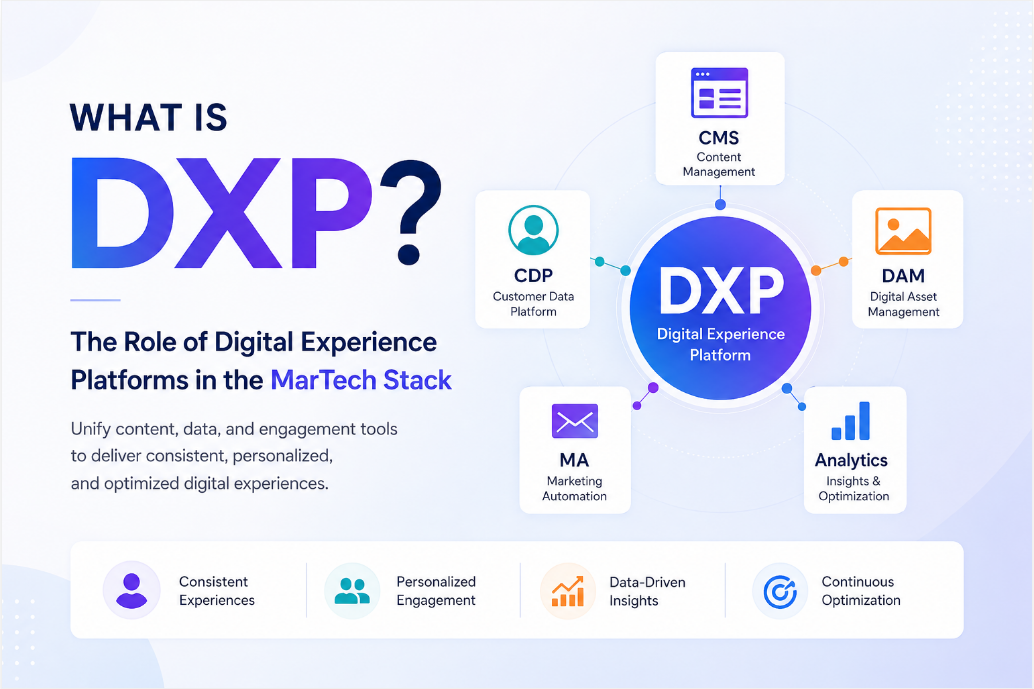
What Is a DXP? The Role of Digital Experience Platforms in MarTech
Adobe Experience Cloud, Adobe Experience Platform, AEM Asset, AEM Sites, CDP, Content Management System (CMS), Digital Asset Management (DAM), MarTech
2 July 2026
- Introduction: Why Enterprises Are Paying Attention to DXP
- What Is a DXP? Definition of a Digital Experience Platform
- DXP vs CMS vs CDP vs CRM: Key Differences
- The Experience Integration Role of DXP in a MarTech Architecture
- Core Value of Implementing a DXP
- What Types of Enterprises Need a DXP?
- How to Plan a DXP Implementation Strategy
- Conclusion: DXP as the Long-Term Foundation for Enterprise Digital Experience
- Further Reading and References
- Introduction: Why Enterprises Are Paying Attention to DXP
- What Is a DXP? Definition of a Digital Experience Platform
- DXP vs CMS vs CDP vs CRM: Key Differences
- The Experience Integration Role of DXP in a MarTech Architecture
- Core Value of Implementing a DXP
- What Types of Enterprises Need a DXP?
- How to Plan a DXP Implementation Strategy
- Conclusion: DXP as the Long-Term Foundation for Enterprise Digital Experience
- Further Reading and References
1. Introduction: Why Enterprises Are Paying Attention to DXP
This article helps enterprise decision-makers, marketing teams, and IT teams understand the basic concept of DXP and its position within a MarTech architecture. After reading it, you will be able to evaluate how DXP relates to existing CMS, CRM, CDP, DAM, and marketing automation tools, and make an initial judgment on whether your enterprise needs to implement a DXP.
In the past, enterprises typically started their digital channels with a corporate website, campaign pages, a membership system, or EDM tools. But as channels increase, content volume expands, and customer journeys become more complex, a single tool can no longer support the full experience.
This is why DXP has become important to enterprises. A DXP is not just a website management tool. It is a digital experience platform that helps enterprises integrate content management, data analytics, personalization, digital assets, marketing automation, and multi-channel delivery.
2. What Is a DXP? Definition of a Digital Experience Platform
DXP stands for Digital Experience Platform. It refers to an integrated set of technologies used to compose, manage, deliver, and optimize cross-channel digital experiences. It is a core technology foundation that supports how enterprises plan, manage, deliver, and improve digital experiences across channels. Adobe and Gartner both emphasize that a DXP is not a single-function tool, but an integrated technology set that supports digital experience composition, management, delivery, and optimization.
Simply put, the core mission of a DXP is to help enterprises deliver consistent, personalized, and continuously optimizable experiences across websites, apps, member centers, e-commerce, campaign pages, and other digital touchpoints.
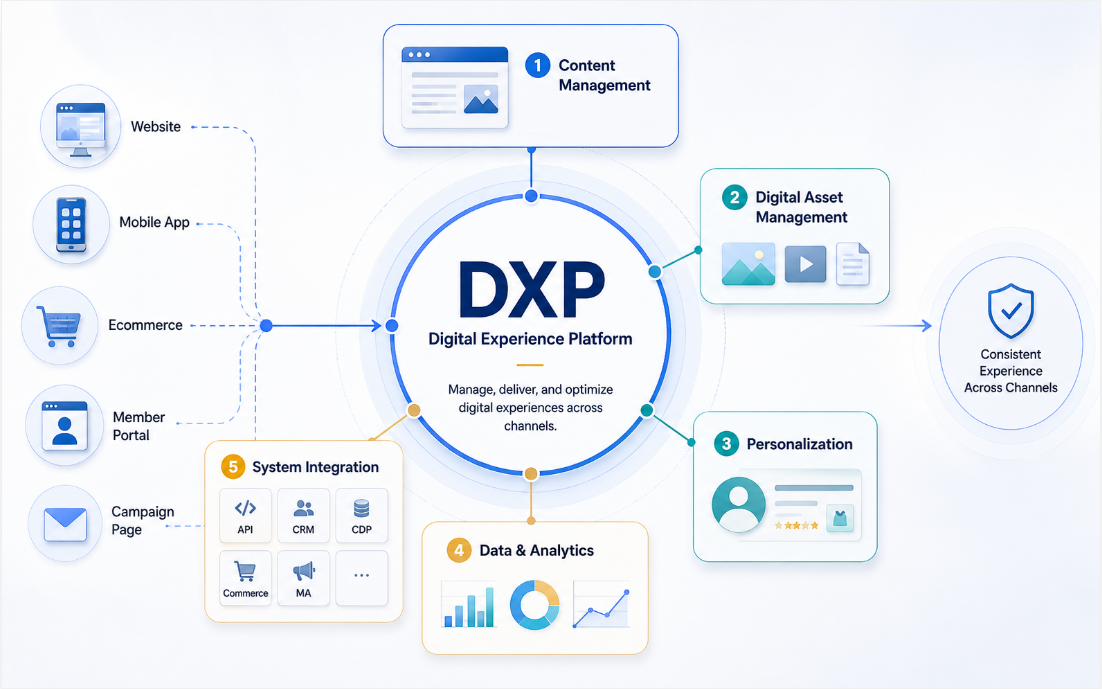
A DXP typically includes the following capabilities:

Content Management
Manage corporate websites, campaign pages, product content, blogs, and multilingual content.

Digital Asset Management
Manage images, videos, documents, brand assets, and reusable content assets.

Personalized Experiences
Deliver different content and recommendations based on customer behavior, identity, location, or interests.

Data and Analytics
Track user interactions and evaluate the performance of content, channels, and conversions.

System Integration
Connect CRM, CDP, e-commerce, MA, customer service, and membership systems to help enterprises build a more connected view of the customer journey.
3. DXP vs CMS vs CDP vs CRM: Key Differences
When enterprises first encounter DXP, they often assume it is simply a more advanced CMS. That understanding is not entirely wrong, but it is incomplete.
A CMS is mainly responsible for content creation, review, publishing, and management. A CDP focuses on customer data integration and audience segmentation. A CRM is more oriented toward sales processes, customer relationships, and opportunity management. The role of a DXP is to serve as an experience integration layer that helps content, data, and interaction channels work together to support customer experience.
In other words, a CMS is the content engine, a CDP is the customer data foundation, and a CRM is the sales and customer relationship management system. A DXP is the experience integration layer that helps enterprises combine content, data, personalization, and channel delivery into digital experiences customers can actually feel.
For enterprises, the value of a DXP is not to replace every tool, but to reduce experience fragmentation caused by tool silos.
4. The Experience Integration Role of DXP in a MarTech Architecture
A MarTech architecture typically includes content, data, advertising, marketing automation, analytics, CRM, and commerce systems. When these tools operate separately, marketing teams often face data inconsistency, repeated content production, broken customer journeys, and difficulty executing personalization.
In a MarTech architecture, a DXP acts as the “experience integration layer.” Through APIs, content models, data connections, personalization rules, and analytics feedback, it helps multiple systems operate together.
Connect Content and Channels
Enable websites, apps, campaign pages, member centers, and other digital channels to use a consistent content source.
Connect Data and Interactions
Link customer behavior, audience segments, and content presentation to support more precise engagement.
Connect Marketing and IT
Marketing teams can build content and campaigns faster, while IT teams maintain platform security, governance, and scalability.
Connect Strategy and Execution
Bring brand experience, content strategy, customer journeys, and performance analytics into one continuously optimizable process.
Therefore, a DXP is not a small standalone tool. It is an important platform in the MarTech architecture that supports collaboration across content, data, channels, and experience delivery.
5. Core Value of Implementing a DXP
The purpose of implementing a DXP is not only to improve website management efficiency, but also to give enterprises the long-term capability to operate digital experiences. For enterprises with multiple brands, markets, languages, and channels, a DXP can deliver structural value.

Improve Content Operations Efficiency
Enterprises can centrally manage content, templates, components, and brand assets, reducing duplicated builds and cross-market communication costs.

Build a Consistent Brand Experience
Different regions, languages, and channels can maintain consistent brand language and visual standards while preserving localization flexibility.

Support Personalization and Customer Journey Optimization
By integrating data and content, enterprises can deliver more relevant content and interactions to different audiences.

Accelerate Time to Market
Marketing teams can build campaign pages, update product content, and publish market messages faster, reducing dependence on development resources.

Strengthen Data-Driven Decisions
When content performance, customer interactions, and conversion data can be tracked, enterprises can continuously optimize experiences instead of relying only on one-off redesigns.
6. What Types of Enterprises Need a DXP?
Not every enterprise needs to implement a DXP immediately. For companies with small websites, low content update frequency, and relatively simple channels, a traditional CMS may already be sufficient.
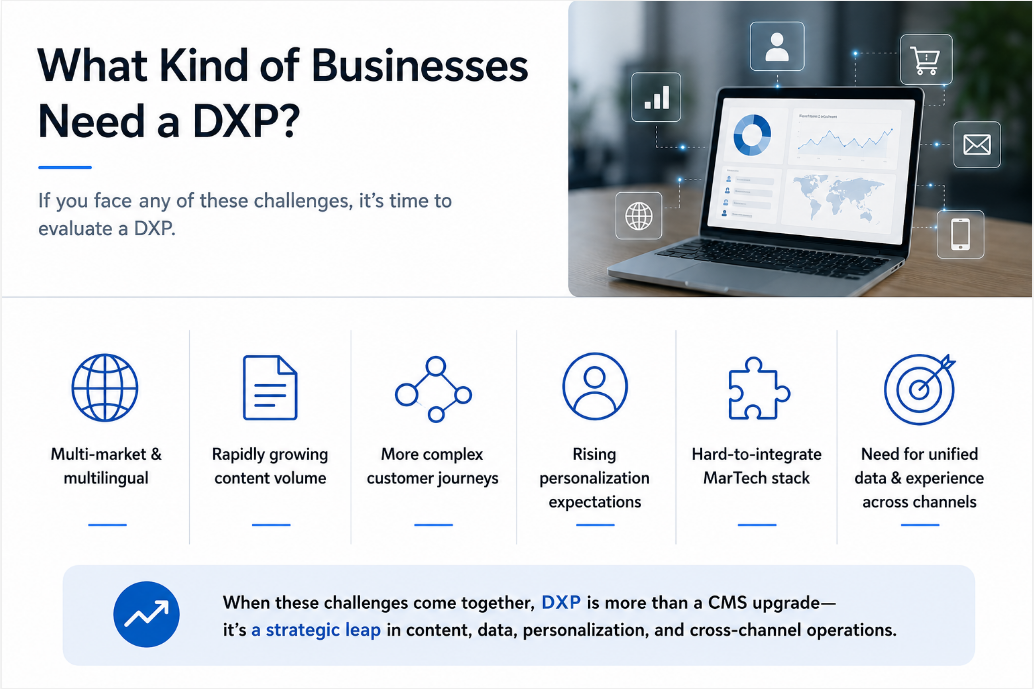
However, if an enterprise faces the following situations, it should begin evaluating a DXP:
Multi-Market and Multilingual Operations
The enterprise needs to manage websites, language versions, and localized content across multiple regions.
Rapid Content Growth
Blogs, product pages, campaign pages, industry solution pages, and asset volumes continue to increase.
More Complex Customer Journeys
Users interact through multiple touchpoints such as websites, apps, EDM, ads, social channels, customer service, and e-commerce.
Increasing Personalization Needs
The enterprise wants to provide differentiated content based on customer identity, behavior, or journey stage.
Existing MarTech Tools Are Difficult to Integrate
CRM, MA, CDP, e-commerce, and analytics tools operate separately, creating breaks in data and experience.
When these issues appear together, a DXP is no longer just a CMS upgrade. It becomes a broader upgrade of content governance, data integration, personalized experience, and cross-channel operations.
7. How to Plan a DXP Implementation Strategy
A DXP implementation should not begin only with product selection. It should start with the enterprise’s experience goals and operating processes. A successful DXP project usually needs to consider content, data, organization, and technical architecture at the same time.
Enterprises can begin with the following directions:
Audit the Existing MarTech Architecture
Identify the current systems, data sources, content workflows, and major pain points.
Define Core Use Cases
Examples include multilingual website management, member personalization, rapid campaign page publishing, content performance analysis, or e-commerce experience integration.
Establish Content Governance Standards
Include content models, review workflows, permission management, brand standards, and component reuse strategies.
Plan the System Integration Blueprint
Clearly define how the DXP will connect with CRM, CDP, DAM, MA, Analytics, Commerce, and other systems.
Implement and Optimize in Phases
Start with CMS and content governance, then expand into DAM, CDP, Analytics, personalization, and omnichannel experience.
8. Conclusion: DXP as the Long-Term Foundation for Enterprise Digital Experience
The value of a DXP is not only to help enterprises build a more powerful website. It gives enterprises the capability to continuously manage, deliver, and optimize digital experiences. In a MarTech architecture, it plays a key role in connecting content, data, channels, and customer journeys.
As enterprises have more digital touchpoints and customers develop higher expectations, a single CMS or point solution can no longer support the full experience. A DXP helps enterprises move from “managing pages” to “operating experiences,” enabling marketing, IT, data, and business teams to collaborate within the same architecture.
If you are evaluating whether an enterprise DXP, CMS, or Adobe Experience Manager (AEM) is suitable for your organization, visit the AEM Sites product page from Leads Technologies to learn how AEM supports content management, multilingual websites, personalization, and enterprise digital experience development.
If you want to further clarify whether your current MarTech architecture needs an upgrade, or evaluate a DXP implementation roadmap, you are welcome to contact us. Leads Technologies can help you plan the most suitable DXP implementation strategy based on your enterprise scale, content workflows, system architecture, and customer journey.
9. Further Reading and References
Related Articles

Enterprise AI MarTech Trends Analysis 2024-2029 Outlook Report
From AI content productivity tools to a core engine for revenue growth and marketing transformation
*The PDF will be sent directly to your inbox.
Email Error
Please enter a valid email address.
Thank You!
The whitepaper has been sent to your inbox. If you don’t see it, please check your spam or promotions folder.